


Sister article: FANUC servo motor replacement: parameter write-back and inertia re-measurement; related: FANUC Servo Amplifier Replacement, FANUC Inertia Ratio: Parameter 2021 and Servo Guide, Fanuc Backlash Compensation 1851, Fanuc Gravity-Axis Brake, How to Classify and Troubleshoot Homing Failures.
23.1 First: amplifier swap or motor swap?
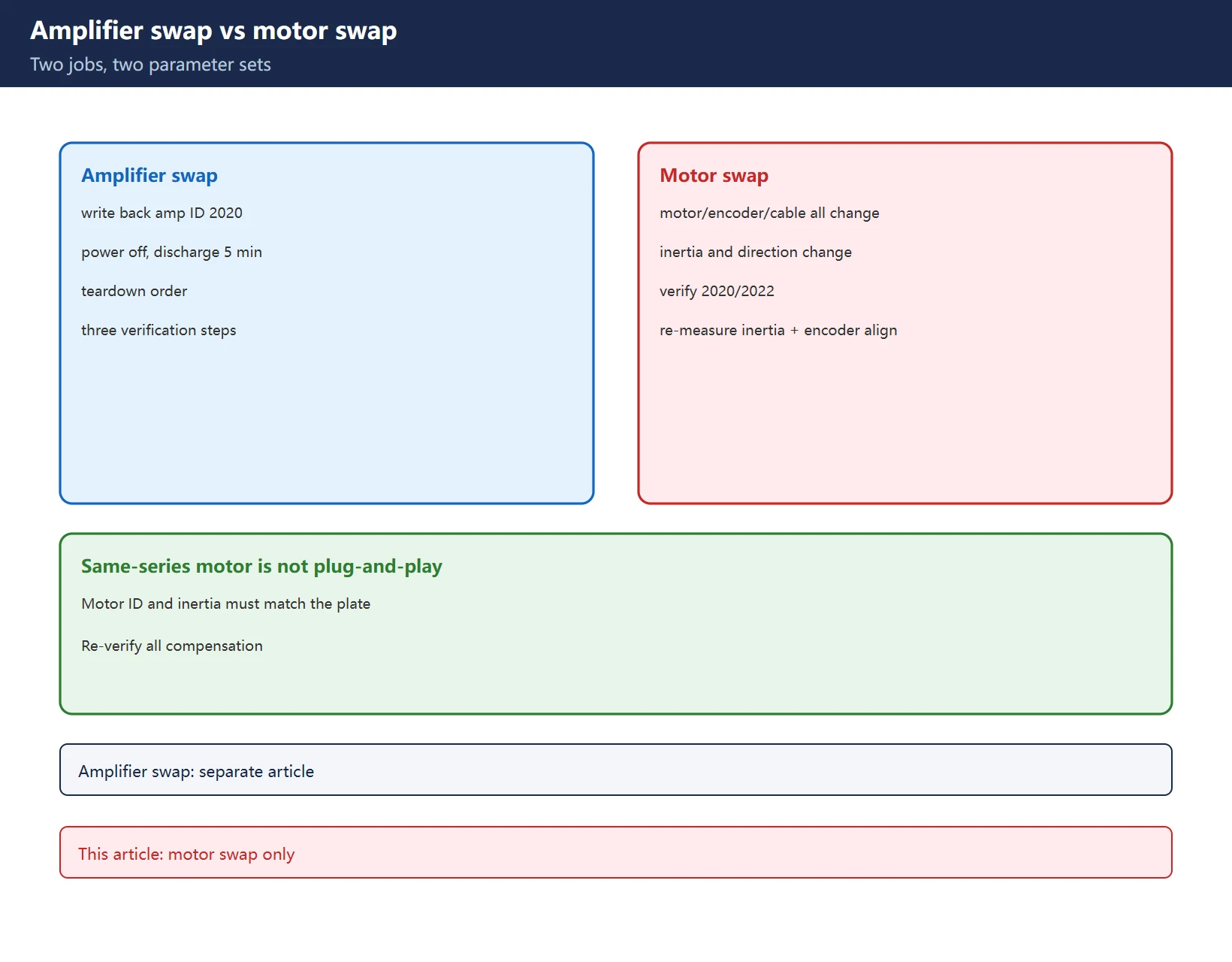
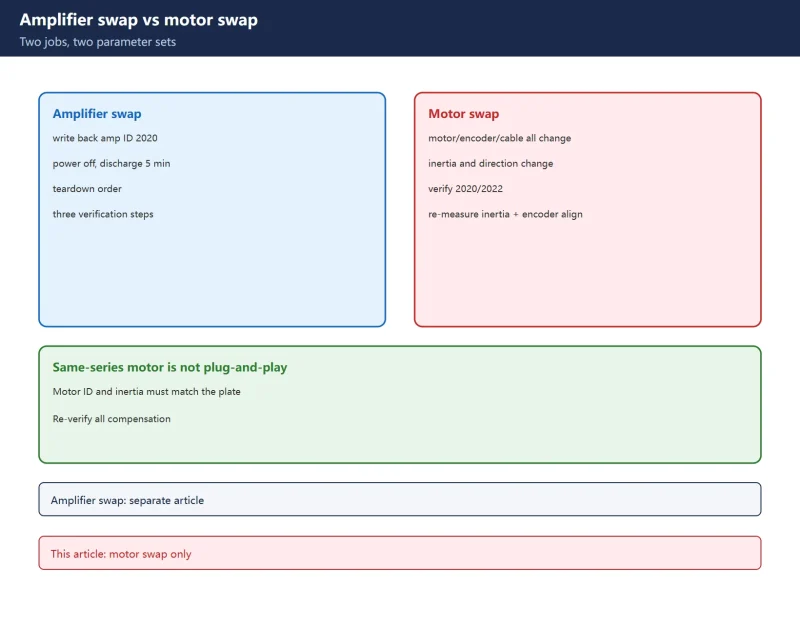
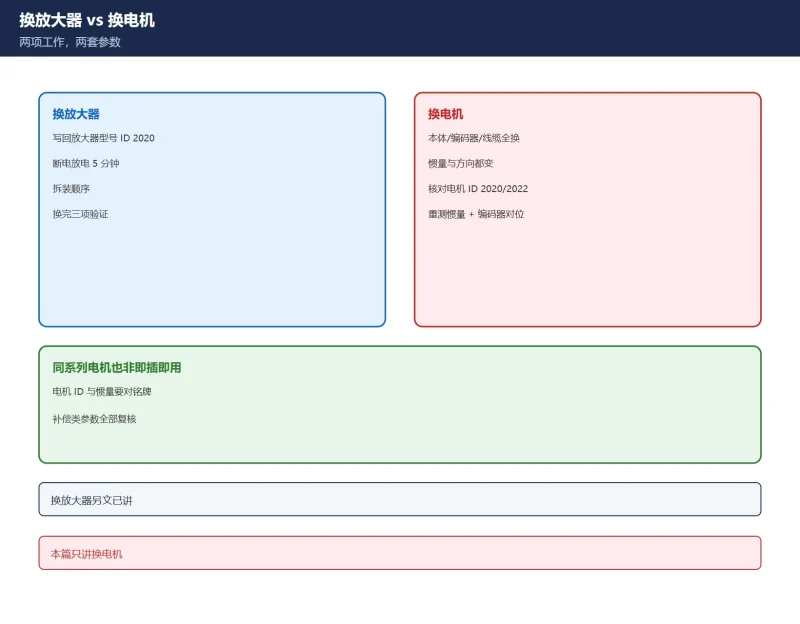
- Amplifier replacement (covered separately): write back the amplifier model ID 2020, power off and discharge for 5 minutes, then three verification steps – see servo amplifier replacement.
- Motor replacement (this article): the motor body, encoder, cable, inertia and direction all change – you must re-check motor ID, rotation direction, inertia ratio and encoder alignment, plus re-verify compensation.
Do not assume “same series motor = plug and play” – even a same-series replacement needs the motor ID and inertia confirmed against the data plate.
23.2 ★ Motor-side parameters: the correct numbers
Table 1 Motor-side parameters (corrected; per your manual)
| Parameter | What it is | After a motor swap |
|---|---|---|
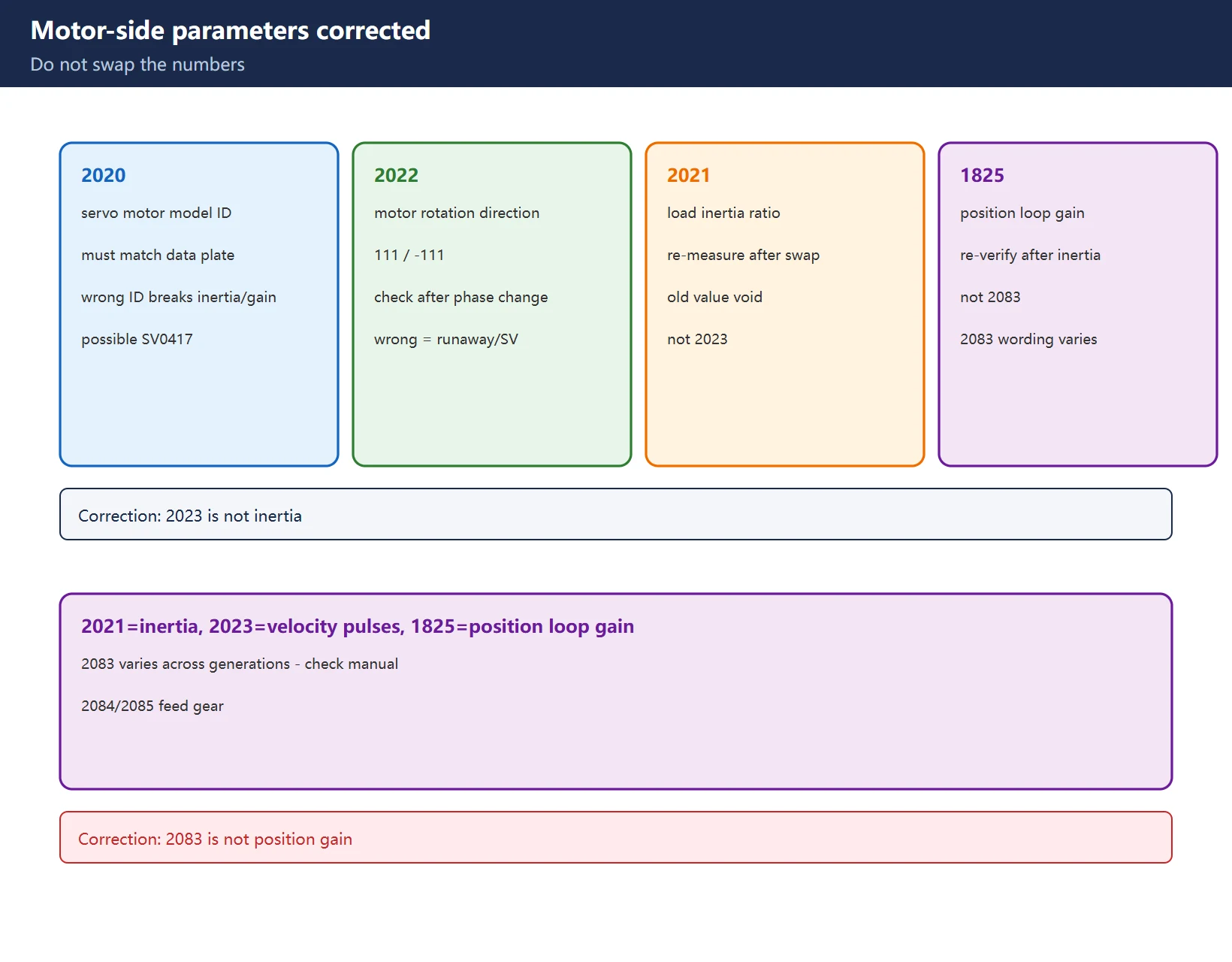
| 2020 | Servo motor model ID (motor number) | Must match the actual motor data plate; wrong ID means the inertia and gain baseline are wrong and the drive may refuse to enable (SV0417) |
| 2022 | Motor rotation direction (e.g. 111 / -111) | Re-check after any phase/power-lead change; wrong direction causes runaway or a servo alarm |
| 2021 | Load inertia ratio | Re-measure after the swap – the old value is void |
| 1825 | Position loop gain (1/s) | Re-verify after the inertia change; this is the position loop gain on modern controls |
| 2023 | Velocity feedback pulse number (e.g. 819/8192 by series) | Not the inertia ratio – a common mislabel in field notes |
| 2084 / 2085 | Flexible feed gear ratio (numerator / denominator) | Re-check when the motor/encoder or gearing changes |
⚠️ Correction to a widespread field list: some articles label “2023 = inertia ratio” and “2083 = position loop gain” – both are wrong. Official FANUC servo setup lists 2021 = load inertia ratio, 2023 = velocity pulse count, 1825 = position loop gain. Parameter 2083 is reported inconsistently across control generations (software-thermal / current-loop contexts) – do not treat it as a position-loop gain; check your own manual.
23.3 Inertia ratio re-measurement
The load inertia ratio changes when the motor changes, so the old value must be discarded:
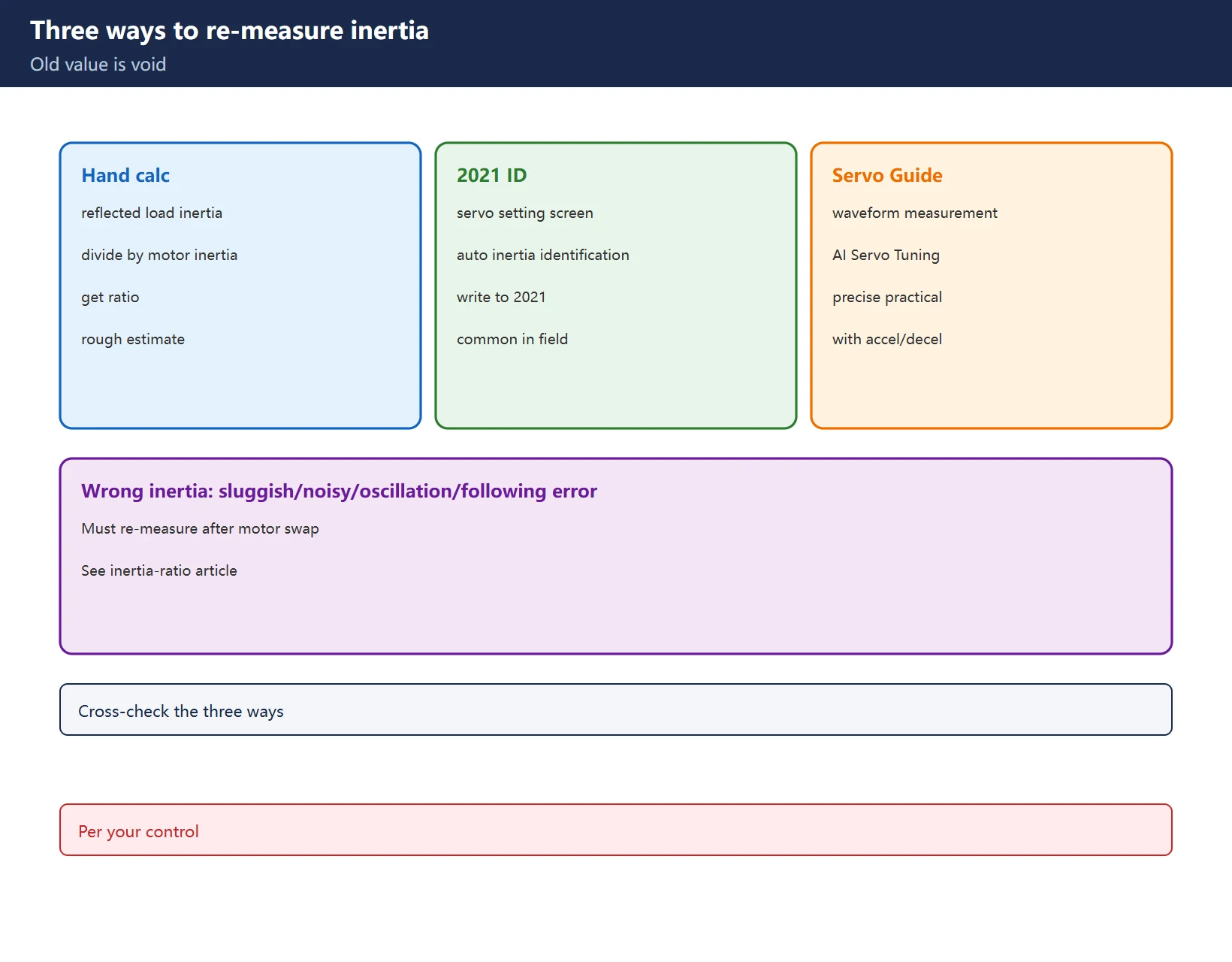
- Hand calculation from machine data (load inertia reflected to the motor / motor inertia);
- Parameter 2021 identification via the servo setting / automatic inertia measurement function on the control;
- Servo Guide / AI Servo Tuning practical measurement – see inertia ratio measurement and SERVO GUIDE.
Table 2 Three ways to establish the inertia ratio (per your control)
Do not skip: a wrong inertia ratio gives a sluggish or noisy axis, oscillation, or following-error alarms on rapid moves.
23.4 Encoder alignment and direction
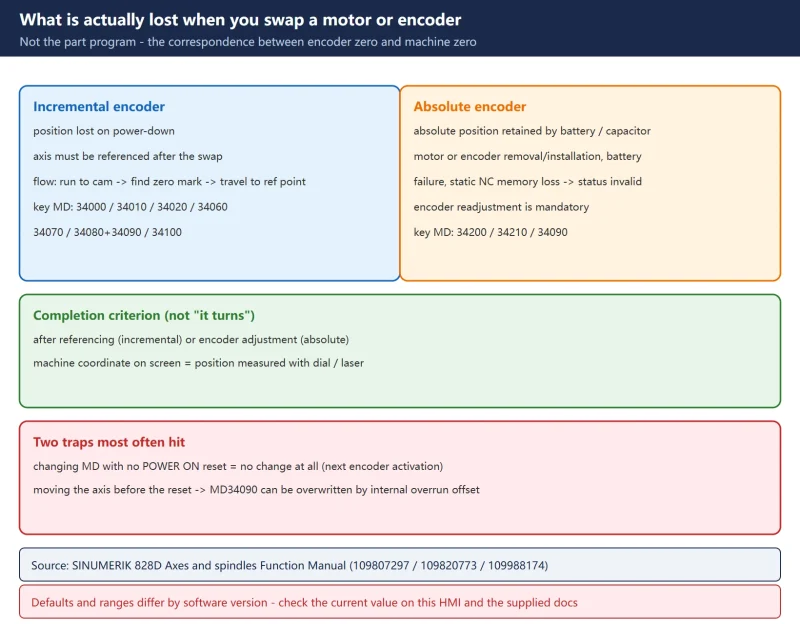
- Incremental encoder: after fitting, confirm the Z-phase / zero pulse and re-establish the reference point; the position reference is lost;
- Absolute encoder (APC battery): write the motor ID and confirm the zero-position battery state – a flat battery or a lost reference means the axis must be re-referenced. For the battery itself, see the related battery articles (this is the “motor swap” case, not a battery-only change);
- Direction: verify 2022 with a low-speed JOG before any rapid or cutting move.
23.5 Mechanical side of the swap
- Coupling alignment – concentricity error goes straight into the servo loop;
- Motor flange fit and shaft extension length – seat the motor correctly;
- Brake (holding brake) and friction disc clearance – especially on gravity axes, see gravity-axis brake;
- Separate routing of power and encoder cables – avoid noise coupling.
23.6 Electrical side of the swap
- Power-line phase order (U/V/W) – wrong phase order reverses rotation;
- Encoder cable shield and grounding;
- Brake 24 V release timing – confirm the brake releases at the right point in the enable sequence.
23.7 Three-step acceptance test
- No-load JOG – listen for abnormal noise and check for servo alarms;
- One low-speed cycle – confirm positioning and backlash (see backlash 1851);
- Cut one test piece – measure dimensions and surface finish.
Table 3 Acceptance sequence (criteria per your machine’s manual)
23.8 Compensation parameters to re-verify after the swap
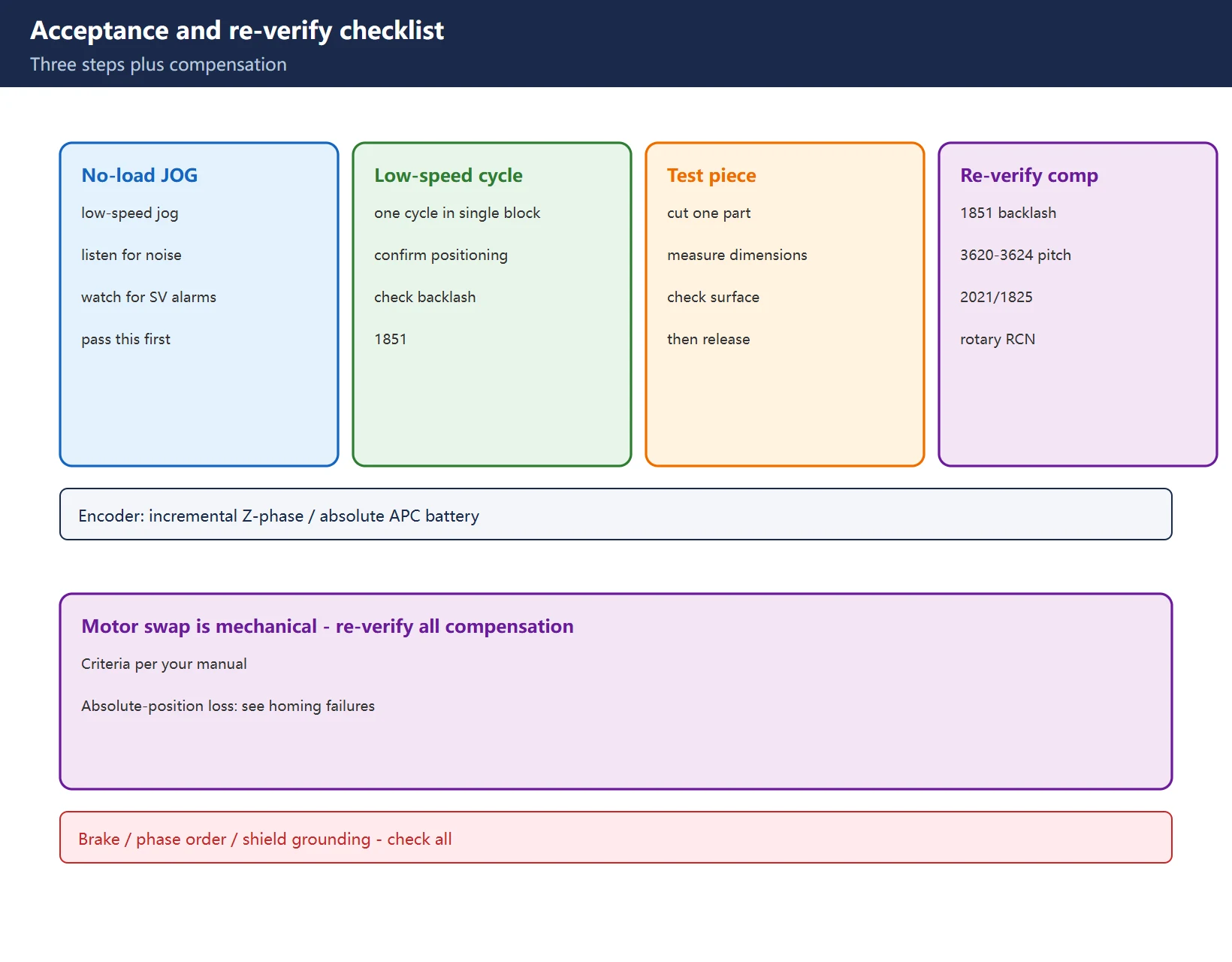
A motor swap is a mechanical change – treat all compensation as suspect:
- Backlash 1851 – re-measure and rewrite (see backlash compensation);
- Pitch error compensation 3620-3624 – re-check (see pitch error compensation);
- 2021 inertia ratio / velocity loop, 1825 position loop gain – re-verify;
- Rotary-axis RCN / detection units – re-check on rotary axes.
The re-verify checklist is summarized in the table below; exact numbers are per your manual.
Table 4 Re-verify checklist after a motor swap
23.9 The absolute-position-loss branch
If the absolute position was not preserved (no APC battery handling), the machine may lose position and require a reference return – follow the homing failure classification. This is distinct from the amplifier-swap case where the amplifier ID was the main item.
Frequently Asked Questions
Which parameters must be changed after replacing a FANUC servo motor, and what is 2020?
2020 is the servo motor model ID and must match the actual motor’s data plate. Verify 2020 (motor ID), 2022 (rotation direction), 2021 (load inertia ratio, re-measured), 1825 (position loop gain) and the 2084/2085 feed gear. 2023 is the velocity feedback pulse count, not the inertia ratio.
Must the inertia ratio be re-measured after a motor swap? How is parameter 2021 handled?
Yes – the old value is void because the motor and load inertia changed. Establish it by hand calculation, the control’s parameter-2021 automatic identification, or Servo Guide / AI Servo Tuning measurement.
Do backlash and pitch-error compensation need to be redone after a motor swap?
Yes. A motor swap is a mechanical change, so backlash 1851, pitch-error compensation 3620-3624, 2021 inertia, 1825 position gain and rotary-axis detection units must all be re-verified against your manual.
Last updated: 2026-11-19
Where to go next
- FANUC Troubleshooting — the full guide library: alarms, diagnosis numbers, servo, spindle, PMC and electrical faults, organised by symptom.
- CNC Repair Tools — which instrument measures what: multimeters, clamp meters, insulation testers and oscilloscopes, with the specification that actually matters.
- Remote Technical Support — have the readings reviewed with you: alarm reverse lookup, PMC ladder analysis and servo tuning advice by call. Repair companies and integrators welcome.
- Buying & Ownership Decisions — refurbished vs new, used-machine checks, software licensing and manuals: spend with the field facts in hand.
Read the guide, get the right instrument, or walk the diagnosis through with someone — pick whichever you need.
The original Chinese version — same procedure, with the full field notes.






















暂无评论内容