


One high-frequency error corrected first: many online tables label Q212 as “finishing allowance” and Q213 as “corner allowance”. Per the official TNCguide, Q212 is the DECREMENT (infeed reduction per plunge) and Q213 is the number of chip breaks before retracting (NR OF BREAKS BEFORE RETRACTING); the real side/floor finishing allowances are Q368 / Q369. Copying the wrong table deforms deep-hole drilling cycle behavior. Every parameter name must be checked against the manual for iTNC530 / TNC620 / TNC640 / TNC7 individually — the same cycle can use different parameter names across generations; your machine manual wins.
Sister article: HEIDENHAIN TNC Fixed Cycle Parameter Reference (Chinese); related: Heidenhain touch-probe calibration: iTNC 530 uses MP, TNC 640/TNC7 uses Cfg, HEIDENHAIN iTNC 530 vs TNC 620/640/TNC7 differences and migration, Fanuc Canned Cycles Explained: G73, G81-G88, Fanuc Canned Cycle Parameter Table.
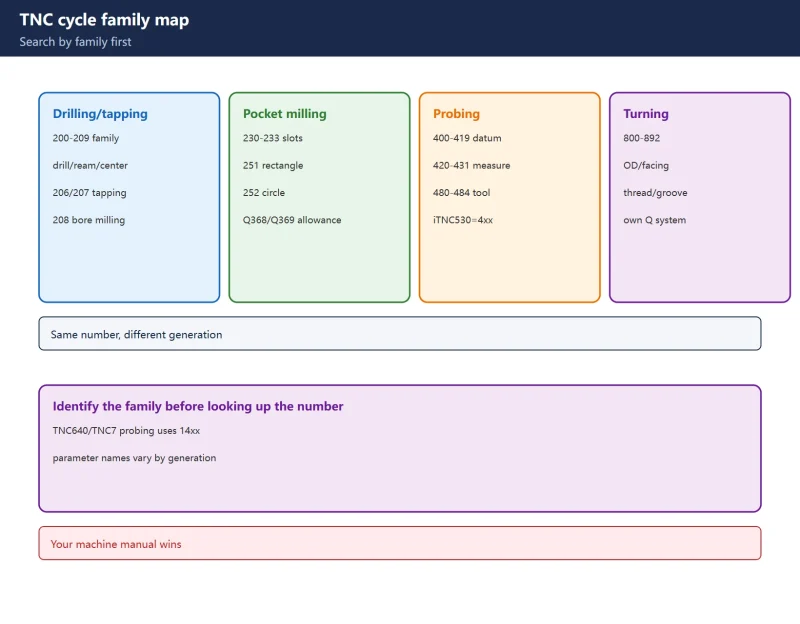
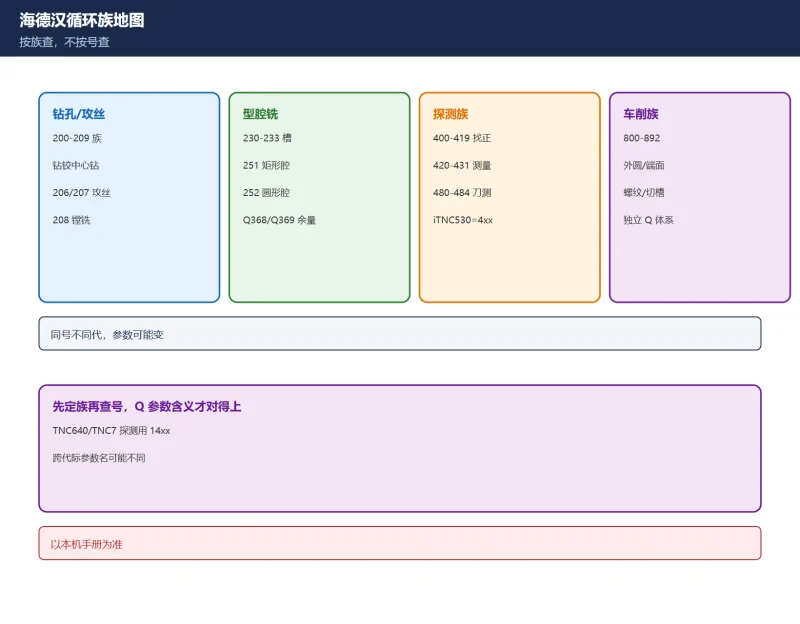
27.1 Search by family first, not by number: the cycle map
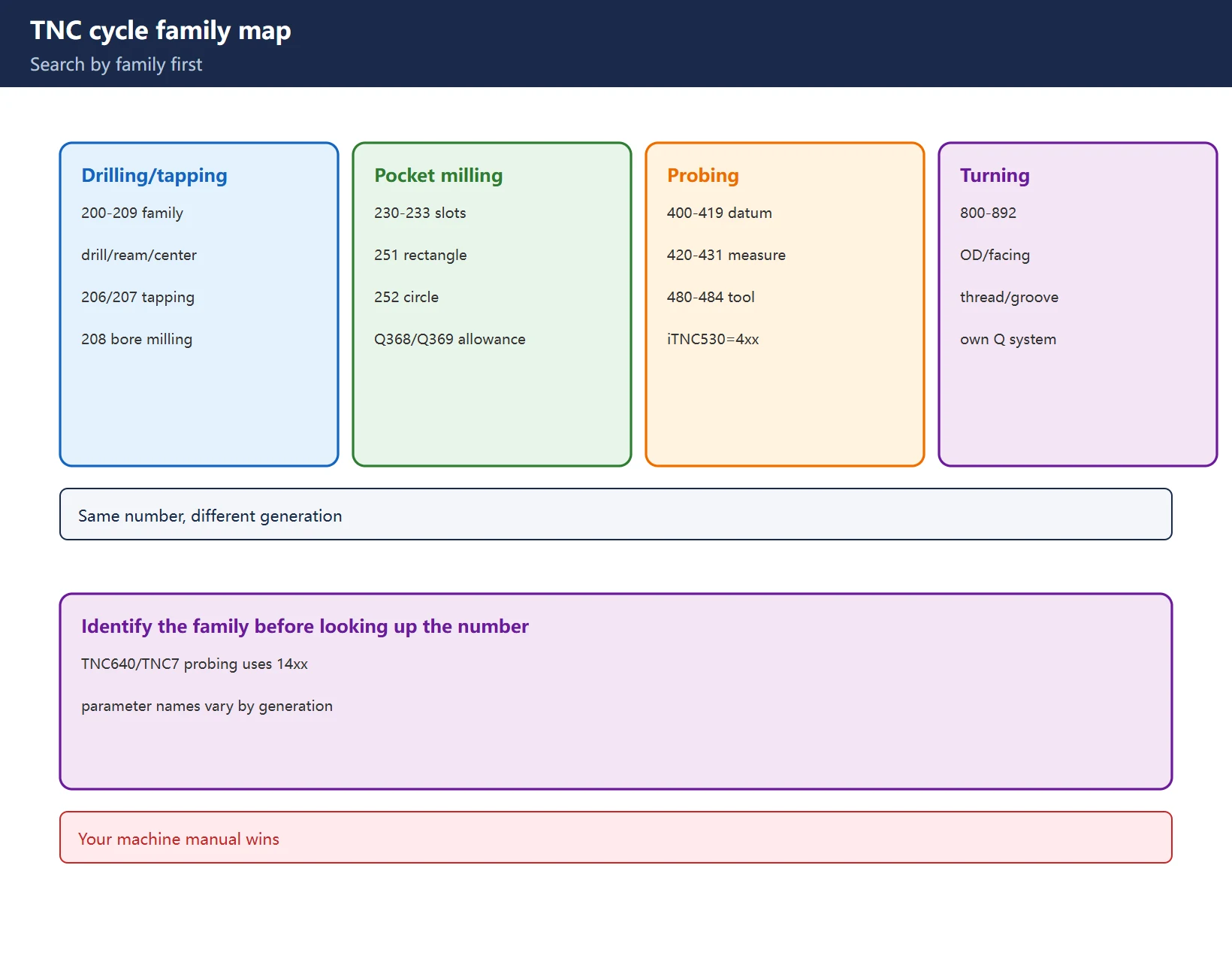
HEIDENHAIN fixed cycles are grouped into families, not scattered numbers. Identify the family before looking up a parameter so the Q-parameter meanings line up.
Table 1 HEIDENHAIN fixed-cycle family map (number ranges vary slightly by generation; check your manual)
| Family | Cycle range | What it does | Where parameters land |
|---|---|---|---|
| Drilling / tapping | 200-209, 240, 241, 262-267 | drill, ream, center drill, tap, bore-mill | Q200/Q201/Q202/Q203/Q204/Q206/Q210/Q211 |
| Pocket milling | 230-233, 251-258, 262-265, 271-277 | slots, rectangular/round pockets, islands | Q215/Q218/Q219/Q368/Q369/Q370/Q351 |
| Contour | 20, 24, 25, 27-29, 39, 276 | contour milling | Q2/Q6/Q7/Q9 (GLOBAL DEF 110/111) |
| Part probing | 400-419 (datum), 420-431 (measurement) | datum setting, hole/plane measurement | Q260/Q261/Q320/Q321-Q324/Q303 |
| Tool measurement | 480-485 (new) / 31-33 (old) | tool length / radius by touch-off device | TOOL.T columns CUT/DIRECT/R-OFFS/L-OFFS |
| Turning | 800-892 | OD, facing, thread, groove | turning-cycle specific Q parameters |
How to read: the iTNC 530 uses the 4xx probing cycles, while newer TNC640 / TNC7 use the 14xx series — the two systems cannot share cycle numbers. Tool measurement 480-483 corresponds functionally to old numbers 31-33, but status parameters live in different places; see Heidenhain touch-probe calibration and TNC generation differences.
27.2 Common Q parameters first: learn these before any specific cycle
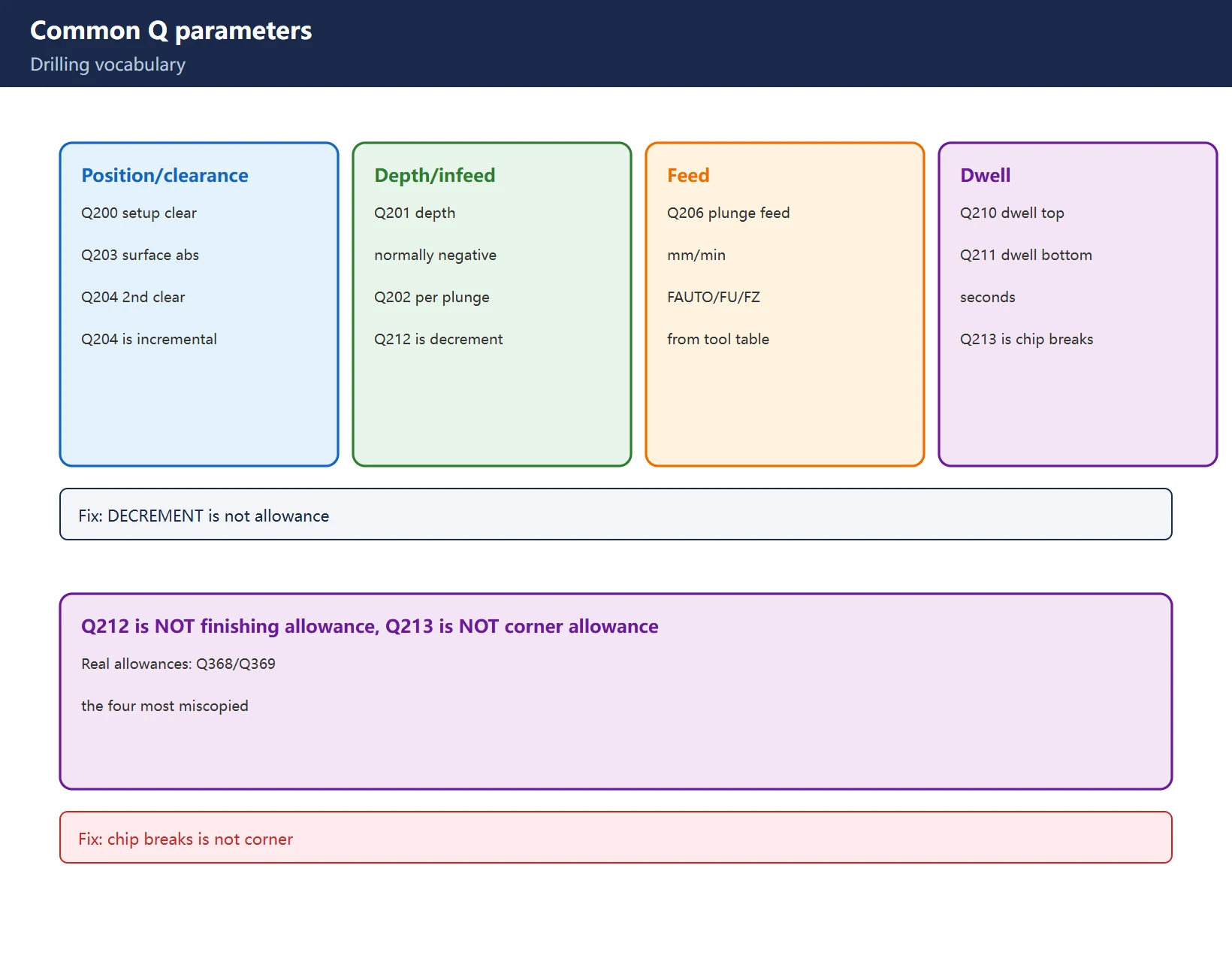
Drilling and pocket cycles share a core set of Q parameters. Learn this “common vocabulary” once and the per-cycle entries need no repetition.
Table 2 Common Q parameters for drilling (per official TNCguide; incremental/absolute nature per your manual)
| Parameter | Official name | Nature | Meaning |
|---|---|---|---|
Q200 | SET-UP CLEARANCE | incremental | Tool tip to workpiece surface; enter positive |
Q201 | DEPTH | incremental | Surface to hole bottom; normally negative; sign sets working direction, =0 skips cycle |
Q202 | PLUNGING DEPTH | incremental | Infeed per cut; need not divide depth evenly |
Q203 | SURFACE COORDINATE | absolute | Workpiece surface coordinate in spindle axis |
Q204 | 2ND SET-UP CLEARANCE | incremental | Retract height clear of workpiece/fixtures |
Q206 | FEED RATE FOR PLUNGING | – | mm/min, or FAUTO / FU / FZ |
Q210 | DWELL TIME AT THE TOP | – | Seconds at setup clearance after chip-removal retract |
Q211 | DWELL TIME AT DEPTH | – | Seconds at hole bottom |
Correction box (the four most-miscopied online)
Q212= DECREMENT (value subtracted from Q202 after each infeed), not “finishing allowance”; works withQ205minimum plunging depth.Q213= NR OF BREAKS BEFORE RETRACTING, not “corner allowance”; works withQ256retract distance andQ257chip-breaking depth.- Real side/floor allowances are
Q368(side) /Q369(floor) in pocket cycles, not Q212/Q213. Q204is officially incremental (clearance above the Q203 surface); some third-party tables call it an “absolute second safety height” — check your manual; the two appear as different numbers in the program.
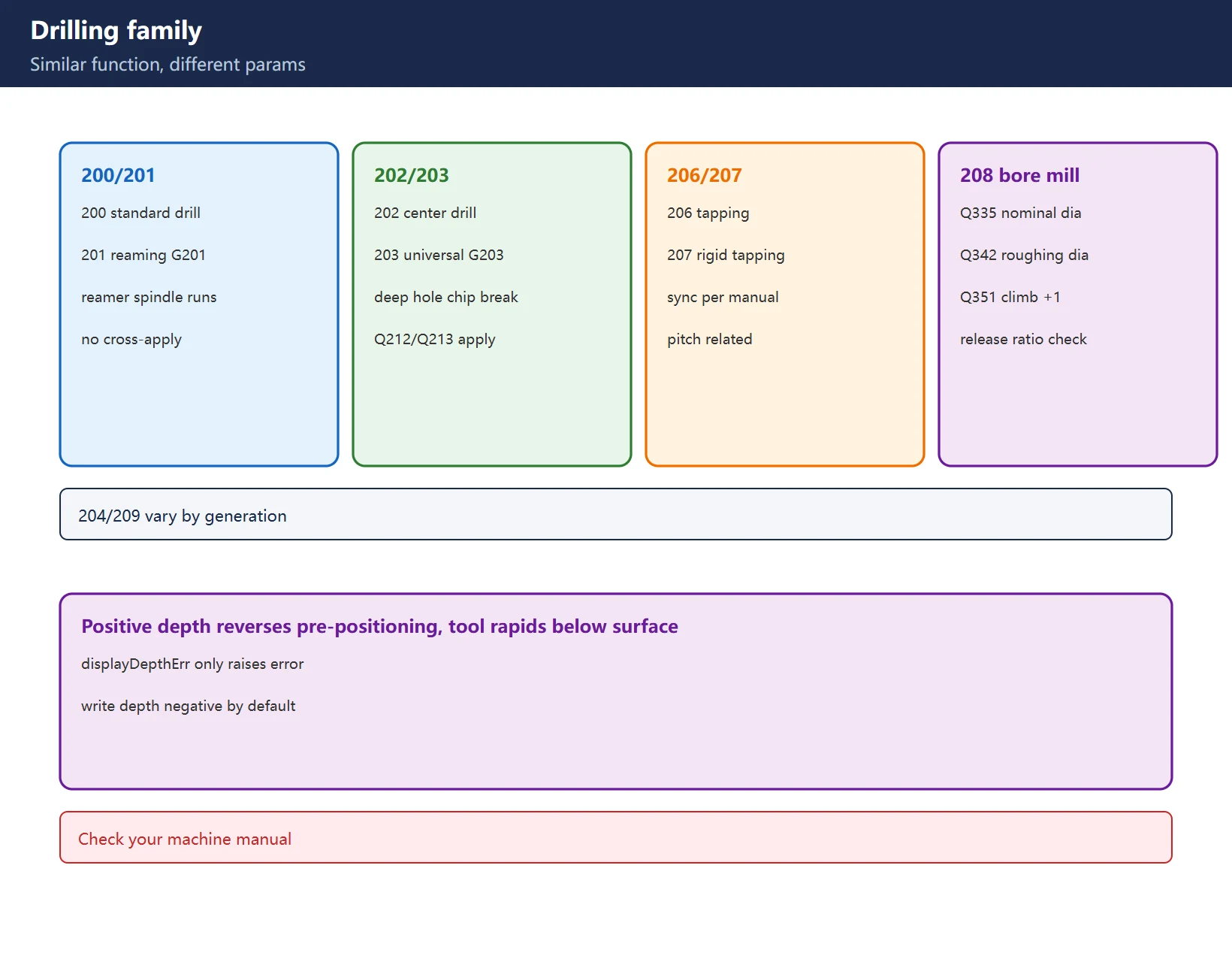
The displayDepthErr trap: the manual is explicit — the machine parameter displayDepthErr decides whether the TNC raises an error on a positive depth. With a positive depth entered, the TNC reverses the pre-positioning calculation and rapid-traverses the tool to the setup clearance BELOW the workpiece surface. Do not flip the depth sign by feel; write depth negative (down) by default.
27.3 Drilling family entry by entry: 200 / 201 / 202 / 203 / 204 / 206 / 207 / 208 / 209
Drilling is the most-looked-up family. Similar function does not mean identical Q parameters: 201 reaming retracts at feed, 203 universal drilling uses chip breaking, 206/207 are tapping — do not cross-apply parameters.
Table 3 Drilling/tapping cycle roles (Q meanings in 27.2; ranges per your manual)
| Cycle | Official name | Key difference | Main Q parameters |
|---|---|---|---|
CYCL DEF 200 | DRILLING | Standard drill, multi-plunge to depth | Q200/Q201/Q202/Q203/Q204/Q206/Q210/Q211 |
CYCL DEF 201 | REAMING (G201) | Reamer in/out at feed, spindle does not stop | Q200/Q201/Q206/Q211 |
CYCL DEF 202 | CENTER DRILLING | Shallow center hole | Q200/Q201/Q203/Q204/Q206 |
CYCL DEF 203 | UNIVERSAL DRILLING (G203) | Chip breaking / retract, first choice for deep holes | 200 set plus Q212/Q213/Q205/Q208/Q256/Q395 |
CYCL DEF 204 | Deep-hole class (generation-dependent) | Definitions differ across manuals — check your machine | Per your manual |
CYCL DEF 206 | TAPPING | Tapping with retract | Q200/Q201/Q203/Q204/Q206 plus pitch parameters |
CYCL DEF 207 | RIGID TAPPING | Spindle/feed synchronized | Sync parameters per your manual |
CYCL DEF 208 | BORE MILLING (G208) | Helical interpolation for large bores | Q335 nominal dia / Q342 roughing dia / Q351 direction / Q334 feed per revolution |
CYCL DEF 209 | Thread-milling class (generation-dependent) | Check your manual | Per your manual |
Q335 vs Q342 (the pair most confused in Cycle 208): Q335 is the nominal bore diameter; if nominal equals tool diameter, the TNC bores straight to depth with no helical interpolation. Q342 is the roughing diameter; any value above 0 stops the TNC from checking the bore/tool diameter ratio, allowing rough-milling of holes larger than twice the tool diameter. Q351 = +1 climb milling, -1 up-cut (0 is also treated as climb).
27.4 Pocket milling family: 230 / 231 / 251 / 252 / 256 / 257 and Q2xx reuse
Pocket cycles have many Q parameters but high reuse: the Q200/Q201/Q203/Q204 positioning set repeats across the family; what distinguishes cycles is shape + allowance + path parameters.
Table 4 Pocket/slot cycles and dedicated Q parameters
| Cycle | Official name | Shape / dedicated parameters | Notes |
|---|---|---|---|
CYCL DEF 230 | SLOT MILLING | slot length/width/direction | Mill a long slot in one pass |
CYCL DEF 231 | Slot milling (multi-pass / generation-dependent) | Per your manual | High-speed deep-hole/slot class, function near FANUC G73 |
CYCL DEF 251 | RECTANGULAR POCKET | Q218 1st side / Q219 2nd side / Q220 corner radius / Q224 rotation | Q215 sets operation (rough/finish) |
CYCL DEF 252 | CIRCULAR POCKET (G252) | Q223 circle diameter | Q215 sets operation |
CYCL DEF 256 | Rect/round pocket (generation-dependent) | Per your manual | Included in TNC640 pocket-cycle global data range |
CYCL DEF 257 | Pocket class (generation-dependent) | Per your manual | Same; do not copy across machines |
Family reuse rules: Q368 (side allowance) and Q369 (floor allowance) take effect only when a finishing operation is defined; Q370 is the path overlap factor (Q370 x tool radius = stepover k, range 0.1-1.9999); Q351 climb +1 / up-cut -1; Q366 plunging strategy (0 vertical, 1 helical, 2 reciprocating). These are the GLOBAL DEF 105/110/111 common data and can be reused family-wide.
27.5 Probing 400-431 and tool measurement 480-484: change parameters in the right place
Probing splits into 400-419 datum setting (build coordinate system), 420-431 measurement (measure size); tool measurement is 480-484 (new) / 31-33 (old). The three groups store parameters in different places — the classic mistake is “editing a measurement parameter inside a datum cycle.”
Table 5 Probing and tool-measurement families (iTNC530 4xx system; TNC640/TNC7 partly 14xx)
| Range | Purpose | Typical cycles | Key Q parameters |
|---|---|---|---|
| 400-419 | Part datum, set zero | 410 datum inside rectangle, 411 datum outside | Q321/Q322 center, Q323/Q324 sides, Q260 clearance, Q261 measuring height, Q305 table number |
| 420-431 | Part measurement | 420 angle, 421 hole, 422 outside circle, 423/424 rectangle, 430 bolt circle, 431 plane | Q260 clearance, Q261 measuring height, Q303 value transfer |
| 480-484 | Tool measurement | 480 calibrate TT, 481 length, 482 radius, 483 both, 484 calibrate IR TT | Status in TOOL.T columns (CUT/DIRECT/R-OFFS/L-OFFS), Q199 status (new numbers) |
Where parameters actually live: on iTNC530, global probe behavior (feed, pre-positioning, max traverse, safety clearance) is in machine parameters MP6120 / MP6130 / MP6140 / MP6150 / MP6151 etc.; on TNC640 / TNC7 this moved to the Cfg configuration tables — exactly the “iTNC530 uses MP, TNC640/TNC7 uses Cfg, don’t edit the wrong place” point stressed in Heidenhain touch-probe calibration. If you change safety clearance in a datum cycle and nothing happens, you most likely edited the wrong generation’s location.
27.6 Turning family 800-892: a separate system, do not mix with milling
The 800-892 turning family covers TNC turning cycles (OD, facing, thread, groove, center drilling, etc.) with a different Q-parameter system from milling, normally seen on turn-mill machines with C/Y axes. Check first that the machine is in turning mode and the cycle is in the 8xx range, then verify each against the machine’s turning manual. This page does not expand the turning Q table to avoid cross-machine copy errors.
27.7 FANUC G-cycle migration map: one line per pair, parameters are not directly convertible
Moving from FANUC to HEIDENHAIN, the common question is “I used G83, which Cycle replaces it?” The table gives function-level approximate mapping — note this is an analogy: FANUC G + address words and HEIDENHAIN CYCL DEF + Q parameters are different systems; parameters cannot be converted one by one.
Table 6 FANUC G-cycle to HEIDENHAIN Cycle approximate functional map (not directly convertible)
| FANUC | Function | HEIDENHAIN approximate | What does not convert |
|---|---|---|---|
G81 | Standard drilling | Cycle 200 | G98/G99 return mode vs Q204 second clearance |
G82 | Counterbore (dwell at bottom) | Cycle 201 / 200 + Q211 | 201 is reaming semantics; dwell is Q211 |
G83 | Deep-hole peck drilling | Cycle 203 | R point vs Q203/Q200; different chip-break system |
G73 | High-speed deep-hole drilling | Cycle 231 class | Different retract-distance definition |
G84 | Tapping | Cycle 206 / 207 | Rigid-tapping sync parameters per your manual |
G85 | Boring (feed in/out) | Cycle 230 / 231 class | Bore-milling 208 is helical, different semantics |
G86 | Boring (rapid retract) | Cycle 22x class | Number range varies widely across generations |
G87 / G88 | Back boring / manual boring | Cycle 241 class | Latter is thread-milling class, only functionally close |
Migration discipline: first align on “what motion this cycle must produce”, then fill every Q parameter against your manual; never take a FANUC R point, Z value or K value and divide by a factor to get a HEIDENHAIN value. The FANUC side is covered in Fanuc Canned Cycles Explained and Fanuc Canned Cycle Parameter Table.
27.8 Common pitfalls: sign, feed semantics, diameter split, climb/up-cut
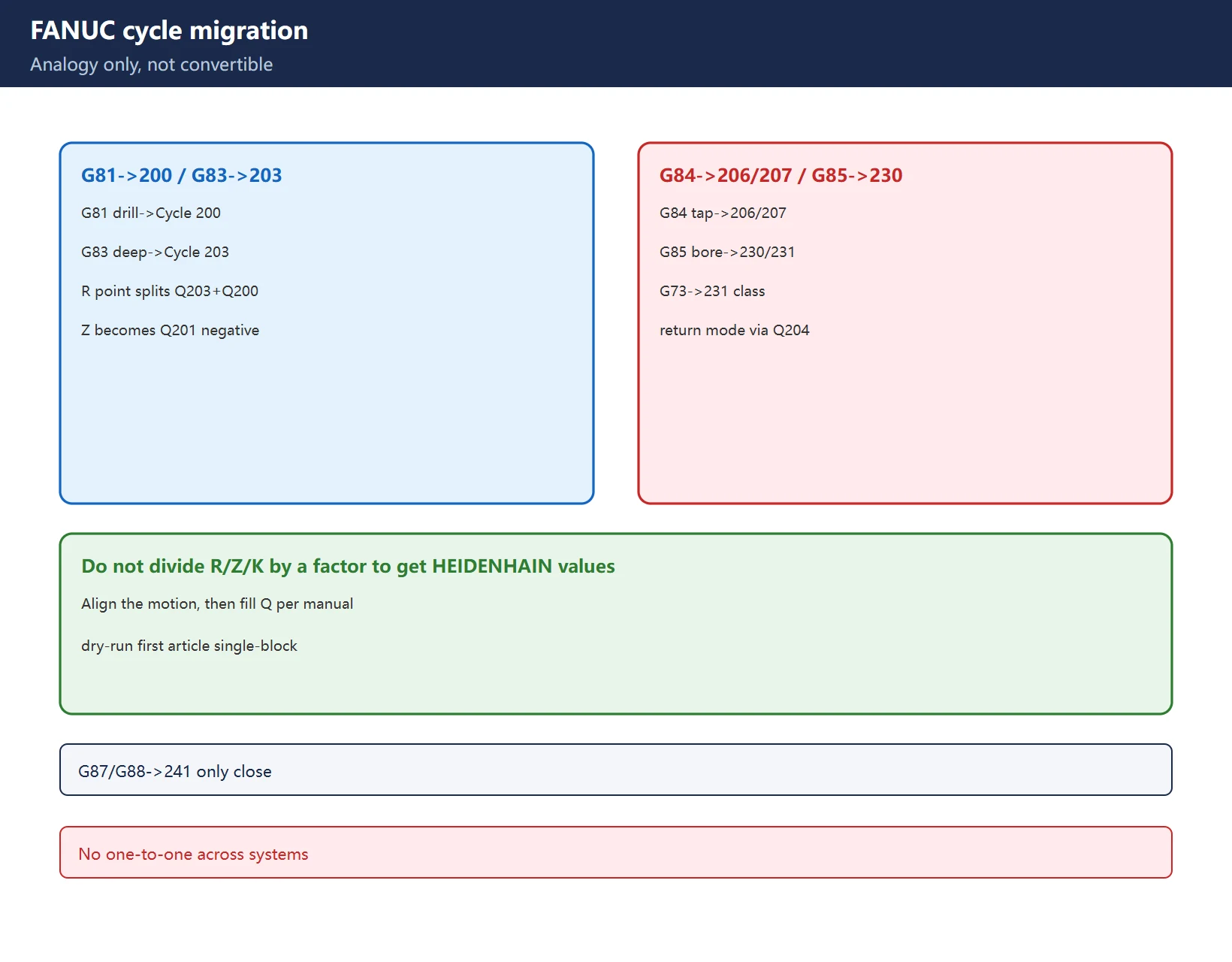
Table 7 Four frequent mis-fills and the correct practice
| Pitfall | Symptom | Correct practice |
|---|---|---|
| Depth sign reversal | Positive depth reverses pre-positioning; tool rapids below surface | Write depth negative (down); displayDepthErr only raises an error, it does not fix it |
| FAUTO / FU semantics | Treating FAUTO as a fixed feed value | FAUTO/FU/FZ mean “compute feed from the tool table”; algorithm per your manual |
| Q335 / Q342 split | Bore larger than twice tool diameter raises an error | Fill Q342 roughing diameter to release the ratio check |
| Q351 climb/up-cut | Up-cut entered as -1, or 0 assumed to be up-cut | +1 climb, -1 up-cut, 0 is treated as climb |
27.9 Table declaration and usage discipline
Declaration: parameter meanings in this table are checked against the individual manuals for iTNC530 / TNC620 / TNC640 / TNC7; the same cycle can use different parameter names across generations. All ranges and examples are subject to your machine manual and shop-floor test cutting. Cycle numbers and Q definitions follow the manual shipped with your machine — this page is a lookup entry point, not a replacement for the manual.
Usage discipline: (1) locate the family, then look up the number; (2) obtain official manuals only through HEIDENHAIN’s official channels and your machine documents — this site does not host manual PDFs; (3) when cross-checking CAM-posted cycles, the post output and your machine manual win; (4) dry-run the first article single-block for deep holes, bore-milling and probing, confirming clearance and depth sign before batch running.
Frequently Asked Questions
What is the difference between HEIDENHAIN Cycle 200 and Cycle 201?
Cycle 200 is standard drilling with multi-plunge to depth, using Q202 for infeed per cut and Q210/Q211 for dwell. Cycle 201 is reaming (G201): the reamer travels in and out at feed with the spindle not stopping, and has no multi-plunge chip-breaking logic. You cannot apply 200 parameters to reaming; feed and retract semantics differ.
When do Q200 and Q204 differ?
Q200 is the setup clearance from tool tip to workpiece surface, the approach height before the cycle starts. Q204 is the second setup clearance, the retract height clear of workpiece/fixtures, officially incremental (above the surface). With tall fixtures or clamps, Q204 must be clearly above Q200; for simple flat drilling they can differ without being equal. Check both against your manual.
Can HEIDENHAIN drilling cycles be used like FANUC G81, and how do parameters convert?
Not directly. G81 is G-code plus R-point/Z-value address words; Cycle 200 is CYCL DEF plus Q parameters. Functionally G81 maps to Cycle 200, but the FANUC R point splits into HEIDENHAIN Q203 (surface coordinate) + Q200 (clearance), Z depth becomes Q201 (mind the negative sign), and return mode is expressed through Q204. Refill every parameter against your manual and dry-run the first article single-block.
Last updated: 2026-11-20
Where to go next
- FANUC Troubleshooting — the full guide library: alarms, diagnosis numbers, servo, spindle, PMC and electrical faults, organised by symptom.
- CNC Repair Tools — which instrument measures what: multimeters, clamp meters, insulation testers and oscilloscopes, with the specification that actually matters.
- Remote Technical Support — have the readings reviewed with you: alarm reverse lookup, PMC ladder analysis and servo tuning advice by call. Repair companies and integrators welcome.
- Buying & Ownership Decisions — refurbished vs new, used-machine checks, software licensing and manuals: spend with the field facts in hand.
Read the guide, get the right instrument, or walk the diagnosis through with someone — pick whichever you need.
The original Chinese version — same procedure, with the full field notes.




















暂无评论内容