


Sister article: FANUC canned cycles: nine cycles, address words and alarm 045 root causes. Related: Fanuc rigid tapping parameters 5200–5294, Fanuc Macro B guide, FANUC SERVO GUIDE and rigid tapping.
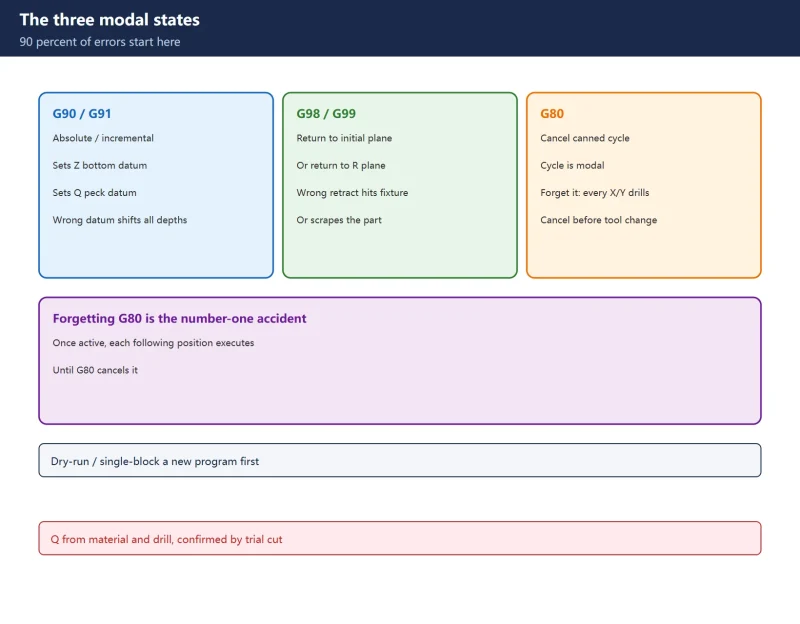
1.1 Get the three modal states right first
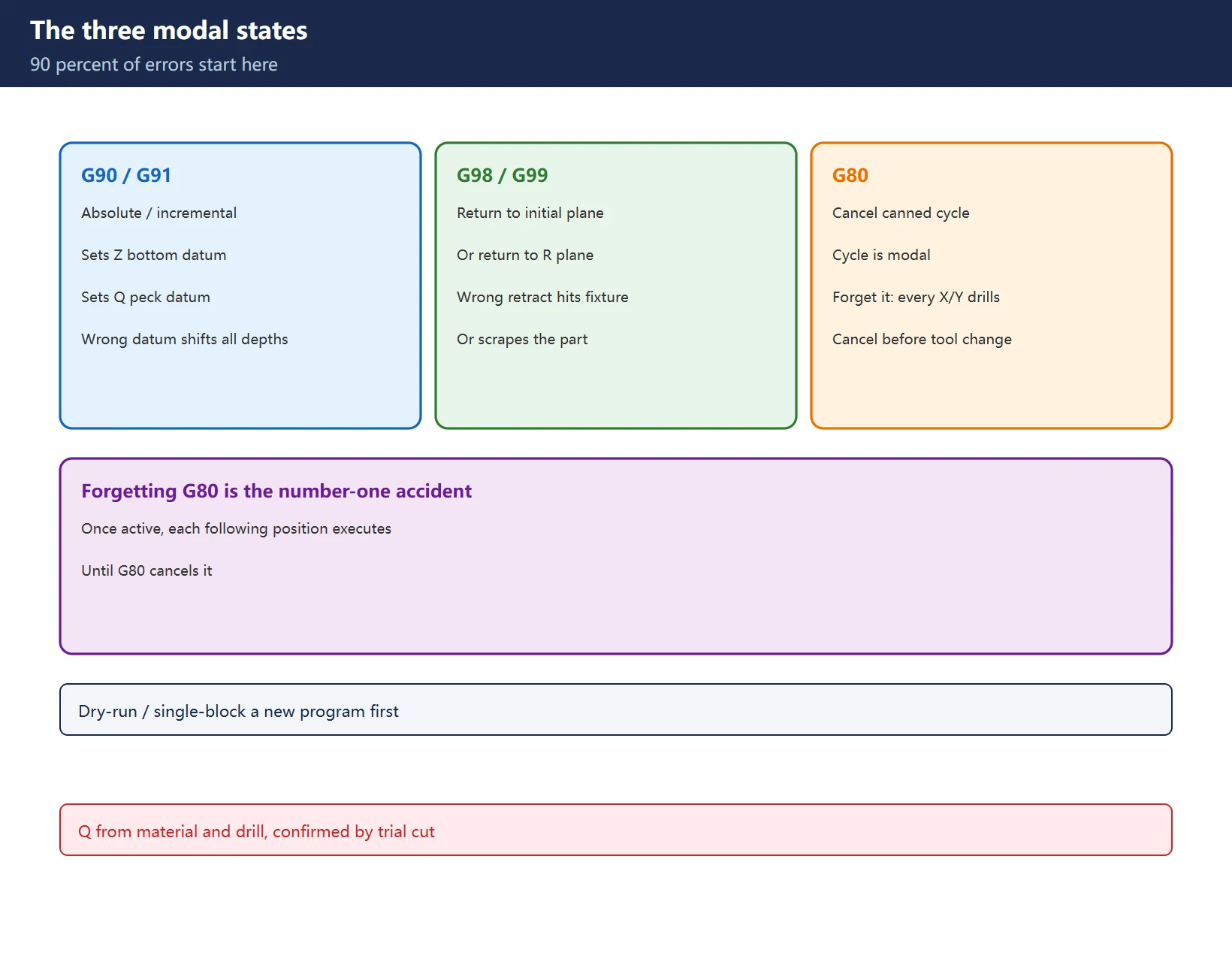
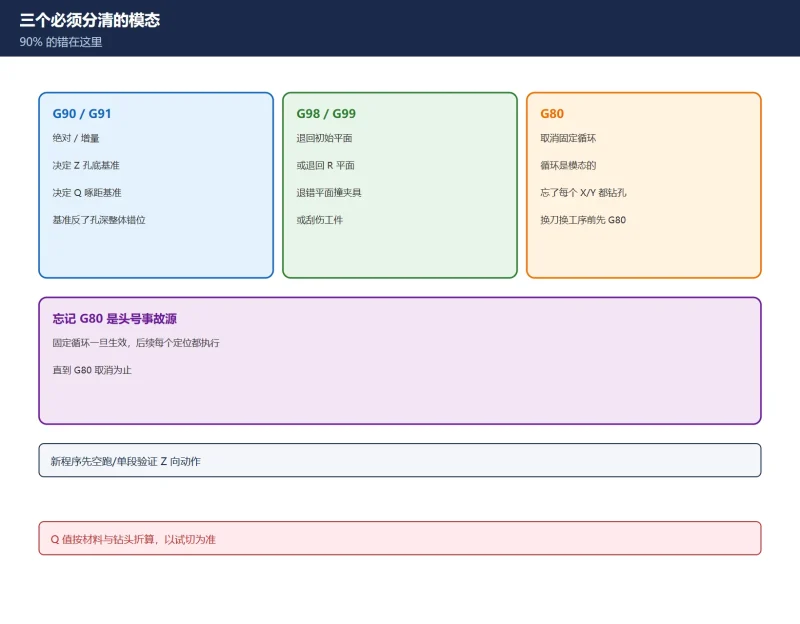
| Modal | Function | If you forget it |
|---|---|---|
| G90 / G91 | Absolute / incremental, sets the datum for Z bottom and Q peck | Wrong datum -> the whole hole depth shifted |
| G98 / G99 | Return to initial plane / return to R plane | Wrong retract plane -> hit the fixture or scrape the part |
| G80 | Cancel canned cycle | Forgotten -> the next position drills again where it should not |
Table 1. The three modals define canned-cycle behaviour
Forgetting G80 is the number-one accident source: a canned cycle is modal, so once active, every following X/Y position executes a drill until G80 cancels. Cancel with G80 before tool changes and operations.
1.2 Address words: X/Y/Z/R/Q/P/F/K
| Address | Meaning | Key point |
|---|---|---|
| X / Y | Hole position | One cycle executes per position |
| Z | Hole bottom | Affected by G90/G91 |
| R | Rapid to R plane | Boundary between rapid and cutting feed |
| Q | Peck depth | Required for G73/G83; must be on the same line as the G code |
| P | Dwell at bottom | Unit set by parameter 5204 (ms or s) |
| F | Feed rate | Cutting feed |
| K | Repeat count | FANUC uses K (some systems use L); with G91 for equally spaced arrays |
Table 2. Canned-cycle address words (units and requirements follow the manual for your control)
K versus L: FANUC canned cycles use K for repeat count; some systems use L. Do not mix them. G91 + K makes an equally spaced hole array in one line, but confirm the R and Z datum first.
1.3 Nine cycles in one table
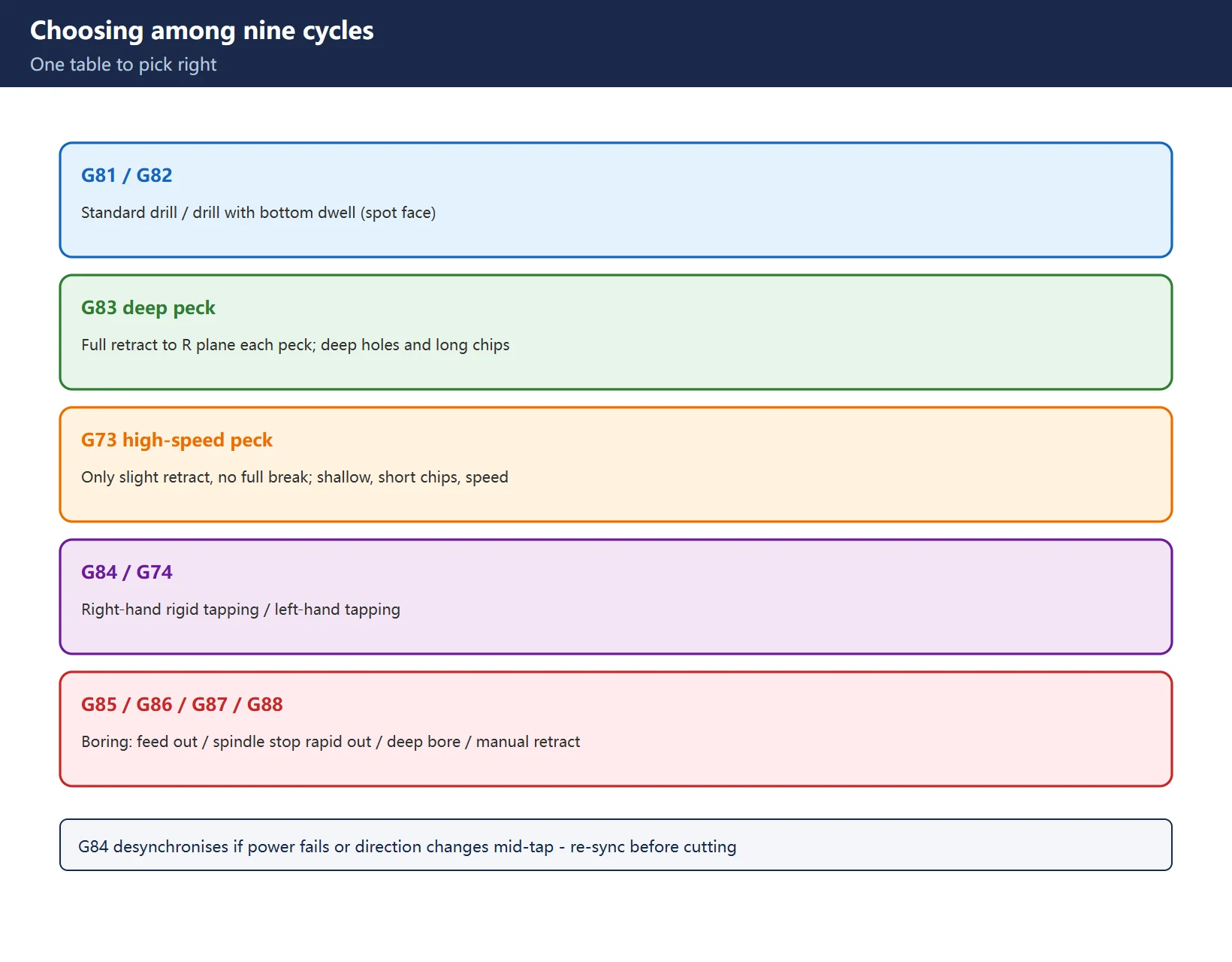
| Cycle | Purpose | Bottom / retract behaviour |
|---|---|---|
| G81 | Standard drill | Feed to bottom, rapid back to R plane |
| G82 | Drill with dwell | Dwell P at bottom (counterbore, spot face) |
| G83 | Deep-hole peck | Each peck Q then fully retracts to R plane to clear chips |
| G73 | High-speed peck | Each peck Q then retracts only slightly, no full chip break |
| G84 | Right-hand rigid tapping | Spindle and Z synchronised, reversed on retract |
| G74 | Left-hand tapping | Reverse tapping |
| G85 | Boring | Feed in, feed out (chip clearing) |
| G86 | Boring | Feed in, spindle stop, rapid out |
| G87 / G88 | Deep-hole boring / manual retract bore | Needs spindle orientation / manual retract |
Table 3. Choosing the nine cycles (exact motions follow the manual for your control)
1.4 G73 versus G83: retract distance decides chip clearing
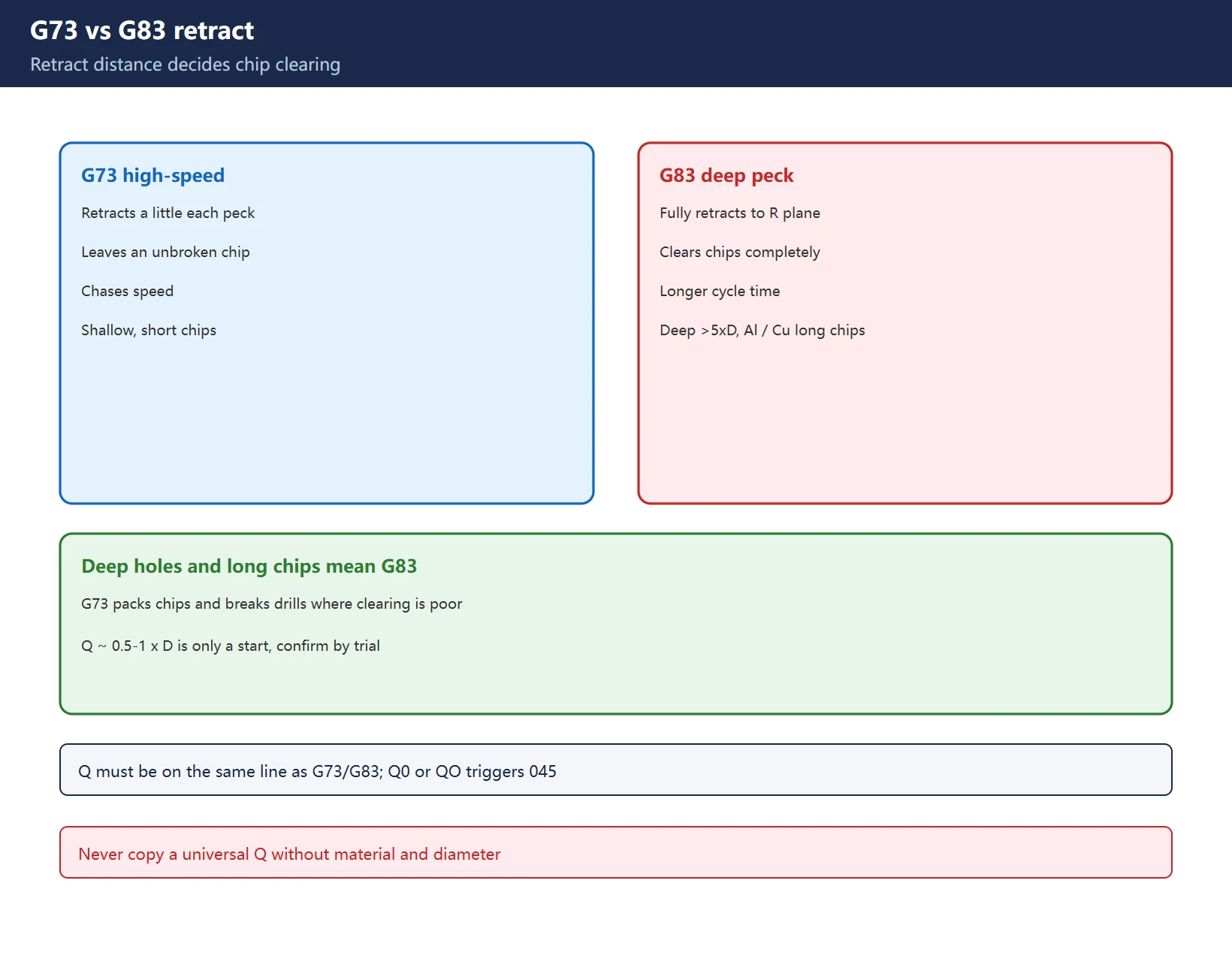
| Aspect | G73 high-speed peck | G83 deep-hole peck |
|---|---|---|
| After each peck | Retracts only a little (breaks chip) | Fully retracts to R plane |
| Chip clearing | No forced clearing, relies on chip breaking | Clears chips fully each peck |
| Use for | Shallow holes, short-chipping material | Deep holes (>5xD), long-chipping material (Al, Cu) |
Table 4. How to choose between G73 and G83
In one line: deep holes and long chips mean G83. G73 chases speed but will pack chips and break the drill where clearing is poor.
1.5 How to set Q: give the rule, not a number
A common starting point for Q (peck depth) is Q ≈ 0.5–1 x D (drill diameter): smaller for steel, larger for aluminium. That is only a starting point – precision grades and drill materials can double it; derive it from material and tool diameter and confirm by trial cutting. Anyone who gives you a “universal Q value” without naming the material and diameter should not be copied.
1.6 G84 rigid tapping versus M29
In rigid tapping, the G84 cycle keeps spindle rotation and Z feed strictly synchronised (through the parameter chain – see rigid tapping parameters 5200–5294). Non-rigid tapping relies on the spindle encoder’s one-revolution signal for synchronisation compensation.
A power interruption or direction change mid-tap desynchronises Z from the thread – the classic rigid-tapping fault. After recovery you must re-establish synchronisation; never resume cutting directly.
1.7 Parameters: 5121 / 5213 / 5200–5209
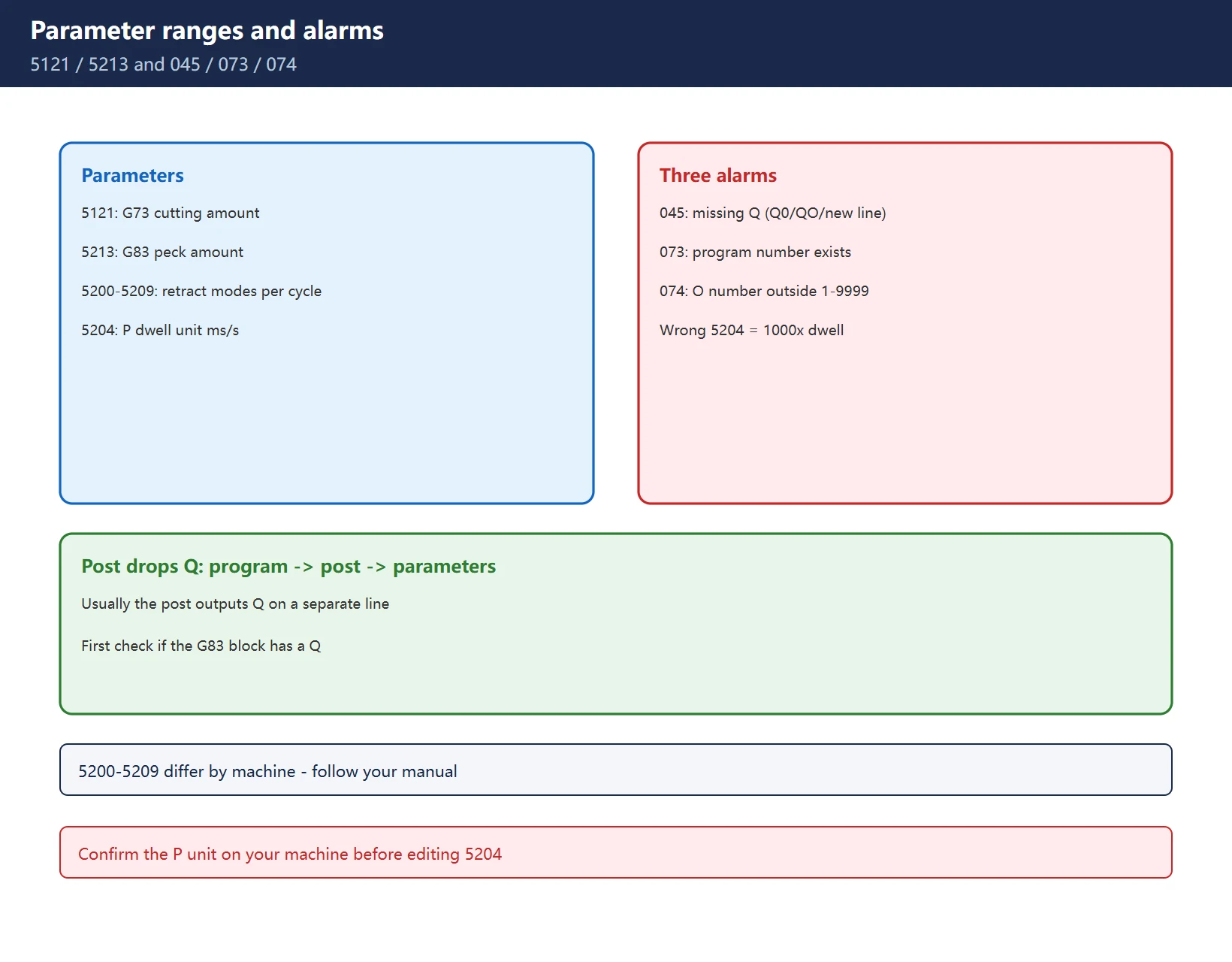
| Parameter | Function | Key point |
|---|---|---|
| 5121 | G73 cutting amount | Affects each high-speed peck |
| 5213 | G83 peck amount | Affects the Q baseline for deep-hole pecking |
| 5200–5209 | Z/R/retract and incremental modes per cycle | Definitions differ by machine – verify against the manual |
| 5204 | P dwell unit (1 ms or 1 s) | Wrong unit = dwell off by 1000 times |
Table 5. Canned-cycle parameters (verify each against the manual for your control)
5204 is the silent killer: P = 500 means half a second if the unit is ms, or 500 seconds if it is s – downtime, crashes and scrap all follow from this. Confirm your machine’s 5204 setting before changing anything.
1.8 Alarm 045 / 073 / 074 root causes
| Alarm | Meaning | Root cause |
|---|---|---|
| 045 | ADDRESS Q NOT FOUND | G73/G83 missing Q: Q typed as 0 or O, or written on the next line (Q must be on the same block as G73/G83) |
| 073 | Program number already exists | Trying to store an O number that is taken |
| 074 | Program number out of range | O number outside 1–9999 |
Table 6. Root causes of the three common alarms
045 is the most frequent: Q must be in the same block as G73/G83; Q0 (zero) or QO (letter O) are both rejected.
1.9 When the post-processor drops Q
A CAM shop changes its post and every hole now throws 045 – troubleshoot in this order: program -> post-processor -> parameters: first look at whether the G83 line in the generated NC code has a Q, then check the post configuration, and only then suspect parameters. Most cases are the post outputting Q on a separate line.
1.10 Safety and verification
For a new or modified cycle, dry-run / single-block to verify Z motion, R plane, hole bottom and retract before cutting metal. With G91 + K arrays, confirm the R and Z datum first or the whole array shifts. For rigid tapping, confirm synchronisation is healthy before cutting.
Frequently Asked Questions
What is the difference between G73 and G83, and which to use for deep holes?
G73 pecks with only a small retract and no full chip break, chasing speed; G83 retracts fully to the R plane each peck to clear chips. Deep holes (>5xD) and long-chipping material such as aluminium or copper need G83, or chips pack and the drill breaks.
Why do I get alarm 045 on a canned cycle, and how do I write Q?
045 is ADDRESS Q NOT FOUND – G73/G83 is missing Q. Common causes are typing Q as 0 or the letter O, or putting Q on the next line. Q must be in the same block as G73/G83.
What is the difference between G98 and G99, and what happens if I forget G80?
G98 returns to the initial plane, G99 to the R plane. Without G80 the cycle stays modal, so each following X/Y position drills again – wrong holes or a crash. Cancel with G80 before tool changes and new operations.
Last updated: 2026-11-19
Where to go next
- FANUC Troubleshooting — the full guide library: alarms, diagnosis numbers, servo, spindle, PMC and electrical faults, organised by symptom.
- CNC Repair Tools — which instrument measures what: multimeters, clamp meters, insulation testers and oscilloscopes, with the specification that actually matters.
- Remote Technical Support — have the readings reviewed with you: alarm reverse lookup, PMC ladder analysis and servo tuning advice by call. Repair companies and integrators welcome.
- Buying & Ownership Decisions — refurbished vs new, used-machine checks, software licensing and manuals: spend with the field facts in hand.
Read the guide, get the right instrument, or walk the diagnosis through with someone — pick whichever you need.




















暂无评论内容