


Sister article: SINUMERIK 828D / 840D sl servo humming and vibration: drive-side tuning. Related: 828D/840D following error and contour tuning (NC side), 828D alarm number ranges quick reference.
1.1 Which layer is the noise coming from
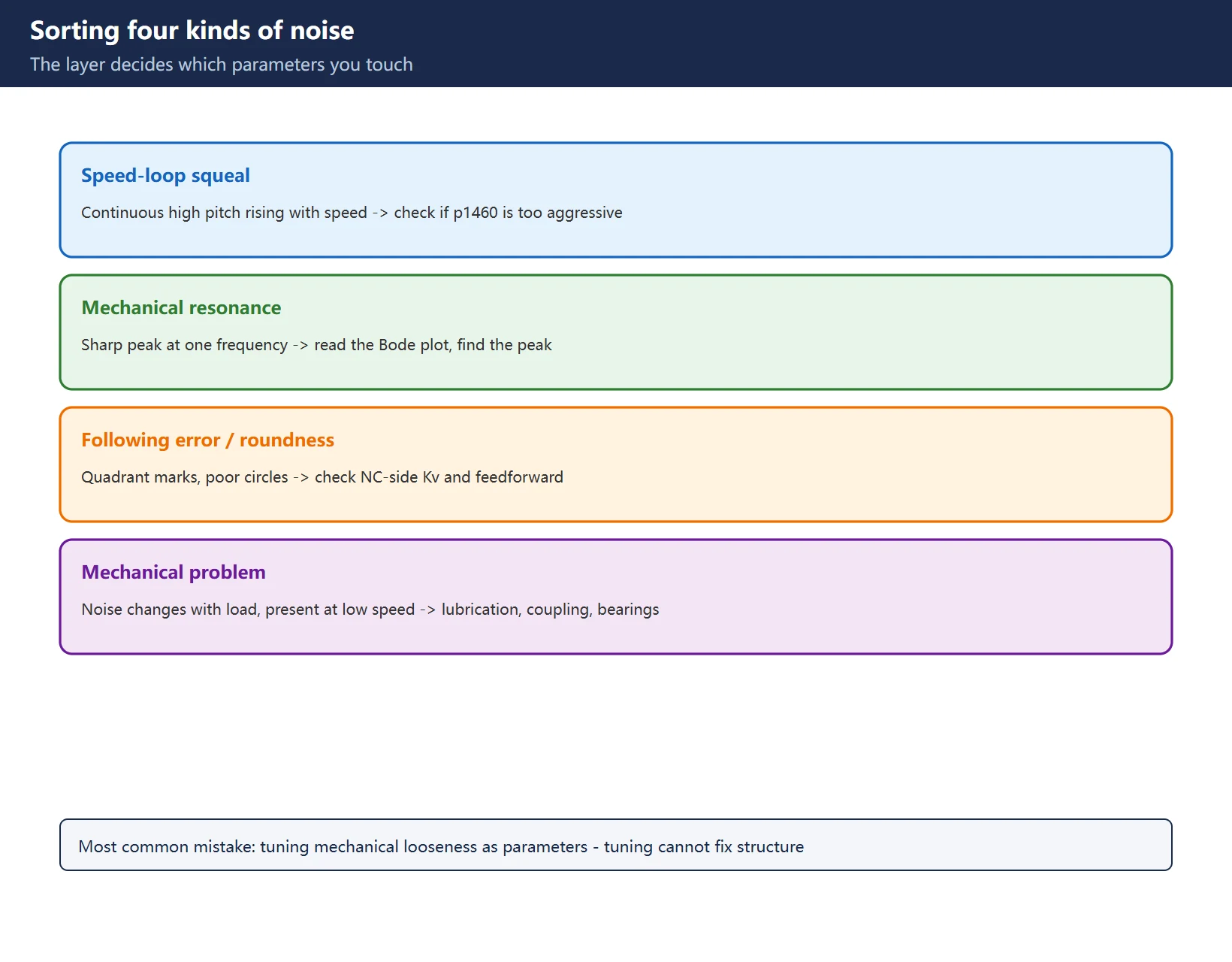
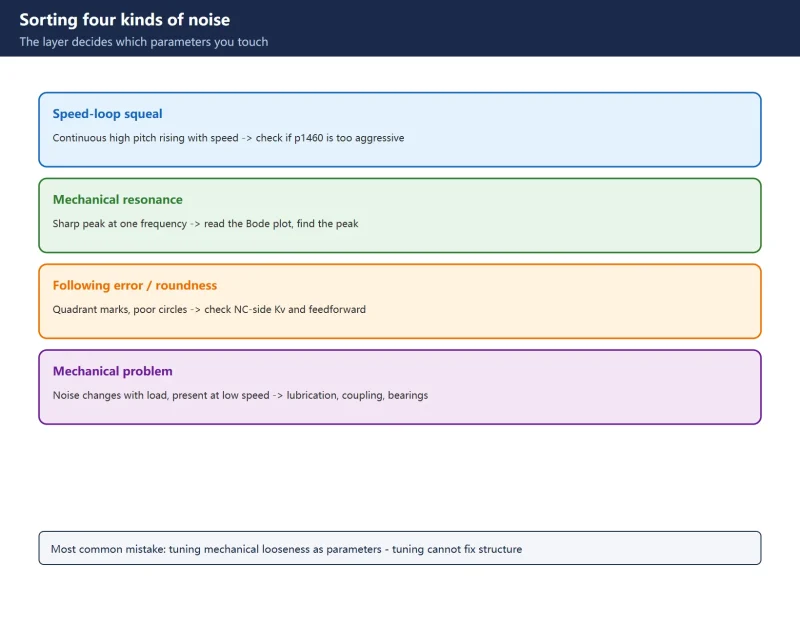
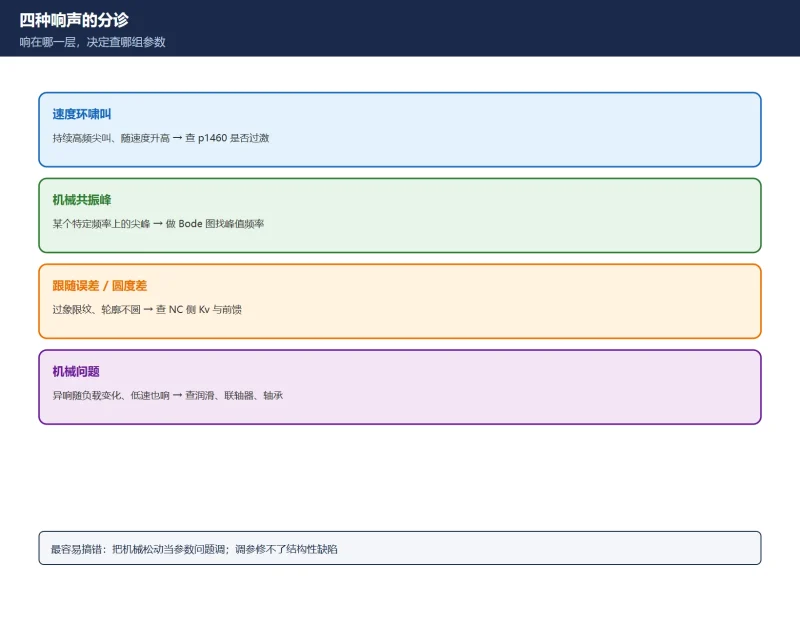
Sort before touching anything – noise from different layers has different cures:
| Symptom | Character | Layer | First action |
|---|---|---|---|
| Speed-loop squeal | Continuous high pitch, rises with speed | Drive side | Check if p1460 is too aggressive |
| Mechanical resonance peak | Sharp peak at one frequency | Drive notch | Read Bode plot, find peak frequency |
| Large following error / poor roundness | Bad circles, quadrant marks | NC side | Check MD32200 Kv and feedforward |
| Mechanical problem | Noise changes with load, present at low speed | Mechanical | Check lubrication, coupling, bearings |
Table 1. Sort by layer first – the layer decides which parameter group you touch
The most common mistake is treating loose or misaligned mechanics as a parameter problem – tuning cannot repair a structural defect. Conversely, piling on Kv because roundness is poor will push an already unstable speed loop into oscillation.
1.2 Order discipline: drive side first, NC side second
This is the single most important rule here:
Run p1960 auto-tuning first to get a well-damped p1460 / p1462 -> then check MD32200 (Kv) against the OEM convention -> only then touch Kv.
Doing it backwards – tuning Kv before the speed loop – is the classic wrong order. The position loop (Kv) is built on a stable speed loop; when the speed loop itself is oscillating, raising Kv only amplifies the oscillation into the position loop, showing up as worse contour chatter and alarms.
1.3 p1960 auto-tuning: the drive-side first choice
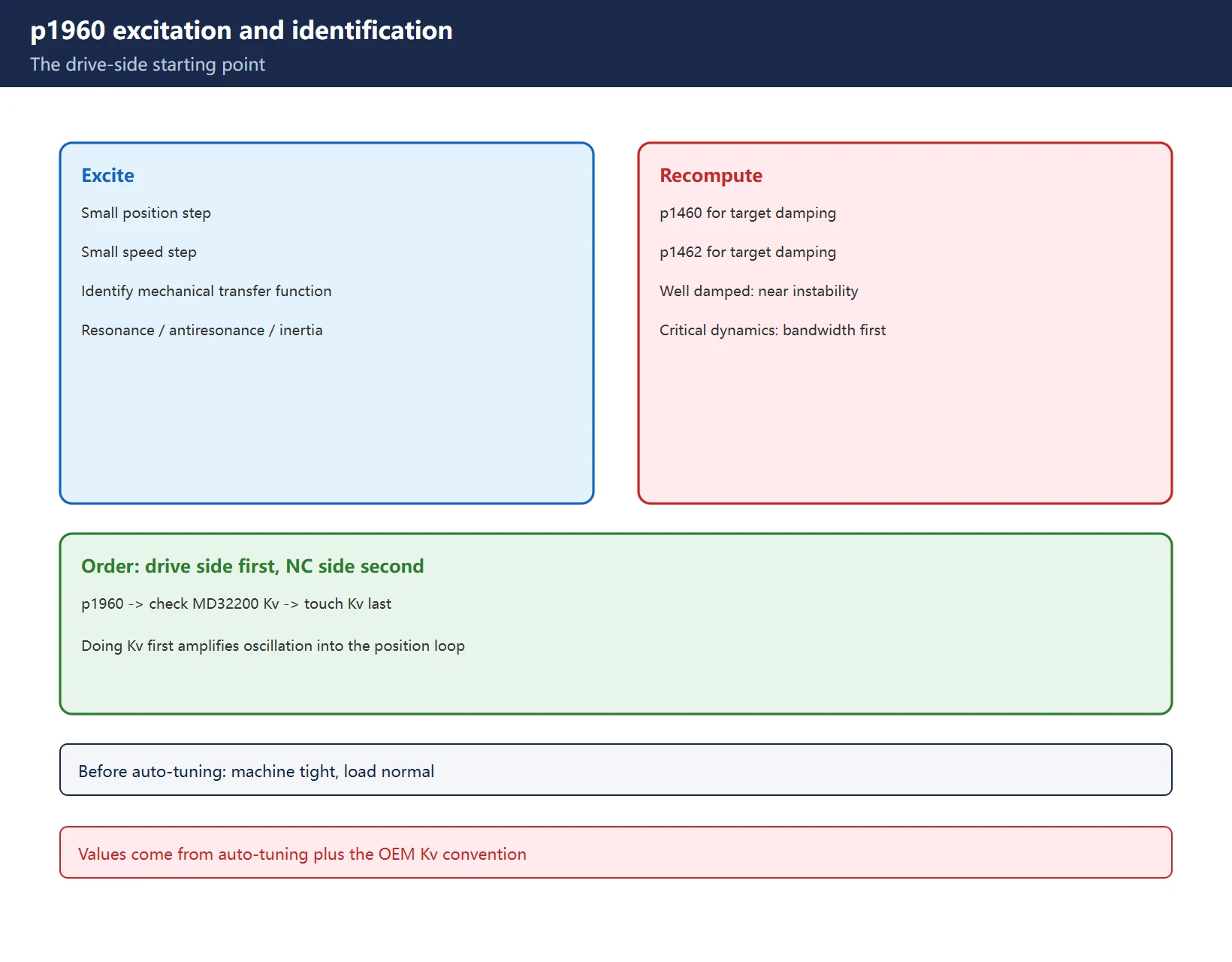
p1960 is the drive-side auto-tuning function, built into Operate. Principle: excite the system with a small position step plus a speed step, identify the mechanical transfer function (resonance, antiresonance, load inertia), then automatically recompute p1460 and p1462 for a target damping.
Two selectable criteria: “well damped” (choose it near instability, trading some response for stability) and “critical dynamic response” (bandwidth first, for fast-following applications). Which one to pick is a process decision, not “always pick the fastest”.
Before auto-tuning, confirm the machine is tight and the load is normal – identify a model on loose mechanics and the model itself is wrong.
1.4 p1400 speed-controller configuration bits
p1400 is the speed-controller configuration bit field: release, adaptation, filter enable. The filter-enable bit is the half-step most often missed – people tune the p1656 notch but never enable the filter, so the parameter does nothing. Record the original value before changing bits and check each against the manual for your version.
1.5 Quantitative rules for p1460 / p1462
Fine-tuning on top of p1960 auto-tuning, there is an executable rule of thumb from mature field methodology:
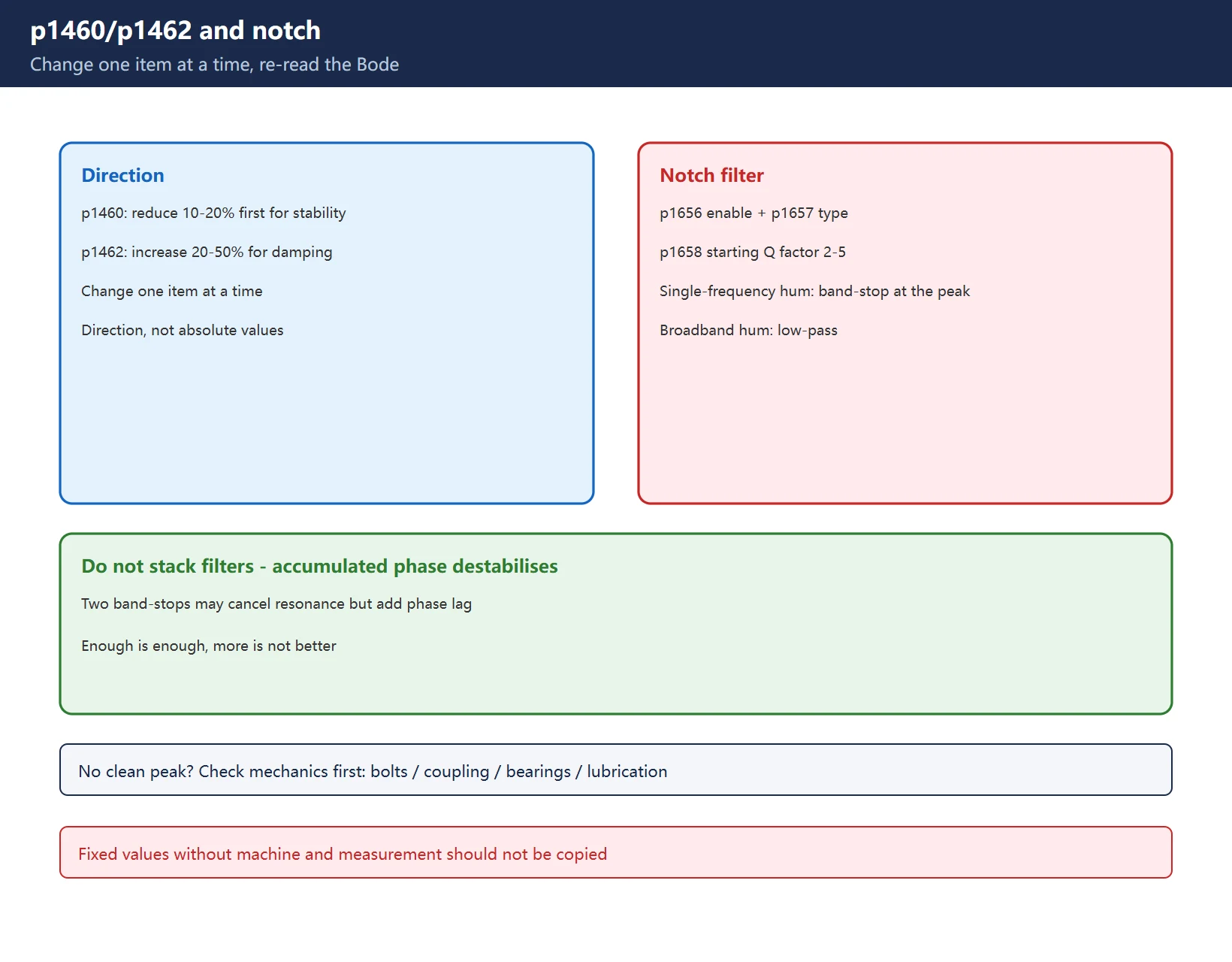
- p1460 (proportional gain Kp): reduce by 10-20% first – trade gain for stability;
- p1462 (integral time Ti): then increase by 20-50% – longer integration means less integral action at the same Kp, the most effective single step for adding damping;
- change one item at a time, then re-check the Bode plot and actual response.
These are direction and magnitude guidelines, not absolute values. The optimum differs widely by machine and inertia; the final point comes from the p1960 result and measured response.
1.6 How to read the Bode plot: turn “hum” into dB
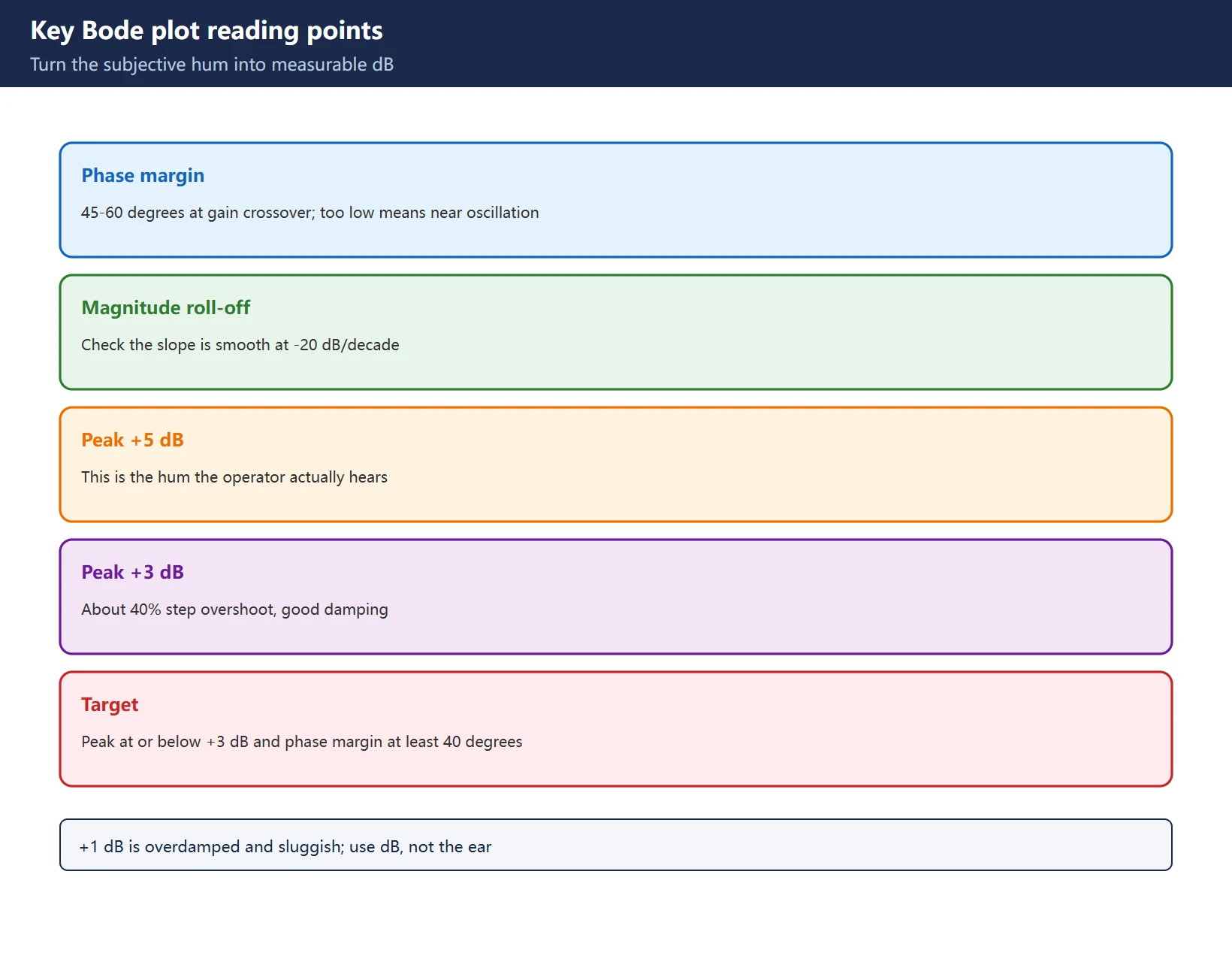
The Bode plot is the “eyes” of this work, with three reading points:
- Phase margin at the gain crossover 45-60 degrees – too little and you are near oscillation;
- Magnitude roll-off at -20 dB/decade – check the slope is smooth;
- Resonant peak in the magnitude trace:
+5 dBis the hum the operator hears,+3 dBmeans about 40% step overshoot and good damping,+1 dBis overdamped and sluggish.
Target: peak at or below +3 dB and phase margin at least 40 degrees. Turning the subjective “it hums” into a measurable dB value gives tuning a basis instead of guesswork by ear.
1.7 p1656 / p1657 notch filter
For a single-frequency sharp peak (one clear spike on the Bode plot), use a notch filter:
- p1656 enable, p1657 type (band-stop / low-pass / feedforward lag), p1658 starting Q factor 2-5;
- single-frequency hum uses band-stop, centre frequency aligned to the Bode peak; broadband hum uses low-pass.
Do not stack filters: every filter adds phase lag. Two band-stops may cancel each other’s resonance, but the accumulated phase lag is enough to destabilise the position loop. Enough is enough – more is not better.
1.8 When tuning cannot help: mechanical problems
If there is no clean resonance peak on the Bode plot, or changing parameters produces no improvement, the problem is probably not parameters: loose bolts, misaligned coupling, worn bearing, poor lubrication. These need mechanical fixes – no parameter set compensates for a structural defect. Check mechanics before talking about tuning.
1.9 Source-of-criteria discipline
This article gives methods and reading rules: sorting, order, p1460/p1462 direction, Bode targets, notch use. It is not a “fill in these values” checklist. Final values come from the p1960 auto-tuning result, the machine’s mechanical behaviour and the OEM’s Kv convention, verified against the manual for your version. Anything that gives you fixed “three parameters to stop servo hum” values without mentioning the machine or measurement should not be copied verbatim.
Frequently Asked Questions
Why does a SINUMERIK 828D motor hum or vibrate, and which parameter do I tune first?
Sort first: speed-loop squeal, mechanical resonance peak, NC-side Kv too high, or a mechanical problem. For a drive-side issue, run p1960 auto-tuning to get well-damped p1460/p1462, then check NC-side Kv – tuning Kv first is the classic wrong order.
What are p1460 and p1462, and which do I change first?
p1460 is the speed-loop proportional gain and p1462 the integral time. On top of auto-tuning, typically reduce p1460 by 10-20% for stability, then increase p1462 by 20-50% for damping, changing one item at a time and re-reading the Bode plot. These are direction guidelines, not absolutes.
What is p1960 auto-tuning and is it mandatory?
p1960 is drive-side auto-tuning: it identifies the mechanical transfer function with small position/speed steps and recomputes p1460/p1462. It is the preferred starting point for drive-side tuning, not optional. Confirm the machine is tight and the load normal first, or the identified model will be inaccurate.
Last updated: 2026-11-19
Where to go next
- FANUC Troubleshooting — the full guide library: alarms, diagnosis numbers, servo, spindle, PMC and electrical faults, organised by symptom.
- CNC Repair Tools — which instrument measures what: multimeters, clamp meters, insulation testers and oscilloscopes, with the specification that actually matters.
- Remote Technical Support — have the readings reviewed with you: alarm reverse lookup, PMC ladder analysis and servo tuning advice by call. Repair companies and integrators welcome.
- Buying & Ownership Decisions — refurbished vs new, used-machine checks, software licensing and manuals: spend with the field facts in hand.
Read the guide, get the right instrument, or walk the diagnosis through with someone — pick whichever you need.






















暂无评论内容