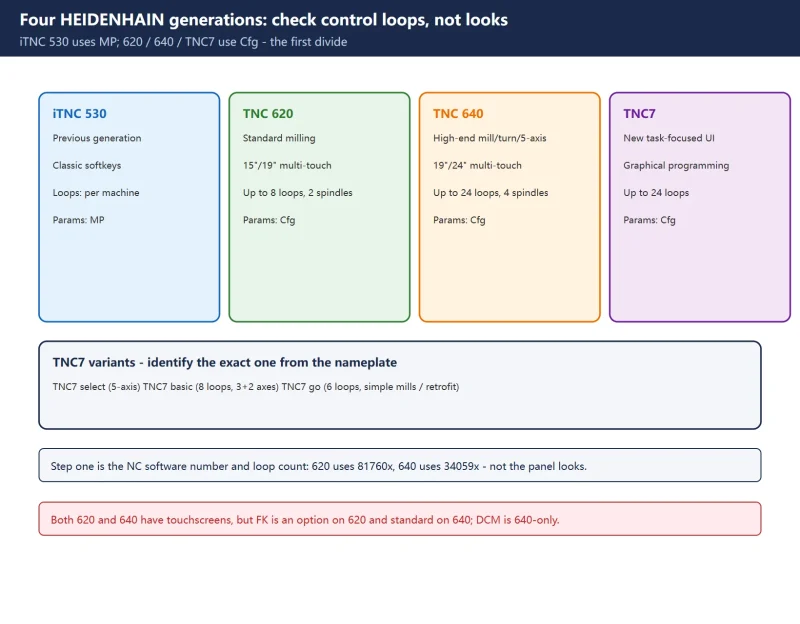



Short answer:
- Parameter divide: iTNC 530 (and the TNC 426 generation) uses MP machine parameters; TNC 620 / 640 / TNC7 use structured configuration objects (Cfg) + machine parameters + table objects;
- Program compatibility: the official TNC7 user brochure states — existing NC programs and tool tables from TNC 640 and TNC 620 can be easily imported into TNC7; programs from older TNC controls also run on TNC7 but may require minor modifications;
- What does not come across automatically: the builder’s PLC program, custom M-codes, machine configuration and option licences.
Generation data, specifications and compatibility statements here come from official HEIDENHAIN product pages (Chinese and English), the TNC 620 brochure, the TNC7 user brochure and the official TNC Transition course outline. Confirm the actual NC software number, enabled options and builder configuration on the machine itself (nameplate / About screen / shipped manuals). Take a full backup before any migration.
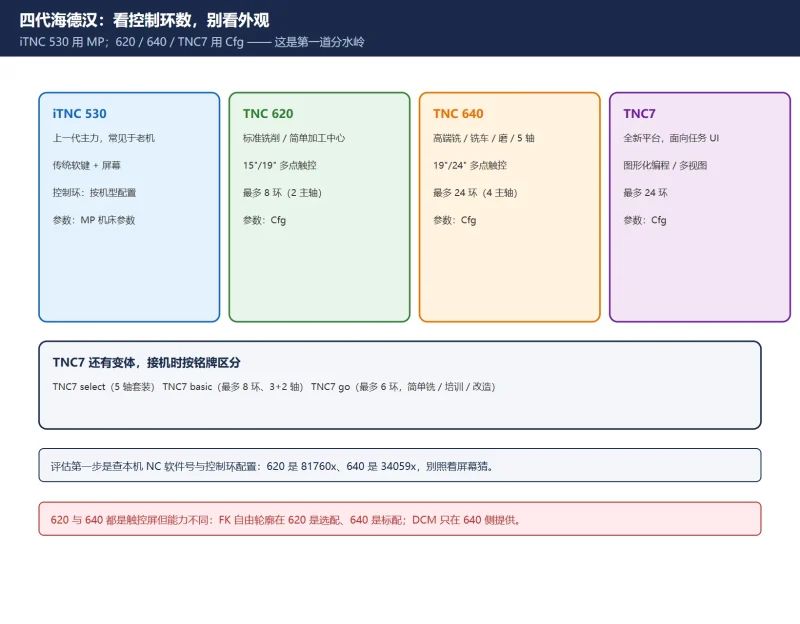
30-second check: identifying the four generations
| Control | Official positioning | Control loops | Interface | Parameters |
|---|---|---|---|---|
| iTNC 530 | Previous-generation mainstay, common on older machines | Per machine config | Classic softkeys | MP |
| TNC 620 | Efficient milling, milling machines / machining centres | Up to 8 (max 2 spindles) | 15″/19″ multi-touch | Cfg |
| TNC 640 | Full-function, milling / mill-turn / grinding / HSC / 5-axis | Up to 24 (max 4 spindles) | 19″/24″ multi-touch | Cfg |
| TNC7 | New platform, task-focused multi-touch UI | Up to 24 | New customisable UI | Cfg |
TNC7 also ships as
TNC7 select(5-axis package),TNC7 basic(compact, up to 8 loops, 3+2 axes) andTNC7 go(simple mills / training / retrofit, up to 6 loops). Identify the exact variant from the nameplate — do not stop at “TNC7”.
1. Four generations: check control loops, not looks
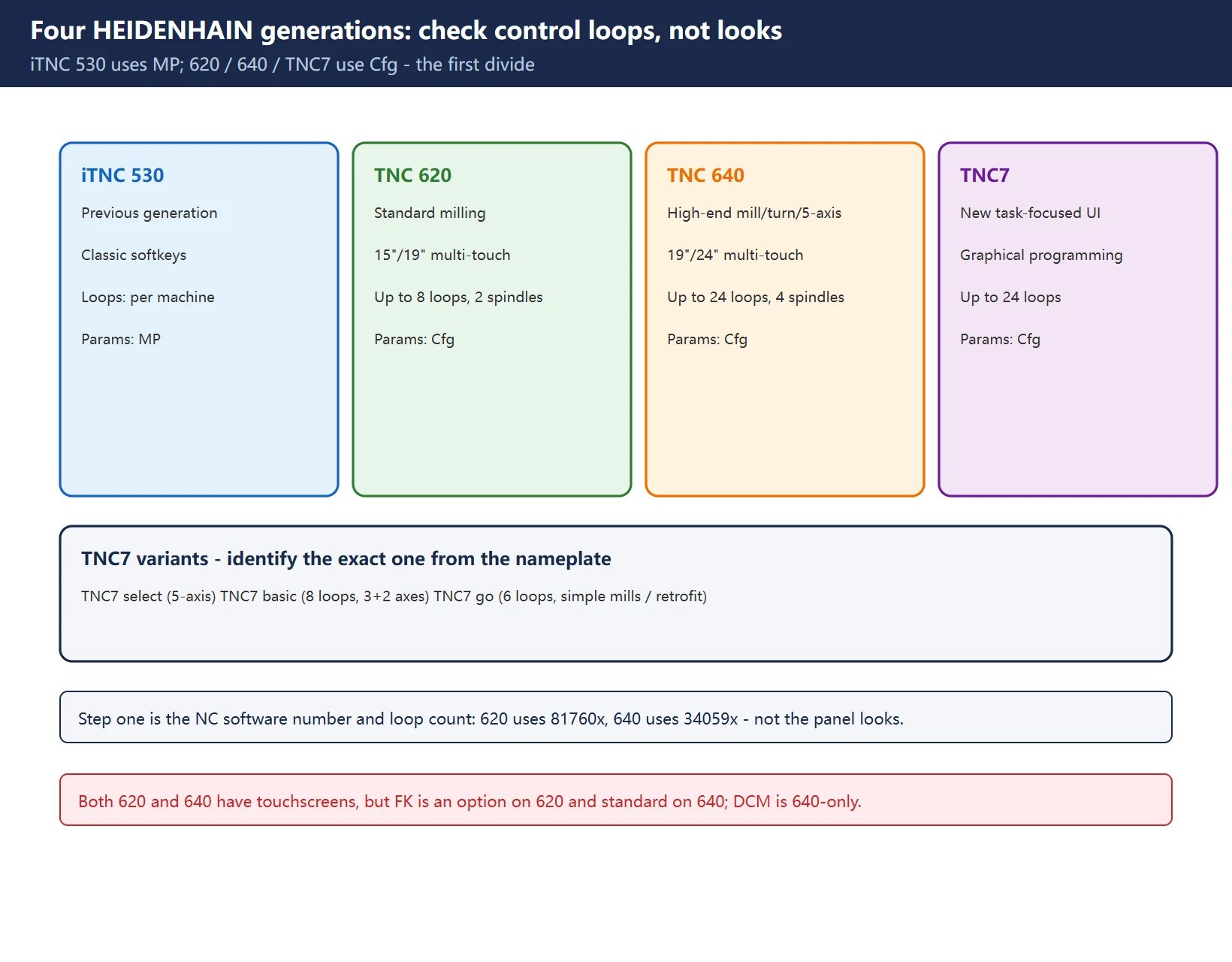
Official HEIDENHAIN product pages state it plainly: TNC 620 is for milling machines and machining centres (up to 8 control loops), TNC 640 for milling, mill-turn and machining centres (up to 24 loops, HSC, 5-axis, gear hobbing / grinding), and TNC7 is a new CNC platform (up to 24 loops, future-oriented user interface, task-focused multi-touch, intelligent probing).
The official TNC 620 brochure includes a direct 620 / 640 comparison, useful for judging a machine’s class:
| Item | TNC 620 | TNC 640 |
|---|---|---|
| Application | Standard milling, simple machining centres | High-end milling / turning / grinding |
| Control loops | Up to 8 (max 2 spindles) | Up to 24 (max 4 spindles) |
| NC software | 81760x | 34059x |
| Block processing time | 1.5 ms (3D line, no radius comp) | < 0.5 ms |
| Screen | 15″/19″ touch | 19″/24″ touch |
| FK free contour programming | Option | Standard |
| Extended milling/drilling cycles, touch-probe cycles | Option | Partly standard |
| DCM, fixture monitoring, KinematicsComp | Not available | Option |
So “both have a touchscreen” does not mean equivalent capability. Step one of any migration assessment is the NC software number and control-loop configuration, not guessing from the panel.
2. The MP to Cfg divide
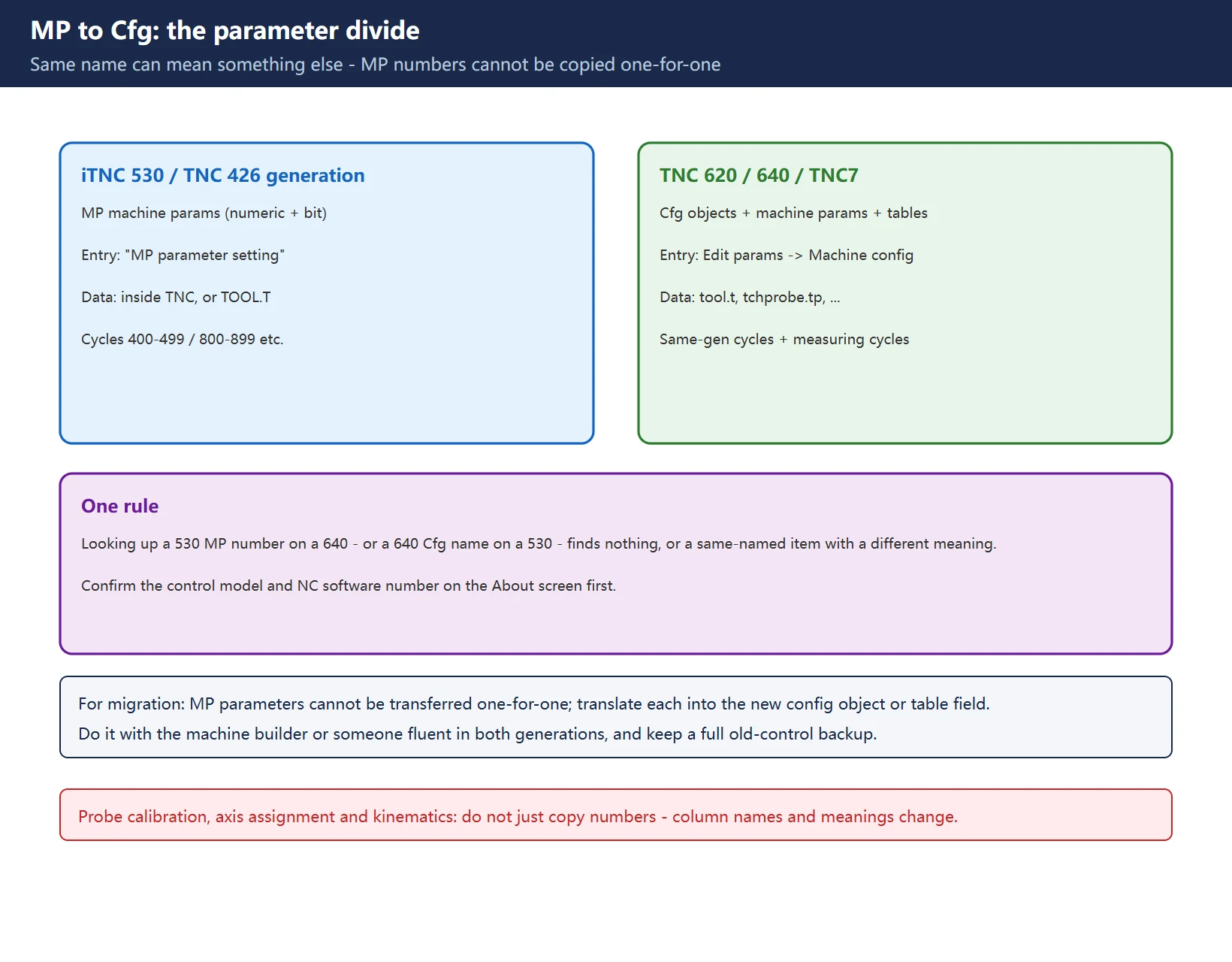
A dedicated article on this site covers the two parameter generations in detail for touch-probe calibration. Migration-wise, the conclusion is:
| Item | iTNC 530 / TNC 426 generation | TNC 620 / 640 / TNC7 generation |
|---|---|---|
| Parameter form | MP machine parameters (numeric + bit) | Structured Cfg objects + machine parameters + table objects |
| Entry | “MP parameter setting” screen | “Edit parameters -> Machine configuration” |
| Where data lives | Inside the TNC, or in TOOL.T etc. per MP setting | Table objects such as tool.t and tchprobe.tp, plus config objects |
| Cycle family | Cycles 400–499 / 800–899 etc. | Same-generation cycles plus high-precision measuring cycles |
One rule: looking up an iTNC 530 MP number on a TNC 640 — or a TNC 640 Cfg name on an iTNC 530 — finds nothing, or finds something with the same name and a different meaning. Confirm the control model and NC software number on the About screen before touching anything.
For migration this means: MP parameters cannot be transferred one-for-one; each must be translated into the new generation’s configuration objects or table fields. Do this with the machine builder or someone fluent in both generations, and keep a complete backup of the old control as reference.
3. Can programs be copied over? The official answer
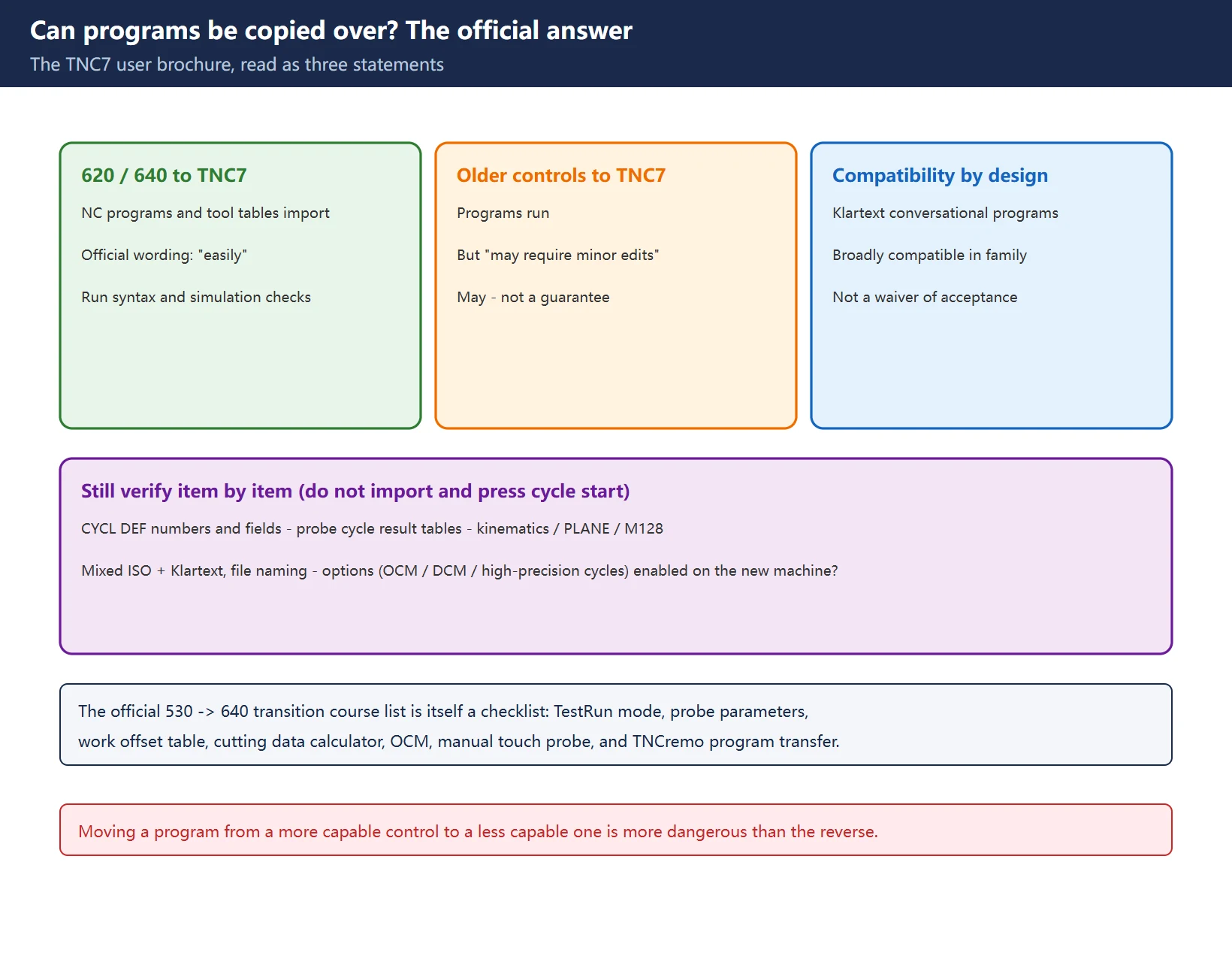
The most reliable statement is the one in the official TNC7 user brochure:
“Existing NC programs and tool tables from the TNC 640 and TNC 620 can be easily imported into the TNC7. Programs from older TNC controls also run on the TNC7, but may require minor modifications.”
Reading it carefully:
- 620 / 640 -> TNC7: programs and tool tables import; HEIDENHAIN explicitly says “easily”;
- Older controls -> TNC7: programs “run, but may require minor modifications” — *may*, not guaranteed;
- The brochure frames this compatibility as a hallmark shared across HEIDENHAIN controls, so Klartext conversational programs are designed to be broadly compatible within the family.
That is still no licence to copy and press cycle start. Differences to verify item by item:
CYCL DEFcycle numbers and parameter fields across generations / software versions;- Probe and measuring cycle fields, and where their result tables live;
- Kinematics and tilted-plane functions (
PLANE,M128and similar); - Mixed ISO / Klartext code, file naming and directory rules;
- Whether options (OCM, DCM, high-precision cycles) are actually enabled on the new machine.
The official TNC Transition course lists the iTNC 530 -> TNC 640 differences as: TestRun mode, probe parameters, work offset table, cutting data calculator, OCM functions, manual touch-probe functions, and connecting HEIDENHAIN controls for program transfers with TNCremo. That course outline is itself a solid migration checklist.
4. Cycles and functions: three layers
| Layer | How to handle it |
|---|---|
| Basic Klartext blocks (lines, arcs, compensation, cycle-call skeleton) | High family compatibility; run syntax and simulation checks after import |
| Cycle definitions and fields (CYCL DEF, probe cycles, OCM) | Check cycle numbers and fields against the new generation; fields can be added or redefined between software versions |
| Options and kinematics (5-axis, DCM, KinematicsOpt/Comp, high-precision cycles) | Check the new machine's option list first; do not use a function that is not enabled |
The official 620 brochure shows FK free contour programming as an option on the 620 but standard on the 640, and DCM / fixture monitoring / KinematicsComp available only on the 640 side. That is a concrete example of the same program having different usability on two machines. Moving a program from a more capable control to a less capable one is more dangerous than the reverse.
TNC7 additionally brings graphical programming (draw / import / edit contours), program comparison, undo, multiple program views and Process Monitoring — workflow improvements, not migration prerequisites.
5. Tool table, pocket table and offsets
Do the tables before the programs:
- Backup first: full old-control backup (programs, tables, configuration, PLC) and a pristine new-control backup;
- Import tables:
TOOL.T/tool.ttool tables, pocket tables, offsets and probe tables such astchprobe.tp. HEIDENHAIN confirms 620/640 tool tables import into TNC7; - Check fields: radius/length columns, probe calibration values (radius, centre offset, spindle angle) — column names and positions may differ in the new generation, and calibration data usually needs re-confirming rather than just copying numbers;
- Then import programs: start with one representative program and validate syntax and simulation;
- Finally check presets and the work offset table: presets, fixtures and coordinate systems are as easy to miss as the programs.
6. PLC, builder M-codes and configuration
This is the layer most often forgotten and least likely to migrate automatically:
- Builder PLC program: a control swap is a platform change; the PLC must be re-adapted and commissioned by the machine builder;
- Builder-defined M-codes: tool change, fixtures, chip conveyor, coolant, door interlocks — numbers and meanings are builder-defined and do not follow the NC program;
- Machine configuration and options: axis assignment, kinematics, probes, magazine, safety integrated — all re-commissioned on the new control;
- Licences: options purchased for the old control do not automatically transfer.
So a “control upgrade” is never just a new panel. Acceptance must exercise every custom M-function individually, not just one machining program.
7. Migration acceptance checklist
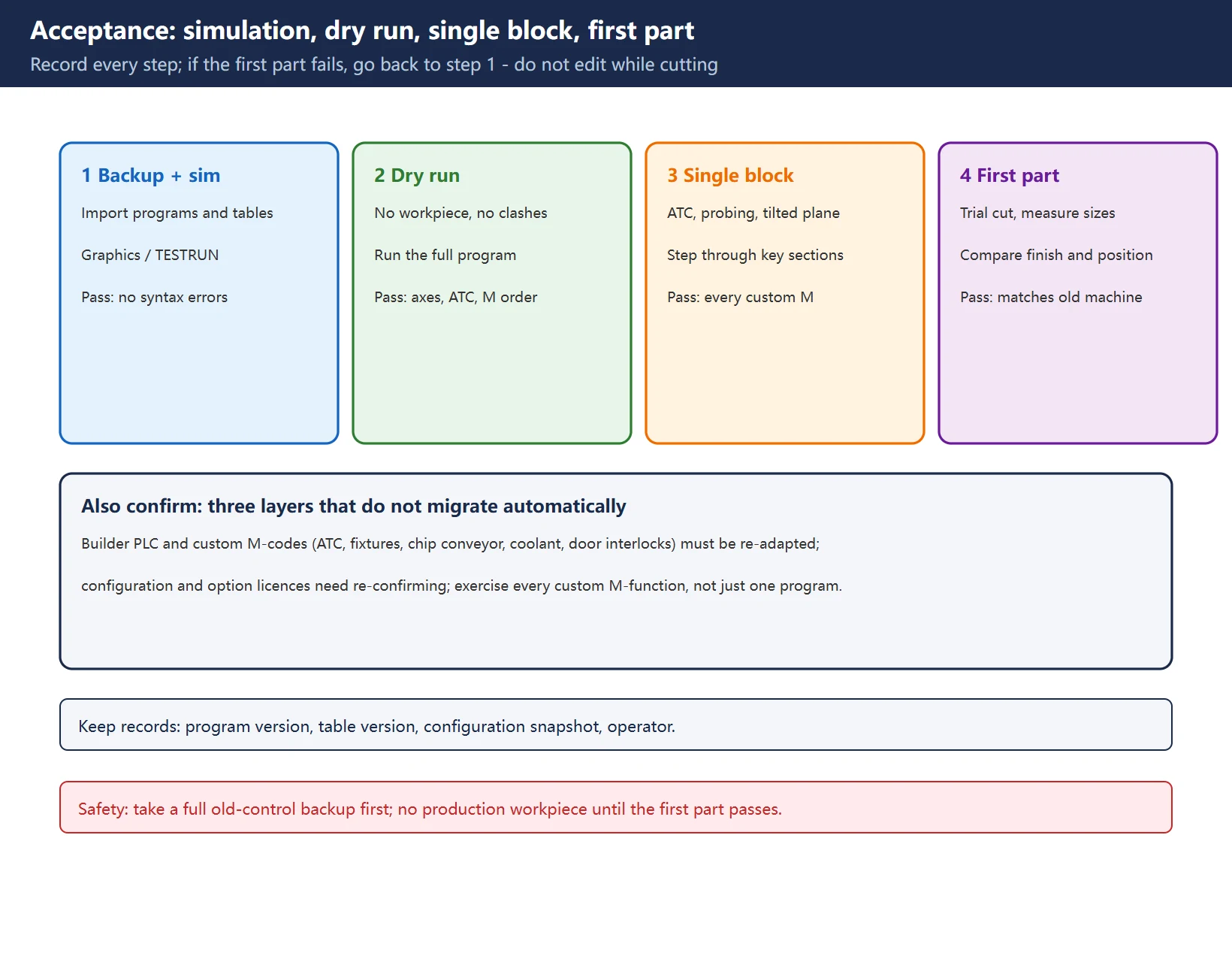
| Step | What | Pass condition |
|---|---|---|
| 1 Backup + simulation | Import programs and tables, run graphics / TESTRUN | No syntax errors, no missing cycle parameters, correct toolpath |
| 2 Dry run | No workpiece, no interference, run the full program | Axes, tool changes and M-function order correct |
| 3 Single block | Step through critical sections (tool change, probing, tilted plane) | Each custom M and probe cycle behaves as expected |
| 4 First part | Trial cut, measure critical dimensions and finish | Size, position and finish match the old machine |
Keep records at each step (program version, table version, configuration snapshot, operator). If the first part fails, go back to step 1 — do not edit the program while the machine is cutting.
Frequently Asked Questions
Can an iTNC 530 program simply be copied to a TNC 640 and run?
Do not assume it. HEIDENHAIN states that TNC 640/620 NC programs and tool tables import easily into TNC7, and that programs from older TNC controls also run on TNC7 but may require minor modifications — note the “may”. For a cross-generation move such as 530 to 640, verify CYCL DEF numbers and parameter fields, probe cycles, kinematics functions (tilted plane), mixed ISO/Klartext code, and whether the required options are enabled; then complete simulation, dry run, single block and first-part acceptance.
I cannot find MP parameters on a TNC 640 — where do I change them?
The generations differ: iTNC 530 uses MP machine parameters (the “MP parameter setting” screen), while TNC 620/640/TNC7 use structured Cfg objects plus machine parameters and table objects, reached via “Edit parameters -> Machine configuration” (probes also via the MOD menu). MP numbers cannot be copied one-for-one; translate each into the new configuration object or table field, and confirm the control model and NC software number on the About screen first. The touch-probe calibration article on this site has a full two-generation comparison.
Are builder-defined M-codes lost after a control swap?
At minimum, do not assume they survive. Custom M-functions for tool change, fixtures, chip conveyor, coolant and door interlocks are defined in the builder’s PLC program; the PLC and machine configuration must be re-adapted to the new control, the M-codes do not follow the NC program automatically, and option licences need re-confirming. Acceptance should exercise every custom M-function individually (dry run plus single block), not just a single part program.
Last updated: 2026-11-07
HEIDENHAIN Touch Probe Calibration: iTNC 530 MP vs TNC 640 Cfg
TCH PROBE 31 / 481: Parameters and MP vs Cfg Differences
HEIDENHAIN TNC Tool Management – tool_p.tch + TOOL.T
HEIDENHAIN TNC Conversational Programming for Beginners
HEIDENHAIN TNC Block Quick Reference
HEIDENHAIN TNCremo / TNCcmd Program Transfer
Where to go next
- FANUC Troubleshooting — the full guide library: alarms, diagnosis numbers, servo, spindle, PMC and electrical faults, organised by symptom.
- CNC Repair Tools — which instrument measures what: multimeters, clamp meters, insulation testers and oscilloscopes, with the specification that actually matters.
- Remote Technical Support — have the readings reviewed with you: alarm reverse lookup, PMC ladder analysis and servo tuning advice by call. Repair companies and integrators welcome.
Read the guide, get the right instrument, or walk the diagnosis through with someone — pick whichever you need.
The original Chinese version — same procedure, with the full field notes.
















暂无评论内容