


Sister article: SINUMERIK 828D Tool Management NC-PLC Interface Explained: DB4300 Job/Acknowledge and Change Steps; related: 828D User Alarm Bits: DB1600, 828D Extended User Alarms: DB9913, 828D PLC Programming Tool: FB1/FB2/OB100.
19.1 DB4300 bit field: NCK-to-PLC job / PLC-to-NCK acknowledgment
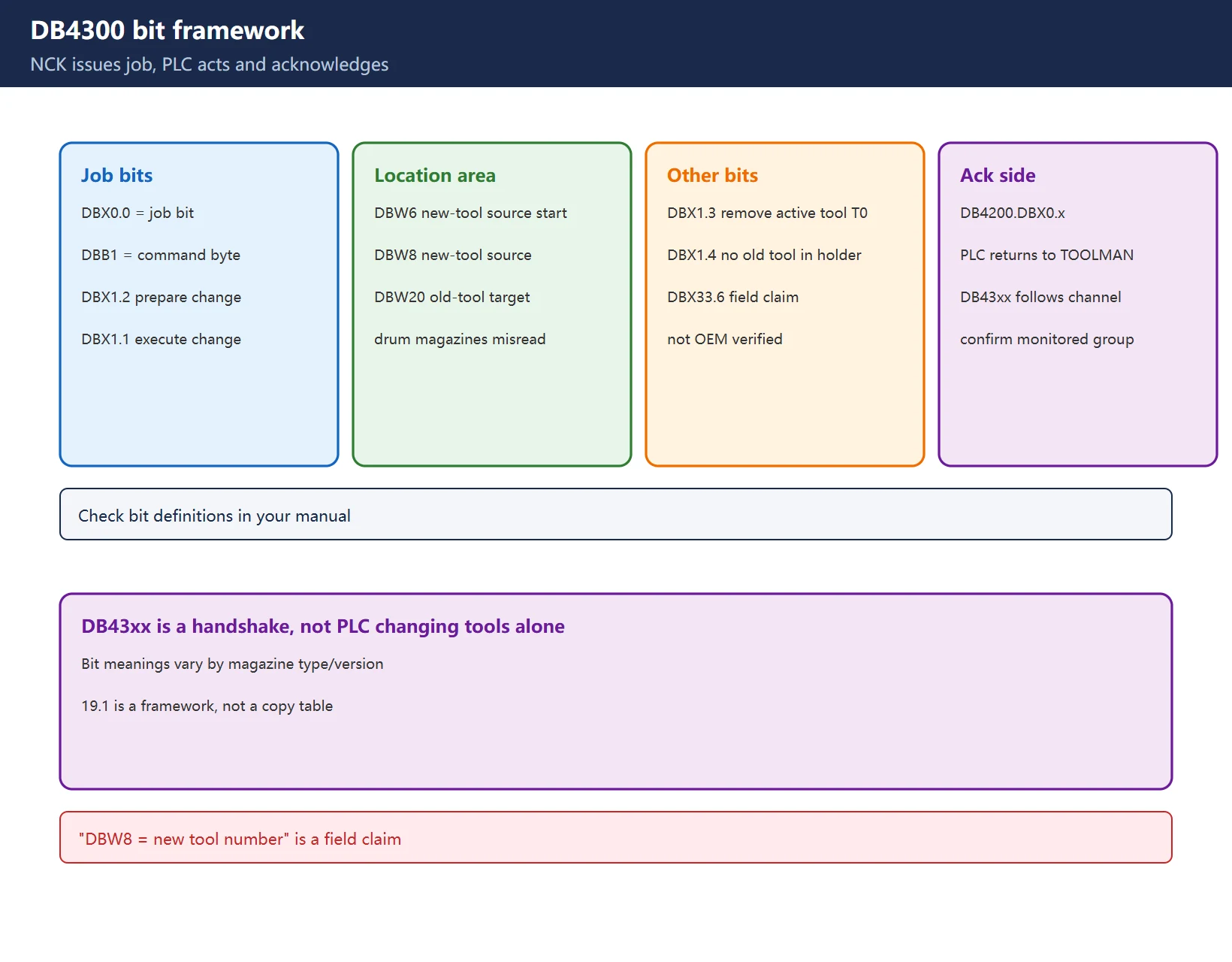
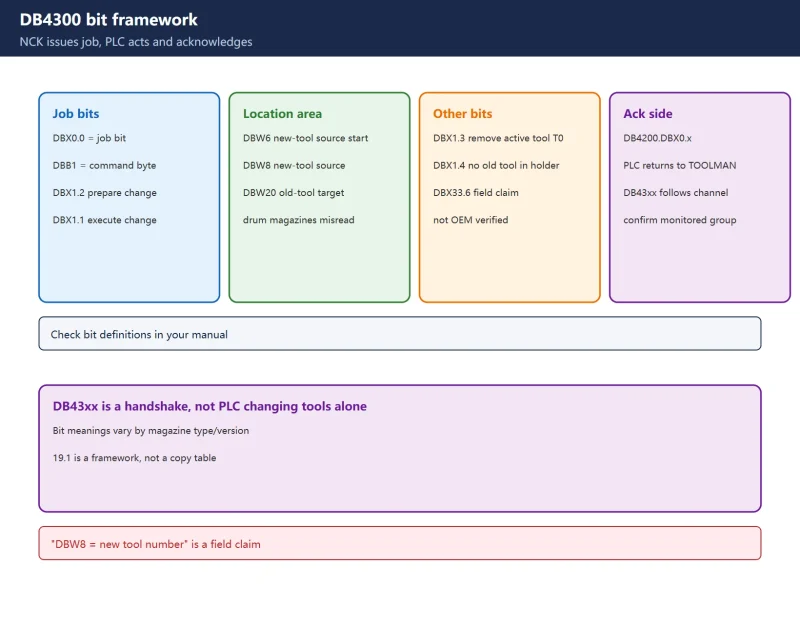
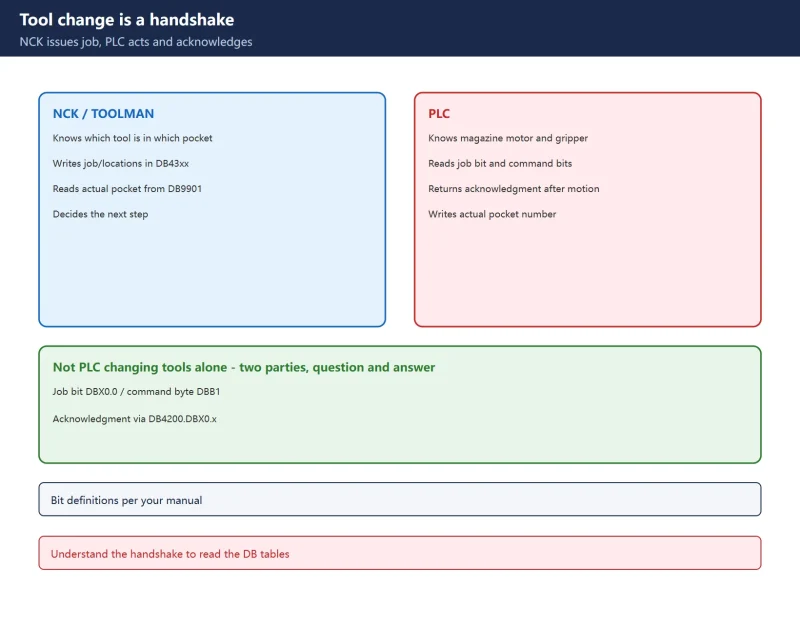
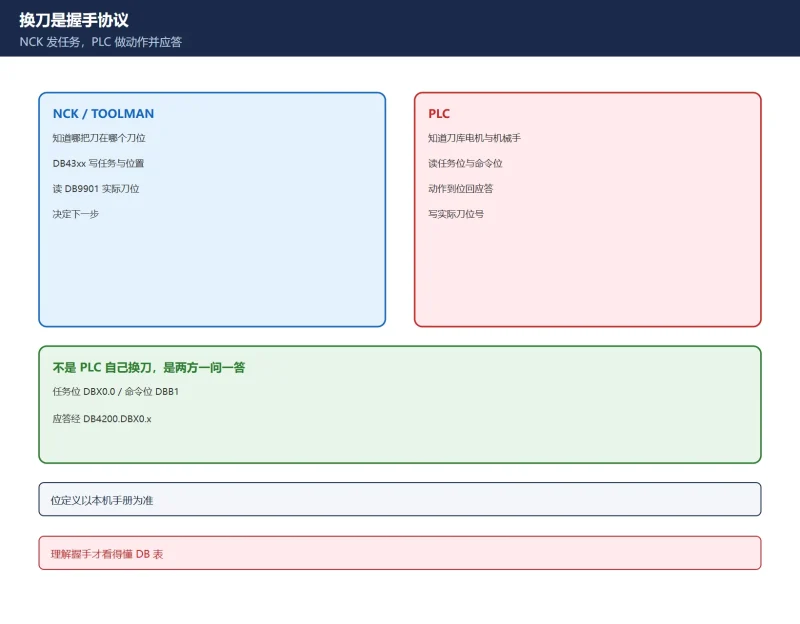
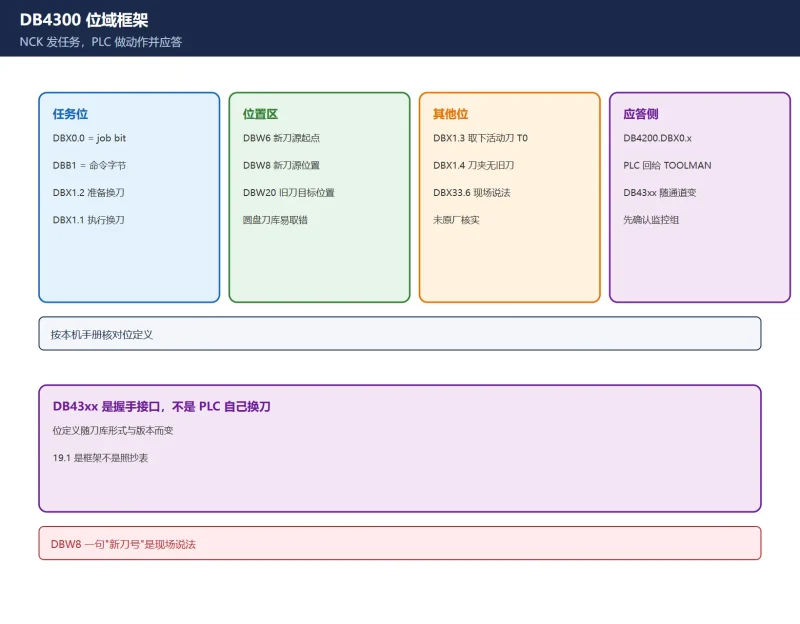
DB43xx is the interface block numbered by channel/magazine (DB4300 is the first group). A tool change is a handshake: NCK issues the job, PLC performs the motion, PLC returns the acknowledgment – the PLC does not change tools on its own. Addresses below come from the 828D commissioning manual section 9.8 milling-machine example.
Table 1 DB4300 (DB43xx) job/acknowledgment bit field
| Address | Type | Meaning | Writer / Reader |
|---|---|---|---|
DBX0.0 | BOOL | Job bit; 1 means NCK has issued a tool-change job | NCK writes / PLC reads |
DBB1 | BYTE | Command bits | NCK writes / PLC reads |
DBX1.2 | BOOL | Prepare change | NCK writes / PLC reads |
DBX1.1 | BOOL | Execute change | NCK writes / PLC reads |
DBX1.3 | BOOL | Whether the active tool in the spindle is to be removed (T0) | NCK writes / PLC reads |
DBX1.4 | BOOL | No old tool in the tool holder | NCK writes / PLC reads |
DBW6 | INT | Start of the new-tool source / old-tool target location range | NCK writes / PLC reads |
DBW8 | INT | Official 9.8 example: new-tool location (source); field reports also write “new tool number” – see 19.4 | NCK writes / PLC reads |
DBW20 | INT | Official 9.8 example: old-tool target location; easily misread on the second change with drum magazines | NCK writes / PLC reads |
DBX33.6 | BOOL | Field-reported “1:1 exchange request flag” – not directly verified in the original manual; drum-magazine cases say it must stay Low | field reports, use with care |
Reading rule: the xx in DB43xx follows the channel, so first confirm which group you are monitoring. Bit meanings change with the magazine type (umbrella/chain/gripper/turret) – 19.1 is an interface framework, not a bit table to copy blindly.
19.2 DB9900 / DB9901 / DB9902: the three transfer tables
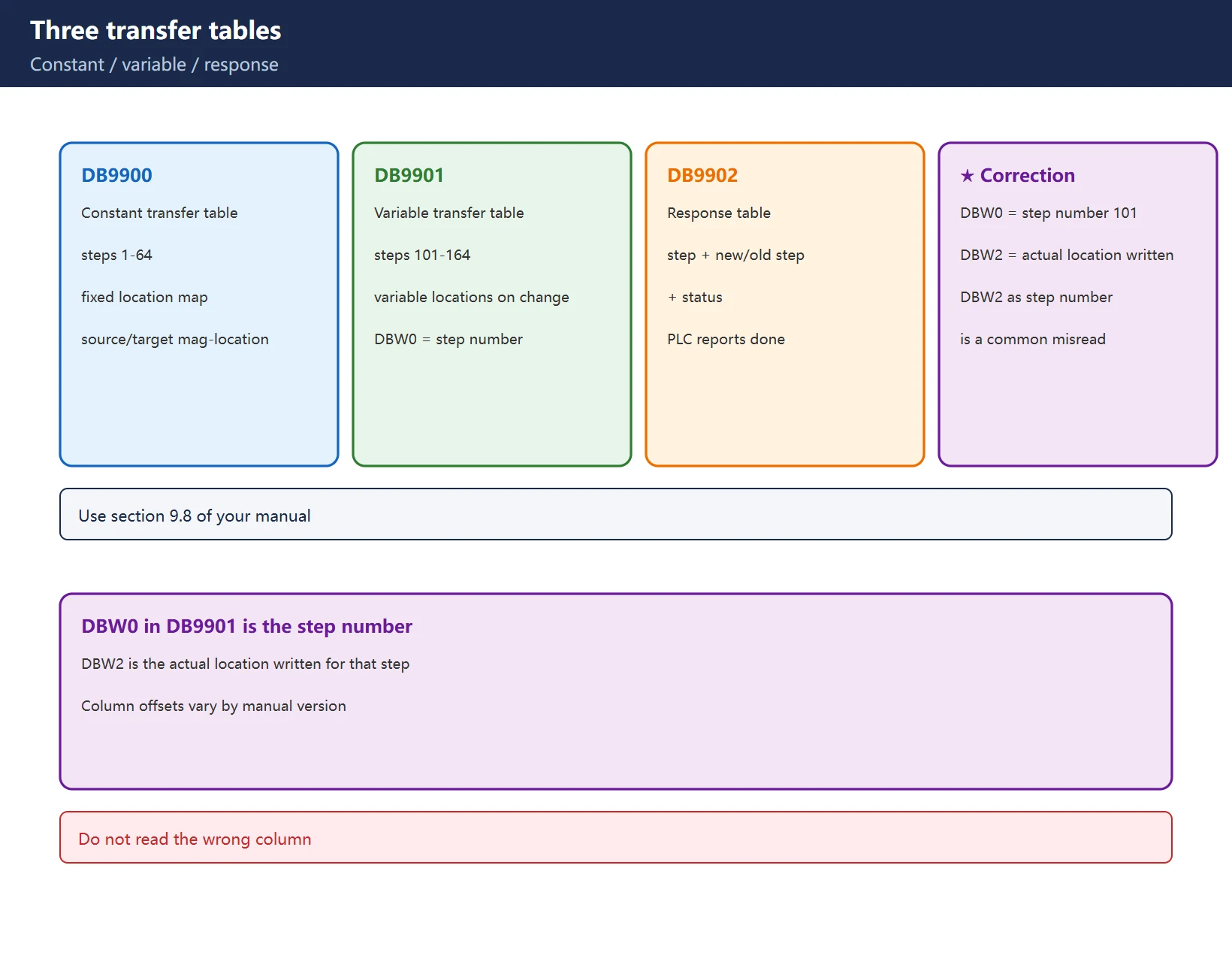
All three tables live on the PLC side and carry “step – magazine – location – acknowledgment” between tool management (TOOLMAN) and the PLC: DB9900 constant transfer table / DB9901 variable transfer table / DB9902 response table. They define all possible states of tools or magazines.
Table 2 DB9900 / DB9901 / DB9902 roles
| Table | Name | Structure (per 828D manual 9.8 / field notes) | Typical use |
|---|---|---|---|
| DB9900 | Constant transfer table | Step number + source magazine + source location + target magazine + target location; steps 1-64, from DBW0/DBW2/DBW4/DBW6 | Fixed location mapping |
| DB9901 | Variable transfer table | Same structure; steps 101-164, from DBW0/DBW2/DBW4/DBW6 | Variable location transfer during a change |
| DB9902 | Response table | Step number + step to acknowledge (new tool) + step to acknowledge (old tool) + status; from DBB0/DBB1/DBB2 | PLC reports “this step is done” |
★ Correction: do not swap DBW0 and DBW2 in DB9901
- The official 9.8 example states: the target location is read from DB4300.DBW8 and written to DB9901.DBW2 (transfer step 101); in the DB9901/DB9902 tables the step-number column is DBW0 (value 101, etc.).
- So: DBW0 = step number (101); DBW2 = the actual location number (n not 0) written by the PLC for that step. Reading DBW2 as “the step number” misreads the column and is a common field misjudgment.
- Column offsets differ slightly between manual versions – check section 9.8 of the manual for your own version.
The actual location write-back happens at DB9901.DBW2: the PLC writes the real magazine location after positioning, and TOOLMAN updates the magazine view from it.
19.3 ★ Transfer step number to acknowledgment step number
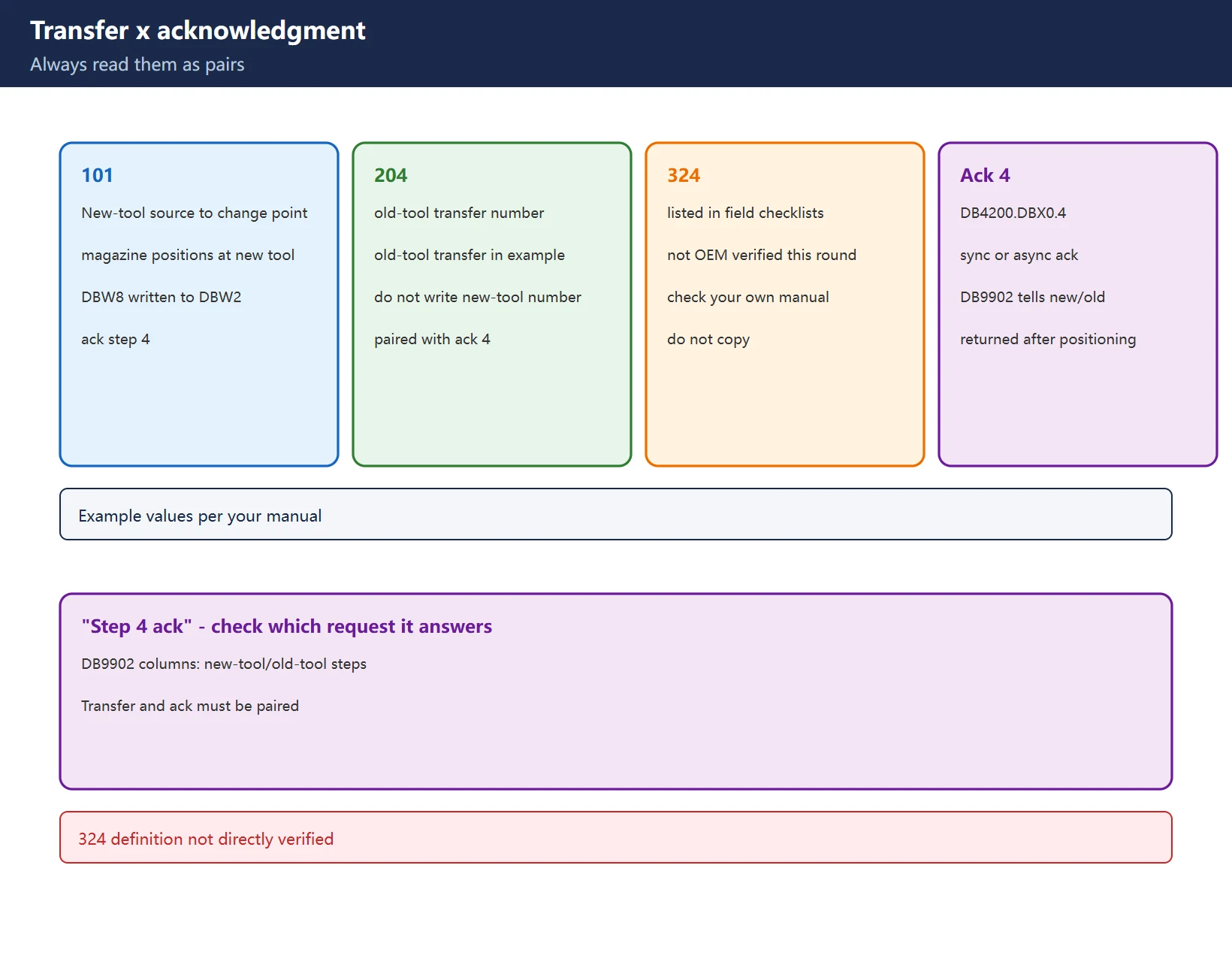
Every change step is a pair of “request step number + acknowledgment step number”. The table is taken from the 828D commissioning manual 9.8 milling-machine example, with row-level anchors for direct citation.
Table 3 Transfer steps to acknowledgment steps (example values, subject to your manual)
| Request step | Meaning | Acknowledgment | Note |
|---|---|---|---|
101 | New-tool source location to change point (magazine positions at the new tool) | Acknowledgment step 4, bit DB4200.DBX0.4 | DB4300.DBW8 written to DB9901.DBW2 |
204 | Old-tool-related transfer step (appears as the old-tool transfer number in the example) | Paired with acknowledgment step 4 | Do not write the new-tool number here |
324 | Step number often listed in field checklists | Warning: its independent definition was not directly verified in the official manual excerpt this round | Check your own manual, do not copy |
4 | Acknowledgment step | Acknowledged by DB4200.DBX0.4, sync or async | Returned to TOOLMAN after positioning |
Pairing rule: always read the transfer number and its acknowledgment together; when you see “step 4 acknowledged”, confirm whether it answers 101 or another request. The “step to acknowledge (new tool / old tool)” columns in DB9902 are the discriminator.
19.4 1:1 exchange versus two-step change: signal differences
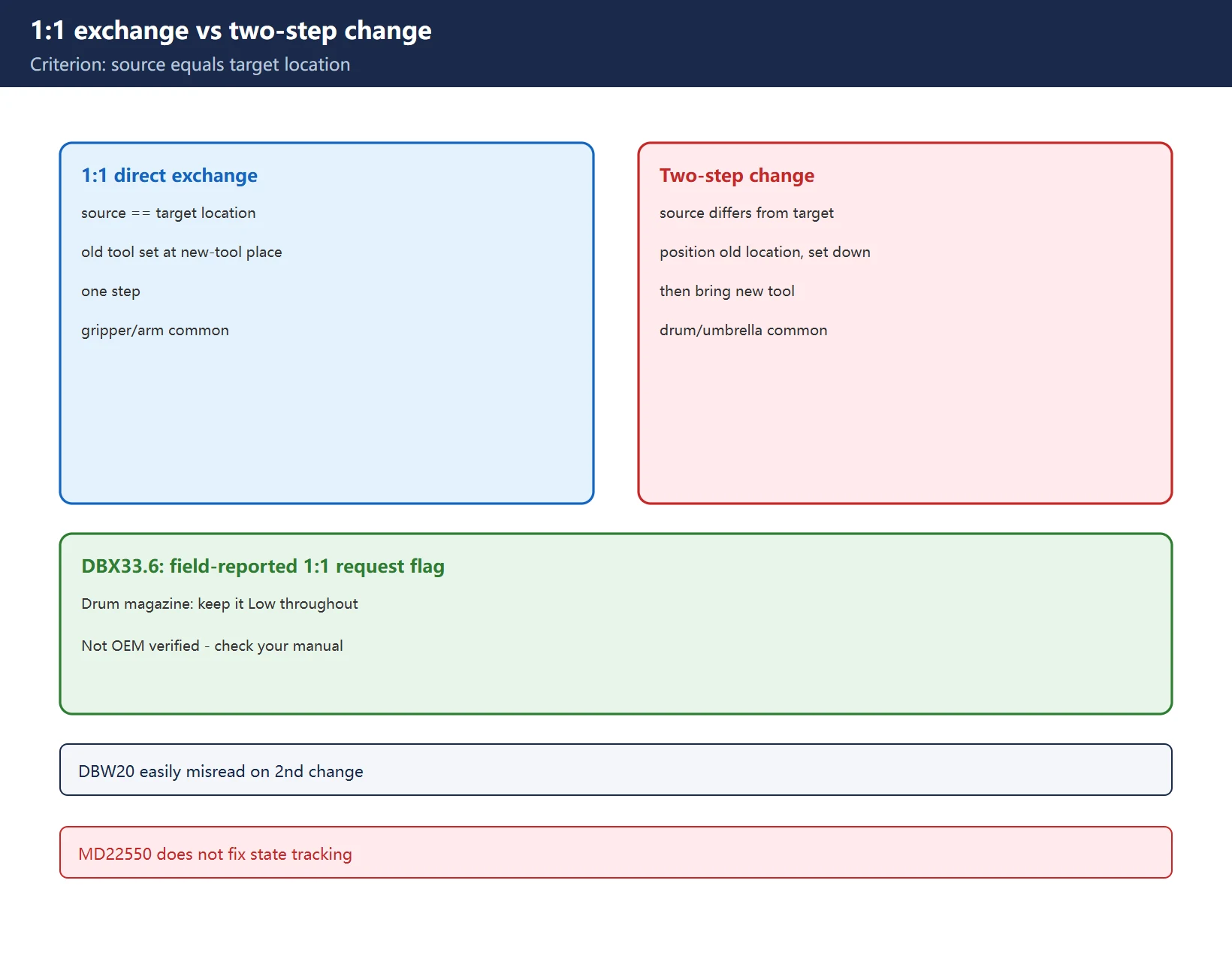
- 1:1 direct exchange: source location equals target location (new-tool source = old-tool target); the old tool is set down at the new tool’s location in one step. Common on gripper magazines.
- Two-step change: source differs from target; the magazine first positions the old-tool location at the change point to set the old tool down, then brings the new tool to the spindle. Common on drum/umbrella magazines.
DBX33.6: field notes call it the 1:1 exchange request flag – drum magazines are reported to require it Low throughout. This bit was not directly verified in the original manual – check your own manual.
Table 4 1:1 versus two-step criteria (per your magazine type)
Drum-magazine second-change trap: a field case (third-party compilation) reports that on the second change DBW8 and DBW20 were both written with the new-tool number, DBX33.6 toggled falsely and the event was misread as a 1:1 exchange; the reported root cause was the NCK tool-change state machine entering an unexpected state after the first change, and that changing MD22550 does not fix state tracking – MAG_CONF.MPF must be run to reinitialize. This is a field-reported case to cross-check against your own manual, not an original-manufacturer conclusion.
19.5 Related machine data index (what it governs only; no bit definitions)
| Machine data | What it governs |
|---|---|
MD22550 $MC_TOOL_CHANGE_MODE | Tool-change mode / M-function enable; meaning varies with magazine type |
MD18080 $MN_MM_TOOL_MANAGEMENT_MASK | Tool management function mask (bit-coded); related bits also in MD20310 |
MD22560 / MD22562 | Tool-change M function code (e.g. M206); values per machine |
MD10715 / MD10716 | M code / subprogram name that calls the change subprogram (e.g. L6) |
MD20310 $MC_TOOL_MANAGEMENT_MASK | Channel-level tool management mask (T = location programming, PLC simulated acknowledge, etc.) |
MD52270 $MCS_TM_FUNCTION_MASK | Tool management function mask (create tool, hide relocate, hide magazine positioning, etc.) |
Table 5 Related machine data index (bit definitions vary by magazine type – check your own manual)
No hard-coded bit values: MD18080 / MD20310 / MD52270 are all bit-coded and their meanings vary by software version and magazine type. This page lists only “what it governs”; the specific bits are per your own manual.
19.6 Sources and compliance note
- Sources: Siemens “SINUMERIK 828D Tool Management Function Manual” (A5E48765003F) and “SINUMERIK 828D Commissioning Manual” section 9.8 milling-machine example (publication 6FC5397-3DP40-5BA3).
- Compiled by this site on 2026-11-19. Step numbers and bit definitions are subject to the official manual of the corresponding version; DBX33.6 and “DBW8 = new tool number” are field-reported claims, flagged individually and not original-manufacturer conclusions.
- Compliance: interface definitions and step numbers are quoted for troubleshooting reference only; no manual body text is reproduced and no Toolbox image or download link is provided. For official software and manual entry points see related articles above.
Frequently Asked Questions
Which DB blocks must the PLC implement for 828D tool management, and what does each do?
The core is a DB43xx job/acknowledgment interface block (e.g. DB4300, the NCK-to-PLC handshake) plus three transfer tables: DB9900 constant transfer table, DB9901 variable transfer table and DB9902 response table. Addresses and bit definitions vary by magazine type and software version – check your own manual.
Where are the job bit and acknowledgment bit in DB4300?
The job bit is DBX0.0, and the command byte is DBB1 (including DBX1.2 prepare change and DBX1.1 execute change); PLC acknowledgment returns to tool management via bits such as DB4200.DBX0.x. The xx in DB43xx follows the channel, so confirm which group you are monitoring.
How do transfer step numbers pair with acknowledgment step numbers?
Transfer numbers (e.g. 101 new-tool positioning, 204 old-tool related) come in pairs with acknowledgment numbers; in the example acknowledgment step 4 is given by DB4200.DBX0.4. The “step to acknowledge (new tool / old tool)” columns in DB9902 are the discriminator. Warning: DBW0 in DB9901 is the step number and DBW2 is the written-back location – do not swap them; example step values are subject to your own manual.
Last updated: 2026-11-19
Beyond the DB quick reference: tool management NC-PLC interface explained
Where to go next
- FANUC Troubleshooting — the full guide library: alarms, diagnosis numbers, servo, spindle, PMC and electrical faults, organised by symptom.
- CNC Repair Tools — which instrument measures what: multimeters, clamp meters, insulation testers and oscilloscopes, with the specification that actually matters.
- Remote Technical Support — have the readings reviewed with you: alarm reverse lookup, PMC ladder analysis and servo tuning advice by call. Repair companies and integrators welcome.
- Buying & Ownership Decisions — refurbished vs new, used-machine checks, software licensing and manuals: spend with the field facts in hand.
Read the guide, get the right instrument, or walk the diagnosis through with someone — pick whichever you need.

















暂无评论内容