


🚨 Scope and compliance: Current figures come from the official FANUC catalogue
FS30i-B(C)-09(Chinese), the FANUC Japan product page for30i/31i/32i/35i-MODEL B, the FANUC Taiwan equivalent, and the FANUC America0i-F Plusproduct page. Earlier figures come from the public FANUC America English brochurefanuc_30ib_low.pdf. Rows tagged “third party” come from a public machine-tool comparison site and are used only to show how the same metric gets sliced differently; they are not acceptance criteria. All axis counts, path counts, interpolated axes, program memory, PMC steps, I/O points and look-ahead figures are maximum ceilings, not the configuration of any specific machine. Real capability depends on the order number, option licences, software version and the machine tool builder specification. Manual text, specification legends and order-number matrices are copyright material: this page gives the framework and the lookup path only, reproduces no original text, and provides no manual download link, file mirror or packaged archive. Before any purchase, retrofit or spare-part decision, verify against the nameplate, the supplied specification sheet, the order list and written confirmation from the machine builder. Nothing here is a selection or modification instruction.
30-Second Triage: Which Number Do You Actually Need
Table 0. Seven needs and the first decision line
1. Two Official Specification Sets
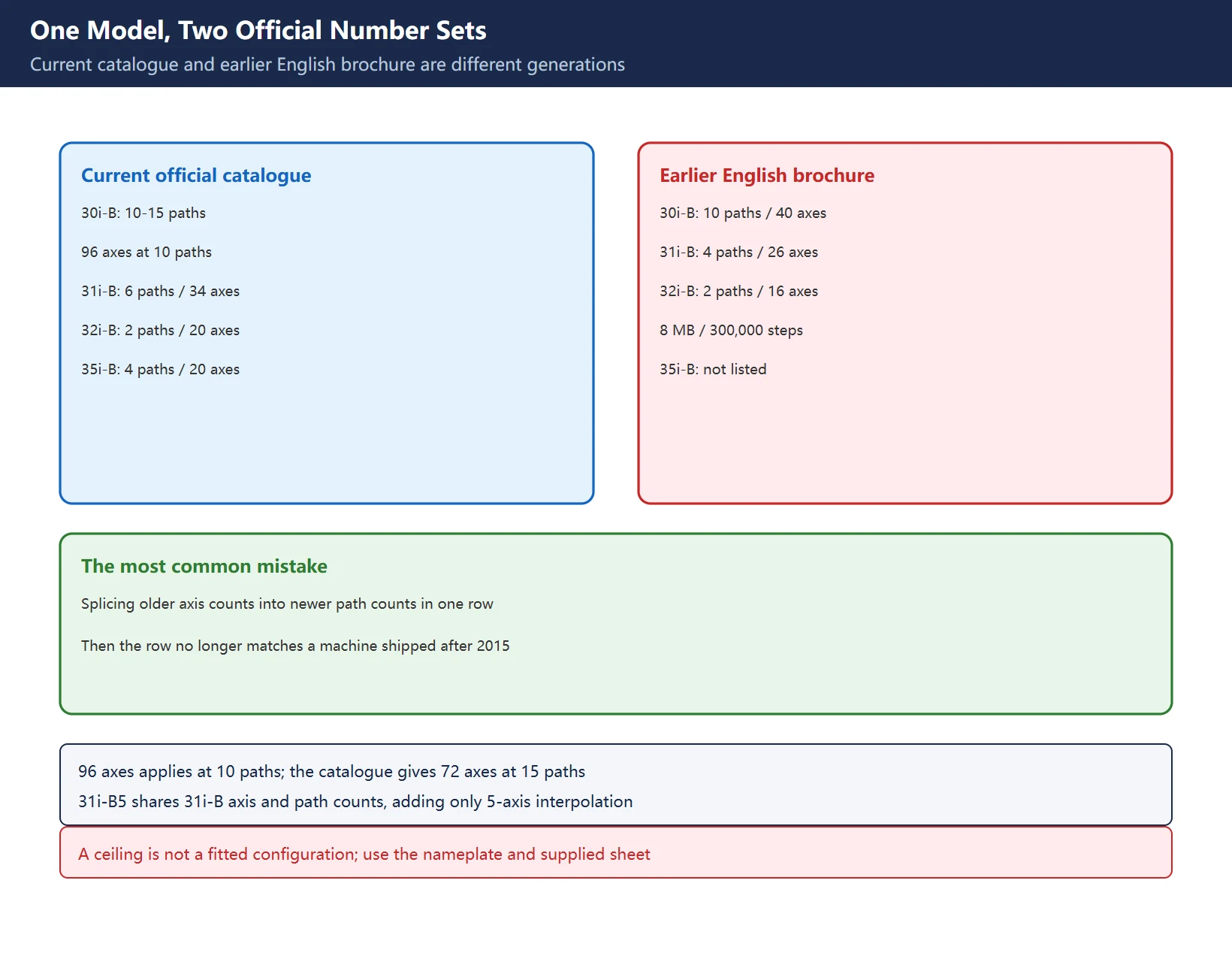
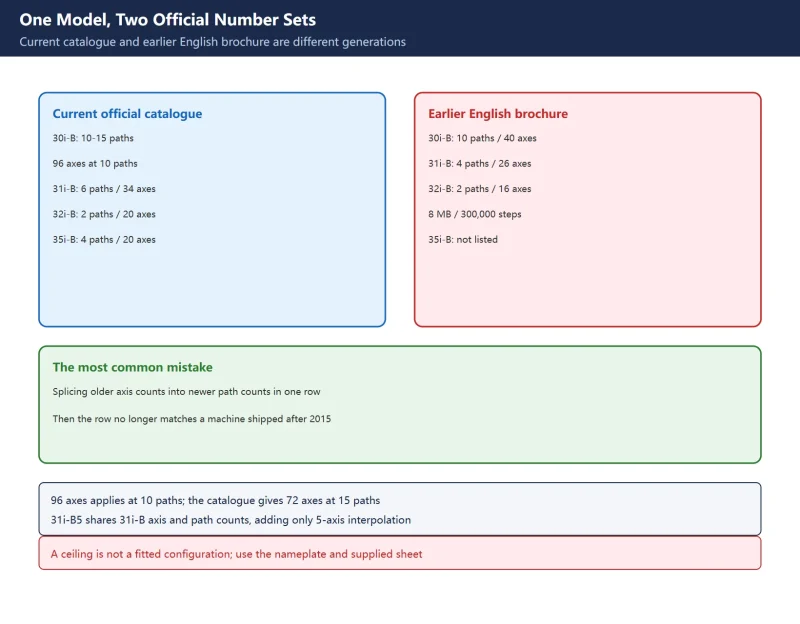
The difference becomes obvious once both documents are opened. FANUC Japan labels the 30i series as redesigned in April 2015, and the current catalogue carries noticeably higher axis and path ceilings, while the earlier FANUC America brochure still lists the previous generation.
| Model | Current official catalogue (paths / axes / interpolated) | Earlier English brochure (paths / axes / interpolated) | Official positioning |
|---|---|---|---|
| 30i-B | 10-15 paths; 96 axes (72 feed + 24 spindle) at 10 paths, 72 axes (56 + 16) at 15 paths; 24 interpolated | 10 paths; 40 axes (32 feed + 8 spindle); 24 interpolated | High-performance multi-axis, multi-path, with 5-axis machining |
| 31i-B | 6 paths; 34 axes (26 feed + 8 spindle); 4 interpolated | 4 paths; 26 axes (20 feed + 6 spindle); 4 interpolated | Core high-end model for lathes and machining centres |
| 31i-B5 | 6 paths; 34 axes; 5 interpolated | 4 paths; 26 axes; 5 interpolated | 31i-B plus simultaneous 5-axis control |
| 32i-B | 2 paths; 20 axes (12 feed + 8 spindle); 4 interpolated | 2 paths; 16 axes (10 feed + 6 spindle); 4 interpolated | Standard model for conventional lathes and machining centres |
| 35i-B | 4 paths; 20 axes (16 feed + 4 spindle); 4 interpolated | Not listed in the earlier brochure | Transfer line CNC with strong PMC function |
| 0i-MF / 0i-TF | Listed separately on the current 0i-F Plus page (max 4 axes per path) | Third-party comparison says 11 / 9 axes (total / per path) | Basic general-purpose models |
Table 1. Two official generations: read axis and path counts as a pair
Three details must be read together. First, 96 axes for the 30i-B applies at 10 paths; the official catalogue gives 72 axes at 15 paths, so writing “96 axes / 15 paths” is wrong. Second, the only stated difference between 31i-B5 and 31i-B is simultaneous 5-axis control; axis and path counts are identical, so treating the B5 as a “larger” model is a misreading. Third, the current catalogue also uses the label 32i-B PLUS, and suffix variants do not share specifications. Third-party reprints of the current catalogue (FANUC Taiwan resellers, machine-tool portals) repeat “10-15 paths / 96 axes” and are useful as cross-checks, but the official PDF remains authoritative.
2. The Fourteen-Item Comparison Table: Framework, Not Invented Numbers
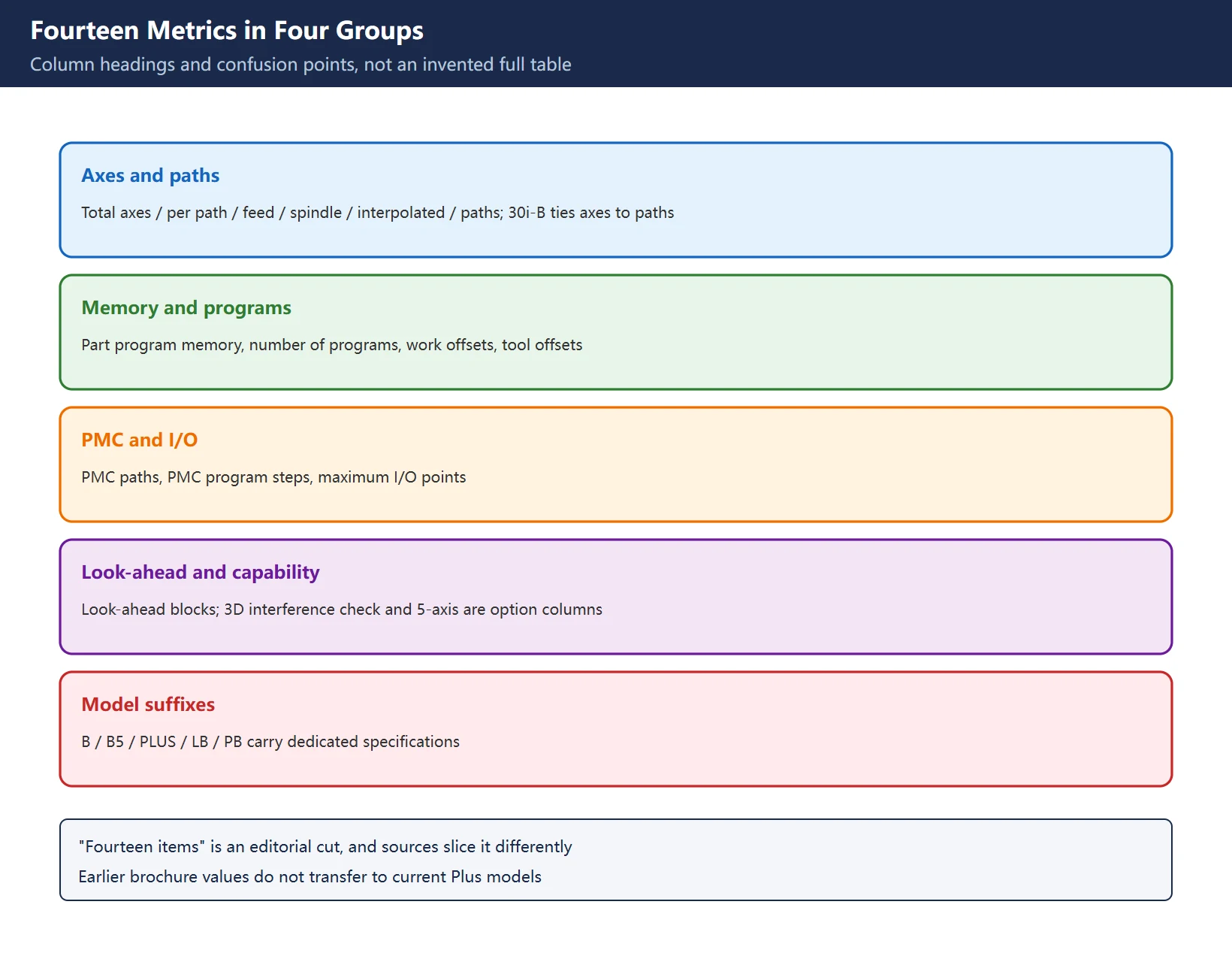
“Fourteen hard indicators” is an editorial cut, not an official grouping: some sources list built-in 3D interference check and native 5-axis as separate rows, others fold them into options. Rather than assemble a table guaranteed to go stale, this page lists each metric’s official column heading and its most common confusion.
| # | Metric | Official column heading | Common confusion |
|---|---|---|---|
| 1 | Max total controlled axes | Max. total number of control axes | A ceiling, not fitted axes; path-dependent on 30i-B |
| 2 | Max axes per path | Max. controlled axes (total / per path) | Third-party tables use a two-value “total / per path” cell |
| 3 | Max feed axes | Max. number of servo / feed axes | Not the same column as total axes |
| 4 | Max spindle axes | Max. number of controlled spindle axes | Often double-counted inside total axes |
| 5 | Simultaneously interpolated axes per path | Max. number of simultaneously interpolated axes | Not the same as “5-axis machining function” |
| 6 | Max controlled paths | Max. number of controlled paths | The column with the largest generation gap |
| 7 | Part program memory | Maximum internal part program memory length | Earlier brochure: 8 MB / 8 MB / 2 MB |
| 8 | Number of programs | Max. Number Programs | Third-party table says 1K / 4K, third-party scope |
| 9 | Workpiece coordinate offsets | Maximum workpiece coordinate offsets | Earlier brochure: 300 / 300 / 48 |
| 10 | Tool offsets | Maximum tool offsets | Earlier brochure: 2000 / 2000 / 400 |
| 11 | PMC paths | Maximum PMC paths | Earlier brochure states 5 simultaneous ladders |
| 12 | PMC program size | Maximum number of steps | Earlier brochure states 300,000 steps for 5 paths |
| 13 | I/O points | Maximum number of I/O points | Earlier brochure: 4096 / 4096 and 3072 / 3072 |
| 14 | Look-ahead blocks | Maximum look-ahead | Earlier brochure 1000 / 1000 / 200; 0i-F Plus page says 400 |
Table 2. Official column headings and confusion points for fourteen metrics
The numbers in rows 7-14 belong to the earlier English brochure or to the 0i-F Plus product page; they are not universal values for current 30i/31i/32i-B controls. Three further items are frequently forced into specification tables although they are option / capability columns: built-in 3D interference check (Yes from 32i-B upward in a third-party table), simultaneous 5-axis machining (Yes on 31i-B5 and 30i-B), and Dual Check Safety (Yes across the range in the same third-party table). They do not sit in the same official table as axis counts.
3. Choosing by Machine Type
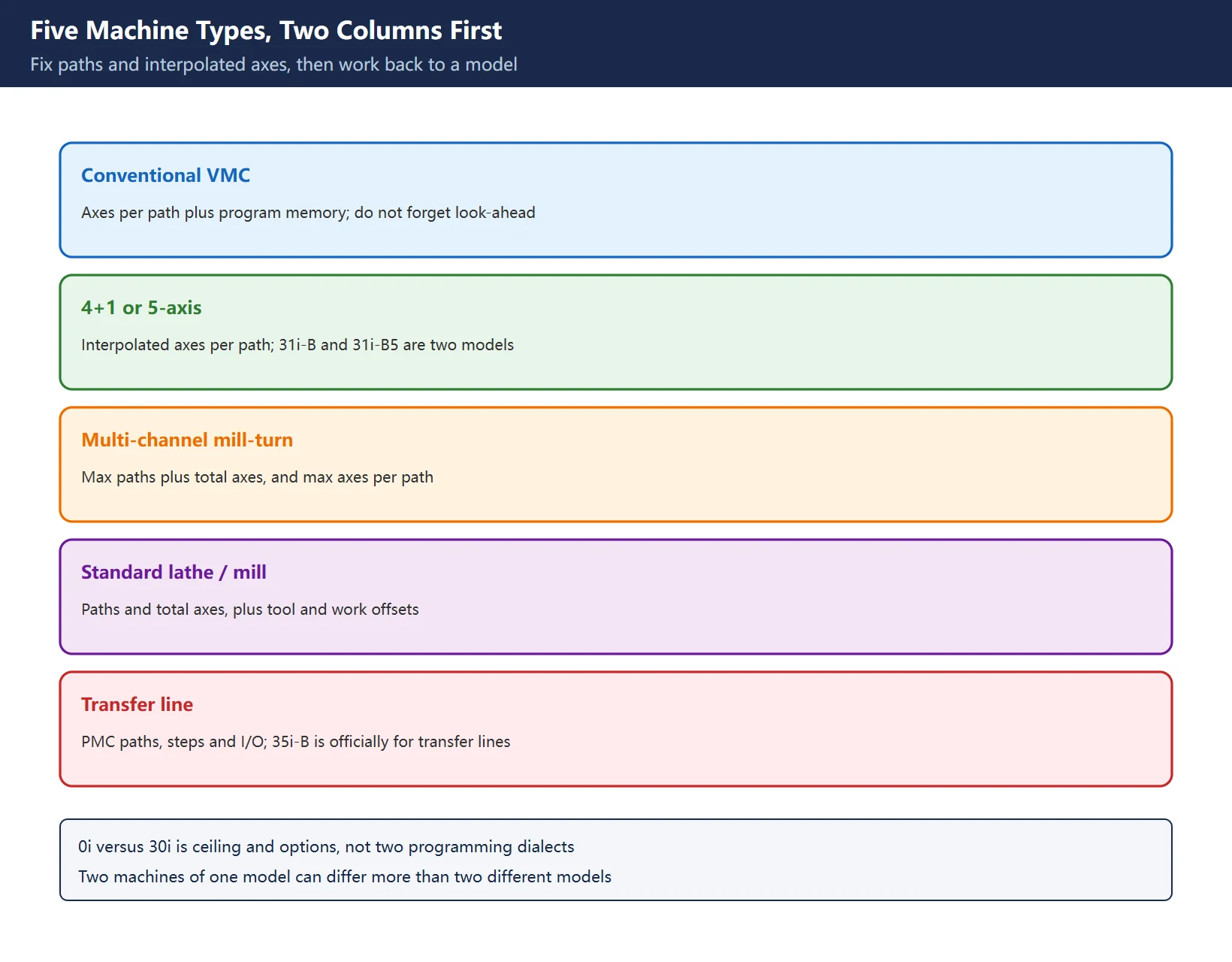
Selection is not “more axes is better”. Determine the required path count and interpolated axes first, then work back to a model. The table gives decision dimensions rather than model recommendations.
| Machine type | Two columns to read first | Column usually forgotten | Field check |
|---|---|---|---|
| Conventional vertical machining centre | Axes per path, program memory | Look-ahead blocks | Die/mould program length, 3D interference check |
| 4+1 or simultaneous 5-axis work | Simultaneously interpolated axes per path | Whether 5-axis option is present | 4-axis versus 5-axis are two different 31i models |
| Multi-channel mill-turn | Max paths, total axes | Max axes per path | Whether each channel needs its own spindle |
| Standard lathe / milling machine | Paths, total axes | Tool offsets, work offsets | Legacy program count and offset table size |
| Transfer line | PMC paths and steps, I/O points | Program memory | 35i-B is officially positioned for transfer lines |
Table 3. Five machine families and the two columns to check first
One persistent misreading: the difference between 0i and 30i is ceiling and options, not two different programming dialects. Core G codes, the macro system, canned cycles and the alarm structure belong to the same FANUC generation. Treating 30i as “a language to learn from scratch” derails the selection discussion. What actually separates two machines of the same model is option licensing and builder configuration – see Fanuc 0i-F / 0i-F Plus Function Options.
4. Four Things We Will Not Invent
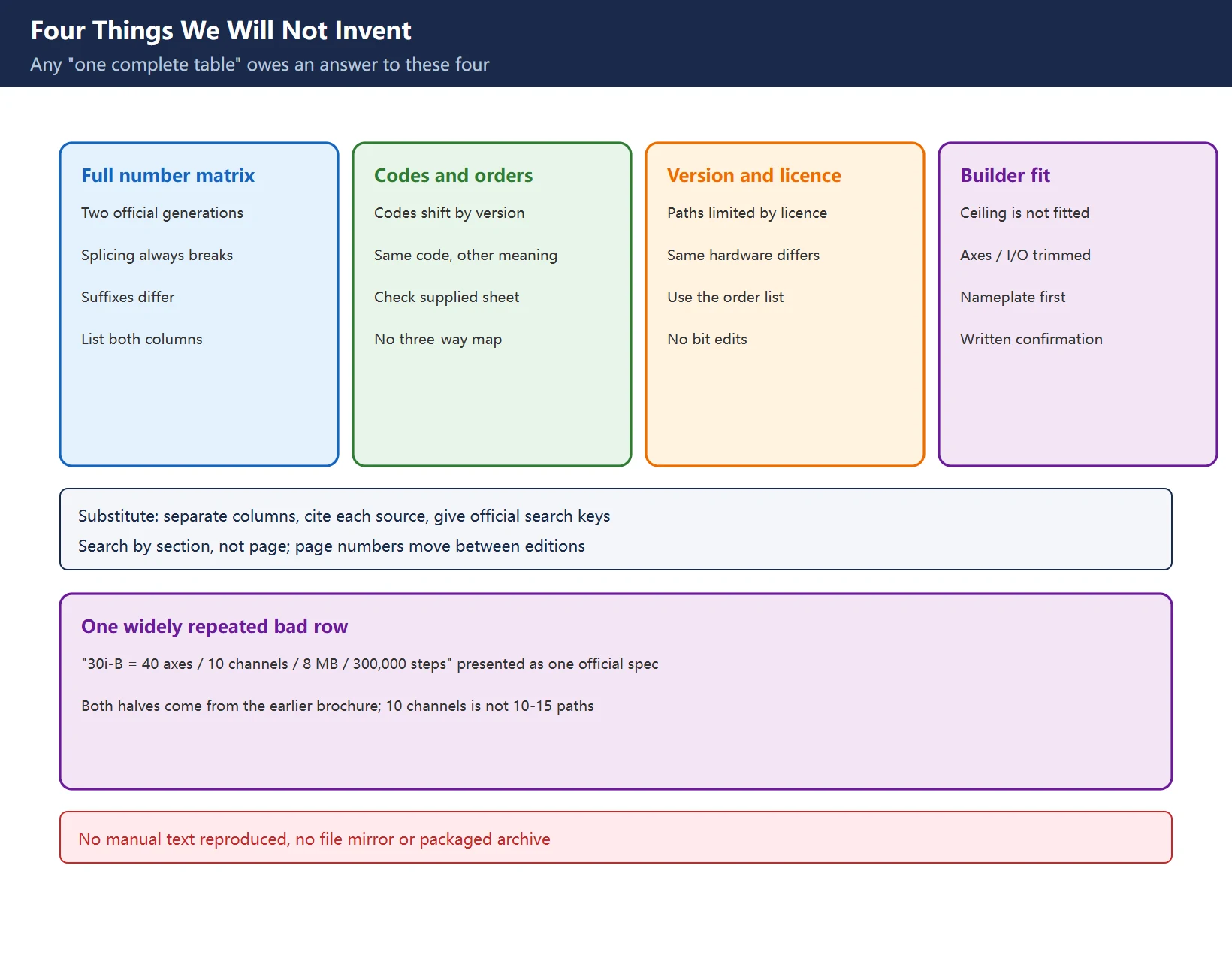
This is the most important section. Any page claiming “one table covers the whole Fanuc range” owes an answer on these four items. Our answer is: do not invent; give the lookup path instead.
| What cannot be invented | Why | What we do instead |
|---|---|---|
| A complete model-by-metric number matrix | Two official generations coexist; cross-generation splicing always breaks, and suffixes (B / B5 / PLUS / LB / PB) have dedicated specifications | Present both generations in separate columns, citing each source |
| One-to-one option code / order number mapping | Codes shift with software version and sales region; identical codes can mean different packages | State that options govern capability; verify codes in the supplied sheet |
| Software version versus axis / path licence | The same hardware opens different path counts under different licences | Use the order list and the on-screen version / option view |
| Machine builder fitted configuration | Ceiling is not the fitted system; builders trim axes, I/O and functions | Nameplate, supplied specification, written builder confirmation |
Table 4. Four classes we refuse to invent, and the substitute approach
A widely repeated line deserves correction: “30i-B = 40 axes / 10 channels / 8 MB / 300,000 PMC steps / 4096 I/O” is presented as one single official specification. In fact the first half (40 axes / 10 paths) and the second half (8 MB, 300,000 steps, 4096 I/O) both come from the earlier brochure, while “10 channels” is not the same statement as the current catalogue’s “10-15 paths”. Copy that row into a proposal and it will not match a 30i-B shipped after 2015.
5. Official Lookup Path: Search by Manual Type and Section, Not Page Number
| To verify | Source to use | Search key |
|---|---|---|
| Model ceiling (axes / paths / interpolation) | Official FANUC catalogue or product page | Full model name plus suffix (B / B5 / PLUS) |
| Memory, PMC, I/O, look-ahead | Same-series English brochure / specification sheet | Column heading, not a translated term |
| Whether a function is enabled | Specification sheet supplied by the machine builder | Option legend plus order number |
| What is actually installed | On-screen software version / option view | Software version number |
| Which functional block a parameter belongs to | Parameter manual for that model | Section number, never page number |
| Whether the manual matches this machine | Cover of the supplied manual | Manual number plus edition date |
Table 5. Six verification targets and their official search keys
Searching by section number rather than page number is the most practical habit in this documentation system: page numbers move between languages and editions, section numbers stay comparatively stable. That matches the approach in Fanuc Parameter Number Map by Range – framework and navigation, never reproduced per-number definitions.
6. Site Index
Table 6. Six further reading paths
Frequently Asked Questions
What is the difference between a Fanuc 30i-B and a 31i-B, and which has more axes?
In the current official catalogue, the 30i-B is 10-15 paths with up to 96 axes (72 feed and 24 spindle, at 10 paths) and 24 interpolated axes; the 31i-B is 6 paths, 34 axes (26 feed and 8 spindle) and 4 interpolated axes. The 30i-B is higher on both counts. Two cautions: the earlier English brochure gives 40 axes / 10 paths and 26 axes / 4 paths, so the two pairs belong to different documentation generations; and the 31i-B5 shares the 31i-B axis and path counts, differing only by simultaneous 5-axis control. Neither pair replaces the supplied specification when assessing an installed machine.
The 32i-B only has 2 MB of memory – what can and cannot it do?
The 2 MB figure comes from the earlier English brochure as the maximum internal part program memory of that generation of 32i-B; the same brochure lists 200 look-ahead blocks, 400 tool offsets and 48 workpiece coordinate offsets. It indicates the model’s positioning as a standard lathe / machining centre control, not that “2 MB cannot hold a mould program” – long programs can run through DNC, a data server or a memory card, and the current catalogue plus 32i-B PLUS specifications must be checked separately. Judge usability from the actual program length, whether a data server option is enabled, and the supplied specification, not from one number.
How do I choose between a 0i-MF and a 30i-B?
Fix the path count and interpolated axes first, then memory and options, and only then the model. A conventional single-channel VMC rarely needs the multi-path ceiling of a 30i-B; multi-channel mill-turn machines or applications needing 24 interpolated axes do. Core language, macro system, canned cycles and alarm structure are shared, so the difference is ceiling and options. Two machines of the same model with different options may differ more than two different models, so the final basis is the builder specification and order list, never an online comparison table.
Last updated: 2026-11-15
Beyond specification generations: keeping product lines separate
Beyond specification generations: the same discipline on tolerance numbers
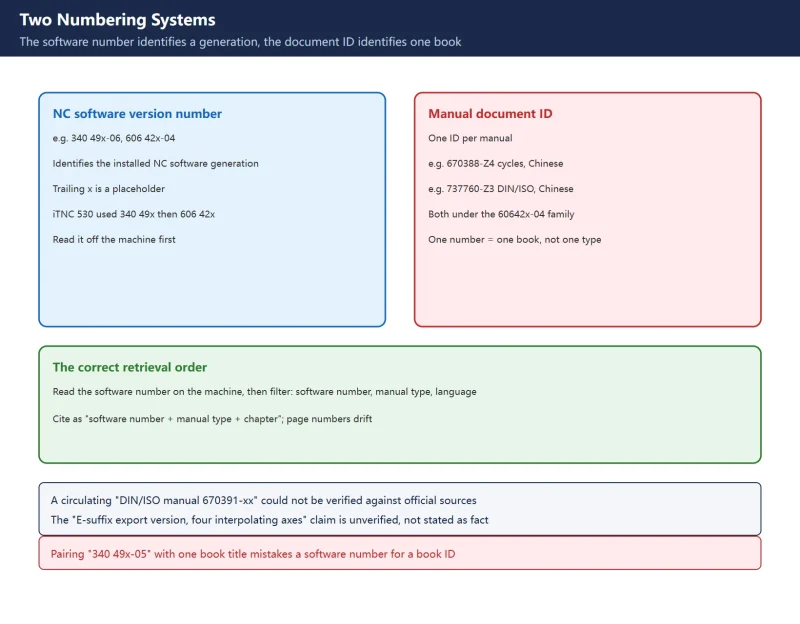
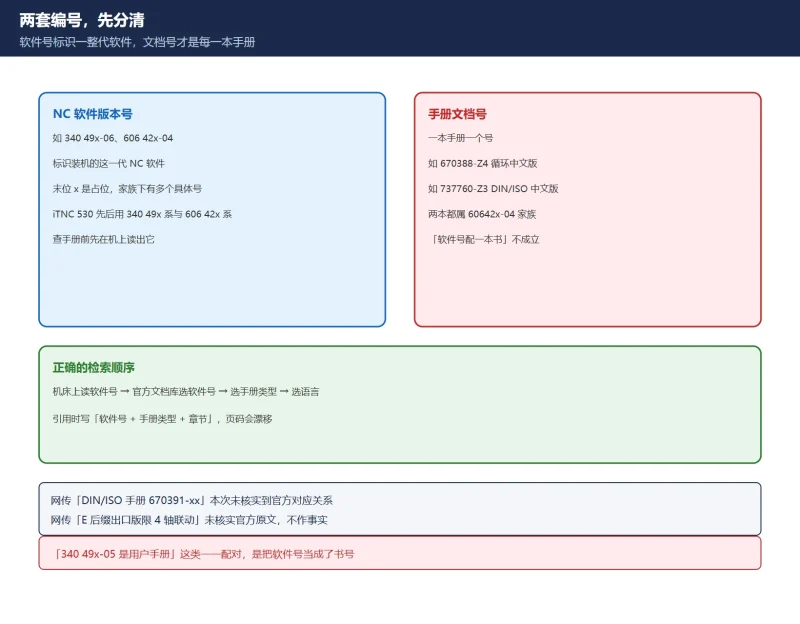
Beyond specification generations: software numbers versus document IDs
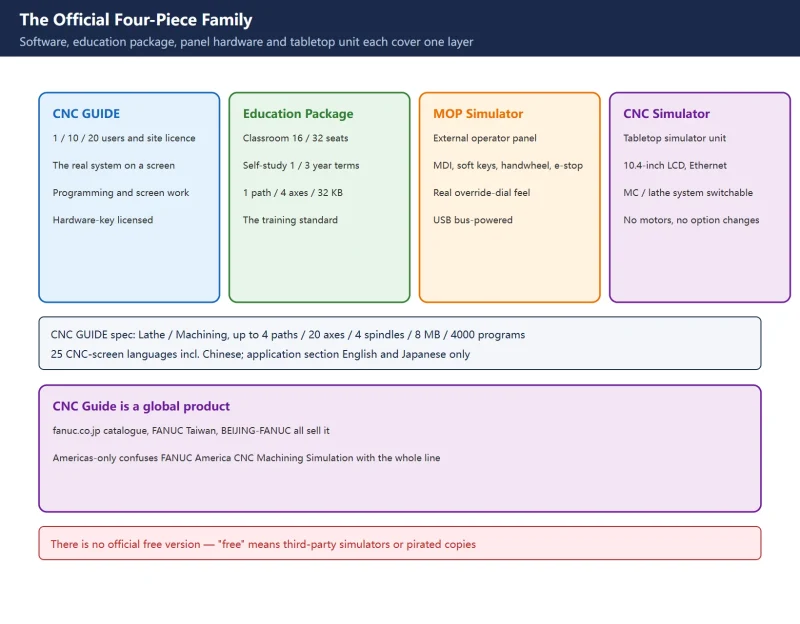
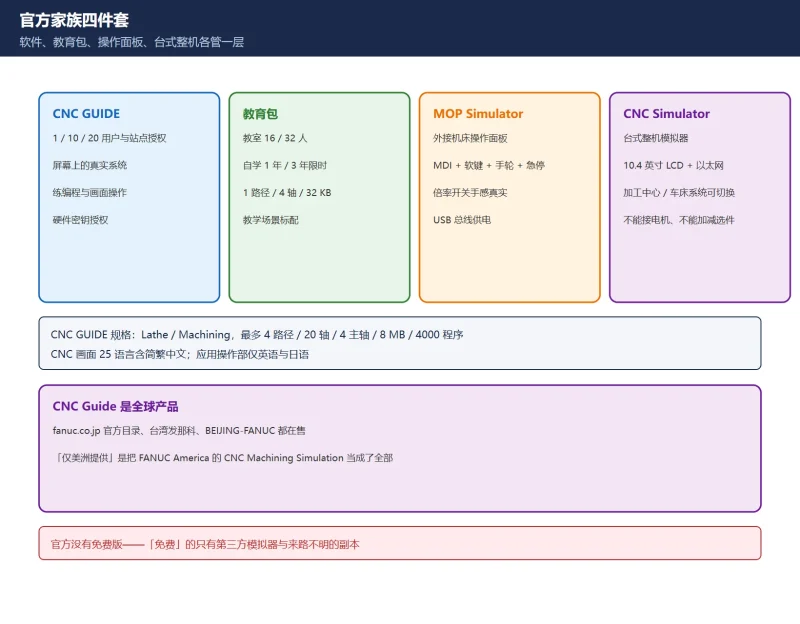
Beyond specification tables: choosing the simulator for your system generation
Where to go next
- FANUC Troubleshooting — the full guide library: alarms, diagnosis numbers, servo, spindle, PMC and electrical faults, organised by symptom.
- CNC Repair Tools — which instrument measures what: multimeters, clamp meters, insulation testers and oscilloscopes, with the specification that actually matters.
- Remote Technical Support — have the readings reviewed with you: alarm reverse lookup, PMC ladder analysis and servo tuning advice by call. Repair companies and integrators welcome.
Read the guide, get the right instrument, or walk the diagnosis through with someone — pick whichever you need.
The original Chinese version — same procedure, with the full field notes.




















暂无评论内容