


Chinese version: 828D G290 / G291 guide; related: 828D cycle alarms 61000 / 62000 / 65xxx, Setting Data vs Machine Data on 828D, 828D PLC Programming Tool and basic blocks, CNC alarm number formats by brand.
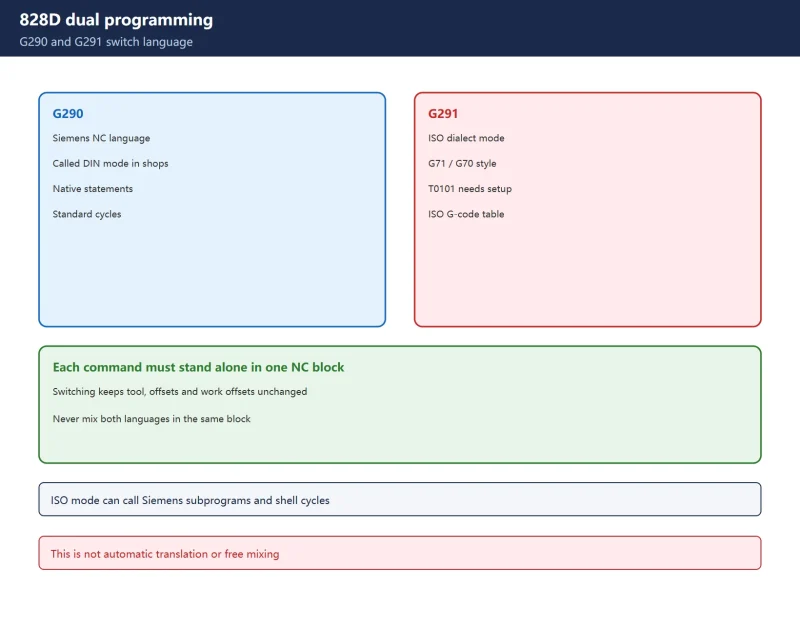
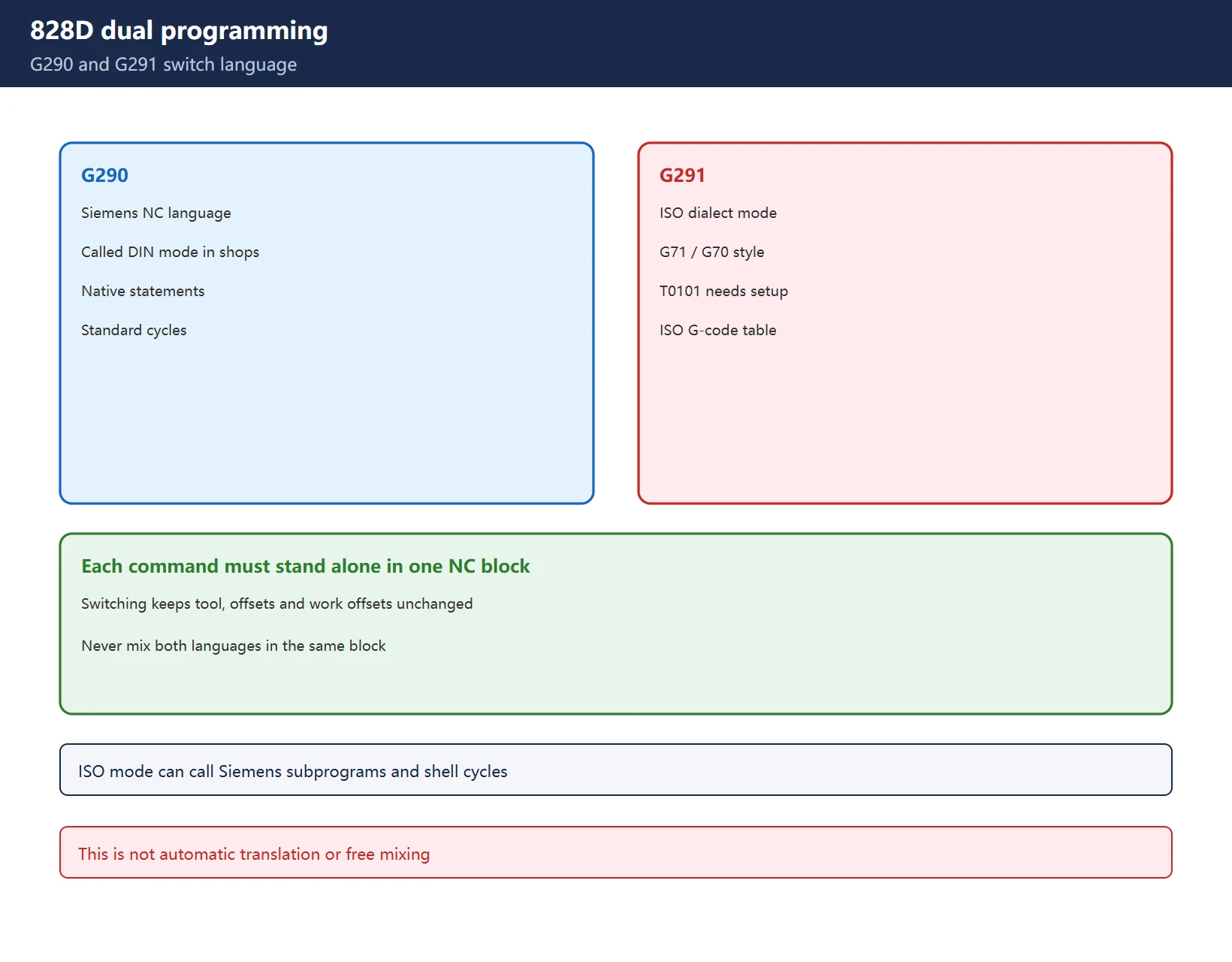
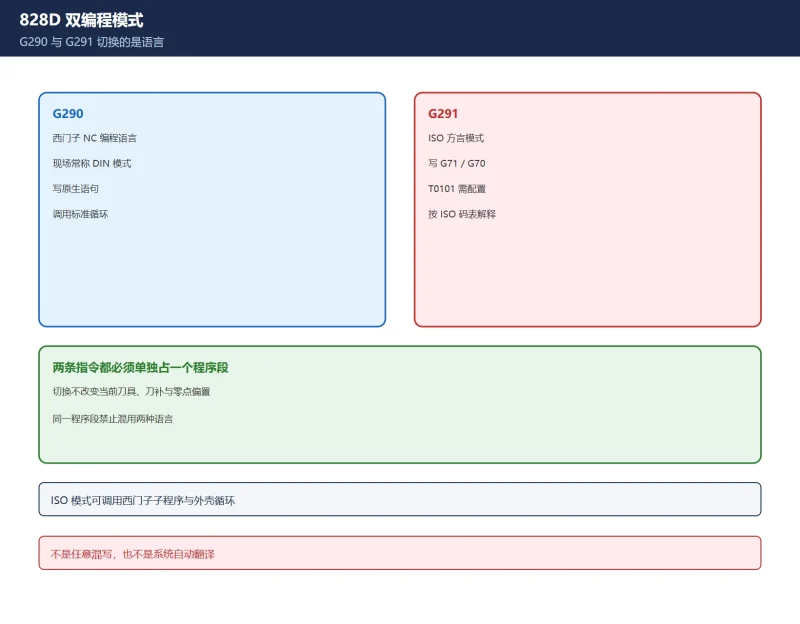
11.1 What G290 and G291 actually switch
| Command | Active language | Official wording | Workshop shorthand |
|---|---|---|---|
| G290 | Siemens NC programming language | Siemens NC programming language active | Back to DIN mode |
| G291 | ISO dialect | ISO Dialect NC Programming language active | Enter ISO mode |
Table 1: official names and shop-floor terms
The Siemens manual adds three boundaries: in ISO dialect mode only ISO G functions may be programmed, not Siemens G functions; ISO dialect and Siemens language cannot be mixed in one NC block; and switching between ISO dialect M and ISO dialect T with a G command is not possible. The often-repeated statement that the two modes “recognize each other” has a narrower meaning: a subprogram written in Siemens mode can be called from ISO mode, and shell cycles implicitly switch to Siemens mode. It is not permission to mix statements freely.
11.2 Why machine builders switch modes
Three sources commonly meet on one machine: legacy programs written in Siemens/DIN style, customer programs migrated from FANUC or other controls using G71/G70 and T0101, and machine-builder cycles that are Siemens standard cycles. Mode switching solves the syntax source problem only. It does not validate the tool, the work offset or the process.
Because the official manual says the active tool, tool compensation and work offsets are not influenced by the switch, those values remain in force. Verify them before switching, not after a collision.
11.3 Side-by-side: program header, tool, spindle, contour, cycle
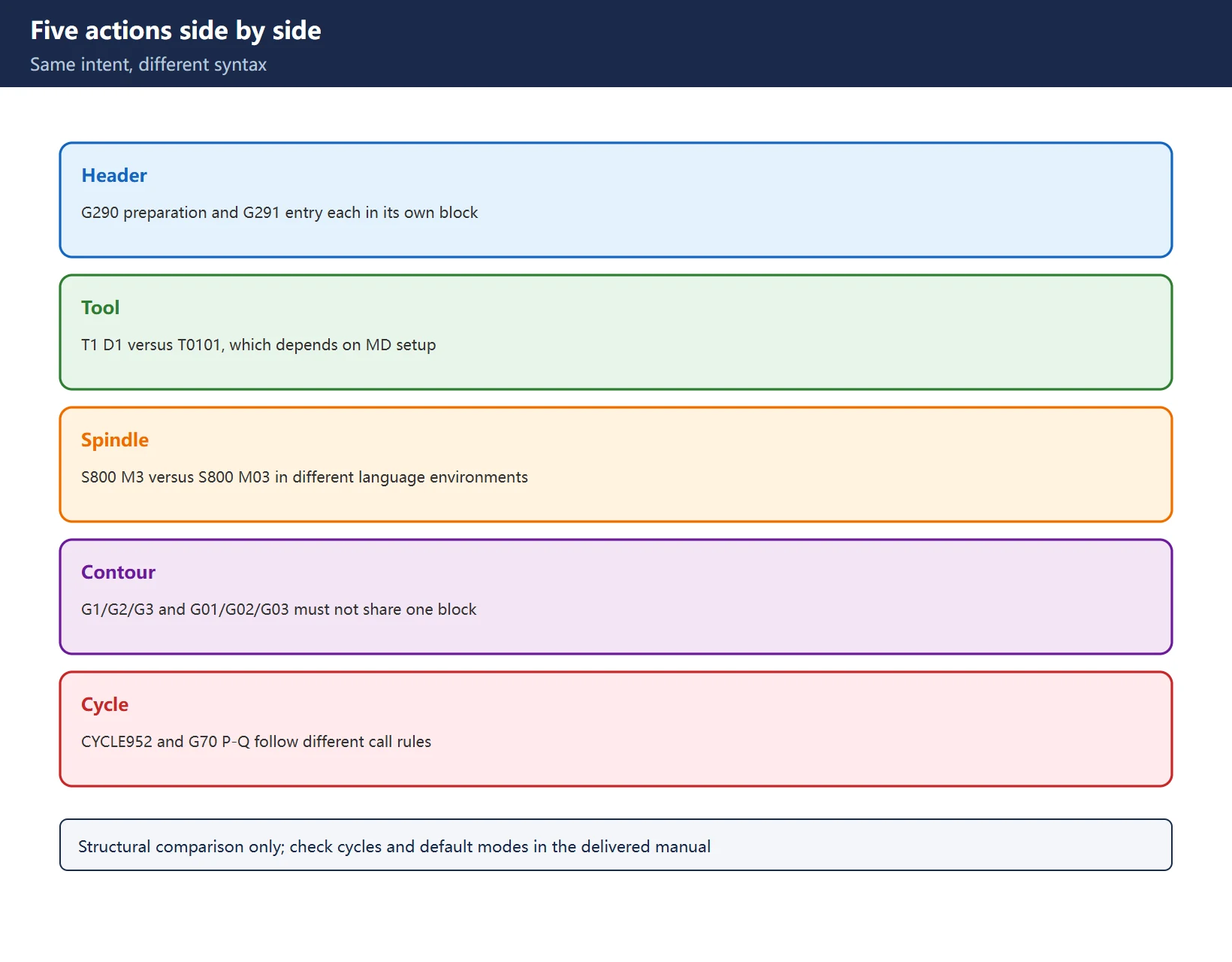
This is a structural comparison, not an automatic translation table. Cycle availability, address meaning and default G groups depend on the installed control version and machine-builder configuration.
| Item | Siemens / DIN style | ISO dialect style | Key point |
|---|---|---|---|
| Header | G290 plus G54 / WORKPIECE setup | G291 plus G90 G40 G99 as configured | Mode switch alone in its own block |
| Tool change | T1 D1 or builder-defined block | T0101 if MD10888/10889/10890 configured | T0101 is not universal by default |
| Spindle | S800 M3 | S800 M03 | ISO mode follows the ISO G-code table |
| Positioning | G0 X… Z… | G00 X… Z… | Same intent, different language environment |
| Contour | G1 / G2 / G3 plus Siemens cycles | G01 / G02 / G03 plus G71/G70 | Never mix both G-code sets in one block |
| Finishing cycle | CYCLE952 and related cycles | G70 P… Q… | Cycle calls implicitly switch mode |
| End | M30 | M30 | Resulting mode follows parameters and call context |
Table 2: shape of equivalent actions, for structure only
11.4 The G71 / G70 trap exists in both styles
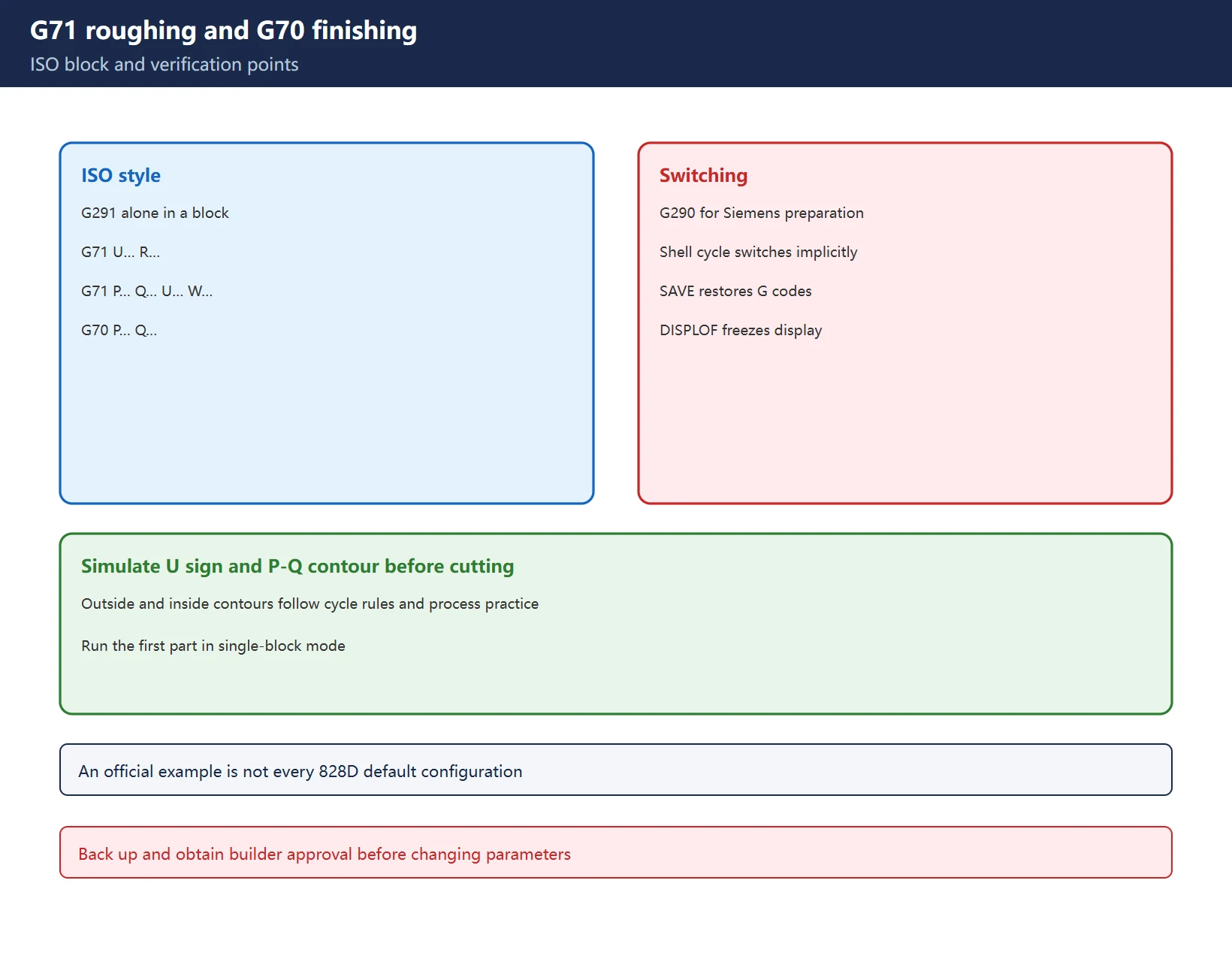
A Siemens CNC4YOU example shows an 828D program that prepares a simulated workpiece with G290, enters ISO mode with G291, then uses G71 U… R…, G71 P… Q… U… W… F… and G70 P… Q… F… for rough and finish turning. Two conclusions follow:
- G71/G70 can be used in ISO mode, but that does not make the whole program language-neutral.
- Siemens cycles can be called from ISO structure because the shell cycle switches mode internally; Siemens statements cannot be dropped into the same ISO block.
Sign of U for outside versus inside contours, P-Q contour monotonicity and allowance direction sit at the boundary between ISO rules and cycle implementation. Verify them with a graphical simulation and dry run before cutting metal.
11.5 Three real mixed-programming failures
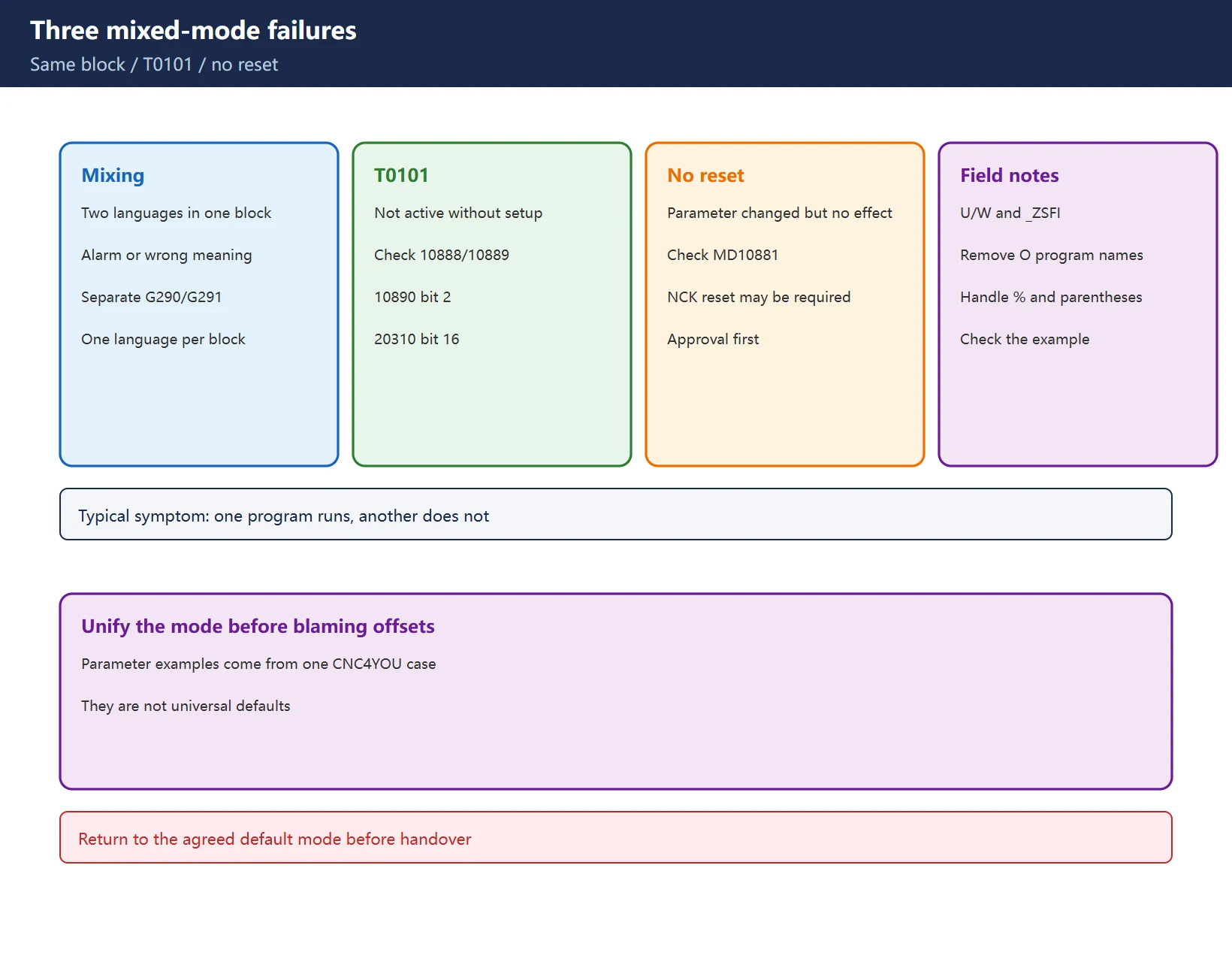
| Failure | Symptom | Action |
|---|---|---|
| Both languages in one block | Alarm or unexpected interpretation | Put G290 / G291 in separate blocks and keep each block single-language |
| T0101 not configured | Tool change or offset does not activate as expected | Check MD10888 / 10889 / 10890 bit 2 / 20310 bit 16 and the tool table H column |
| Parameter changed but no reset | Value changed, behaviour did not | Perform the required NCK reset; obtain machine-builder approval first |
Table 3: the three most common 828D mixed-mode errors
The CNC4YOU example also mentions U/W incremental programming with MD10881, removing ( ), O program numbers and % from imported ISO programs, and using channel user variable _ZSFI for G92 thread run-out. These belong to that example, not to every 828D default.
11.6 CYCLE62 and CYCLE952 in an ISO-structured program
Siemens’ example uses CYCLE62 and CYCLE952 inside a program whose visible structure is largely ISO style. The control still executes standard Siemens cycles: a shell cycle is called through the main program, the Siemens mode is selected automatically, and G codes changed inside the shell cycle are restored at the end through the SAVE attribute. DISPLOF keeps the displayed block language frozen on ISO while the cycle runs internally in Siemens mode.
Before relying on this, check three things: the cycle is in the standard scope for that channel, the call point is correctly placed relative to the mode switch, and the machine builder has not overridden the cycle.
11.7 A safe dual-style workflow
- Back up the original program and relevant machine data; record current mode, G54, tool and offsets.
- Use a standalone
G290block for Siemens-side preparation and a standaloneG291block to enter ISO. - Keep every NC block in one language; treat Siemens cycle calls through their shell-cycle rules.
- Run graphical simulation, then dry run; focus on tool changes, approach/retract, U/W direction and the P-Q contour range.
- Run the first article in single-block mode with the feed hold ready.
- Return the machine to its agreed default mode before handing the control to the next operator.
11.8 Scope and compliance
- Mode definitions, the standalone-block rule, the ban on same-block mixing, unchanged tool/offsets and implicit shell-cycle switching come from the Siemens SINUMERIK 840D sl / 828D ISO Turning Programming Manual and the ISO dialects function manual.
- G71/G70, CYCLE62, CYCLE952 and machine-data hints come from a Siemens CNC4YOU worked example. They are example settings, not a substitute for the delivered manual or machine-builder approval.
- No manual text is reproduced and no cracked software, drive link or pirated archive is offered. Back up before edits and validate the first article under a qualified operator.
Frequently Asked Questions
What is the difference between G290 and G291 on an 828D?
G290 activates the Siemens NC programming language, often called DIN mode; G291 activates the ISO dialect. Use G291 for customer ISO programs or G71/G70 style code, and G290 for Siemens-native statements and standard cycles. Each command must stand alone in its own NC block.
Can G71 roughing be used in G291 mode?
Yes, but G71/G70 belong to the ISO dialect, so the surrounding program must follow ISO rules. Siemens standard cycles called from ISO structure switch mode through a shell cycle. The difference is syntax and modality, not the ability to cut. Simulate U/W direction, P-Q range and allowances before the first part.
Why do some programs run on the same 828D while others fail?
Check mode consistency, standalone G290/G291 blocks, whether ISO-style T0101 is configured through machine data, and whether an NCK reset followed parameter changes. These four checks explain most “same machine, different result” cases.
Last updated: 2026-11-16
Where to go next
- FANUC Troubleshooting — the full guide library: alarms, diagnosis numbers, servo, spindle, PMC and electrical faults, organised by symptom.
- CNC Repair Tools — which instrument measures what: multimeters, clamp meters, insulation testers and oscilloscopes, with the specification that actually matters.
- Remote Technical Support — have the readings reviewed with you: alarm reverse lookup, PMC ladder analysis and servo tuning advice by call. Repair companies and integrators welcome.
- Buying & Ownership Decisions — refurbished vs new, used-machine checks, software licensing and manuals: spend with the field facts in hand.
Read the guide, get the right instrument, or walk the diagnosis through with someone — pick whichever you need.
The original Chinese version — same procedure, with the full field notes.

















暂无评论内容