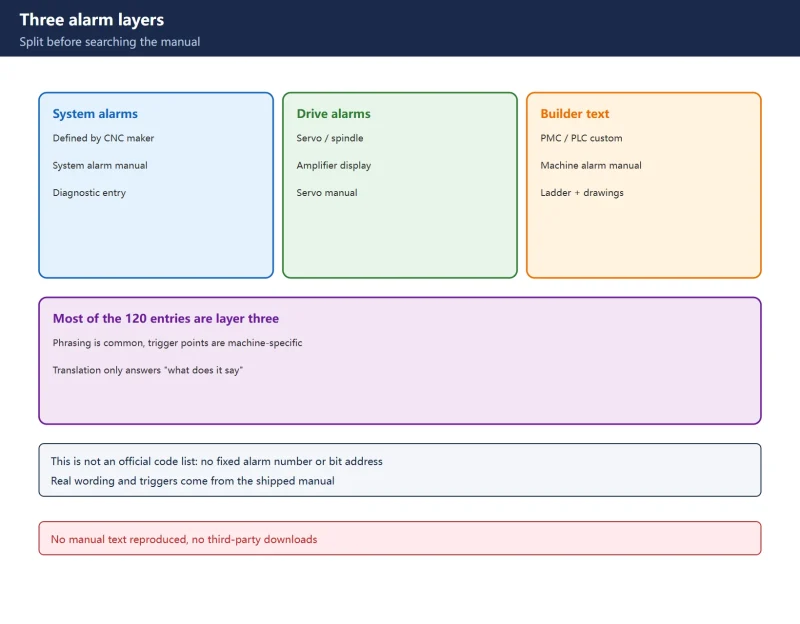



🚨 Scope and compliance: The 120 entries below are common field phrasings for understanding and search practice, not an official code list from any CNC maker or machine builder. No entry maps to a fixed alarm number or a fixed PMC address. Real wording, numbers and trigger conditions come from the alarm manual, electrical drawings and ladder shipped with that machine. This page neither provides nor invents machine-builder bit addresses, reproduces no manual text, and provides no third-party download links. Reverse lookup is covered in FANUC external alarm tracing.
30-second triage: eight keywords first
| Keyword | Trigger semantics | First check |
|---|---|---|
NOT READY | Precondition unmet | Enable chain and initial switch states |
OVERLOAD | Motion obstructed | Mechanical load, then motor thermal relay |
FAULT | Action failed / drive error | Compare command and feedback |
TIMEOUT | Not reached within the expected time | Jam and timer setting |
LOW / HIGH | Quantity out of range | Measure pressure, level or temperature |
OPEN / CLOSE | Switch state differs from expectation | Valve, door, contact |
INTERLOCK | Interlock condition unmet | Safety chain and sequence |
NOT IN POSITION | Position signal missing | Feedback device first, parameters last |
Table 0 Semantic mapping of eight high-frequency keywords
Related: Five peripheral alarm clusters, external alarm reverse lookup, ATC builder alarms, gravity-axis brake, spindle alarm triage.
1. Boundary: phrase corpus, not an official code list
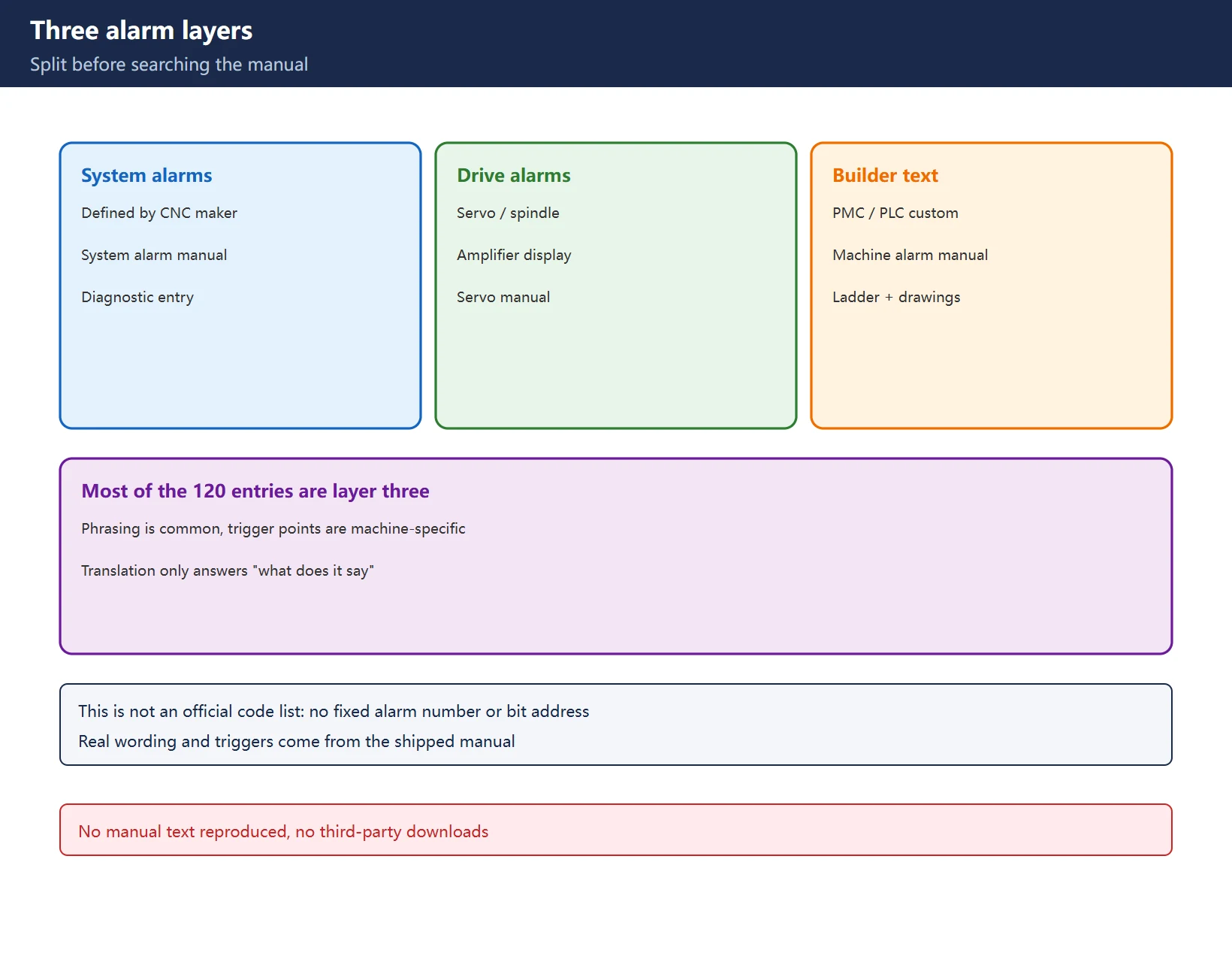
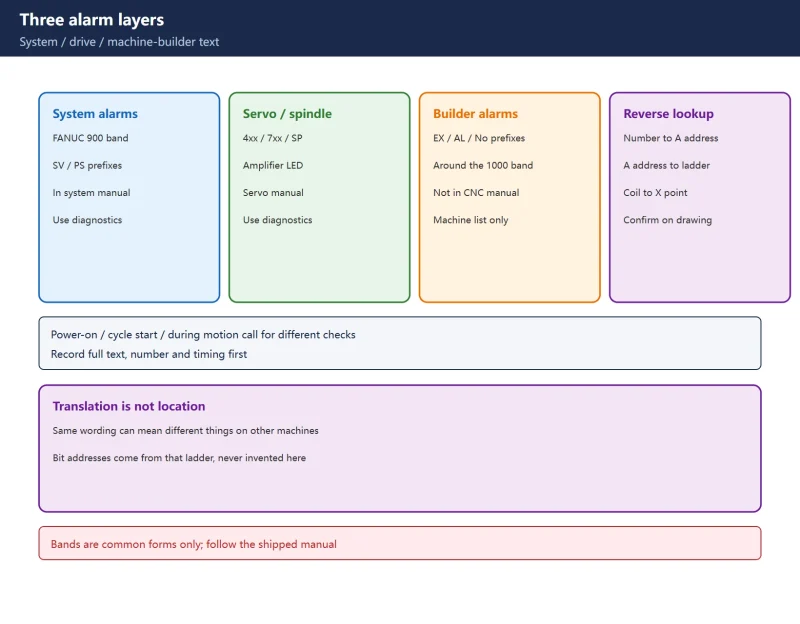
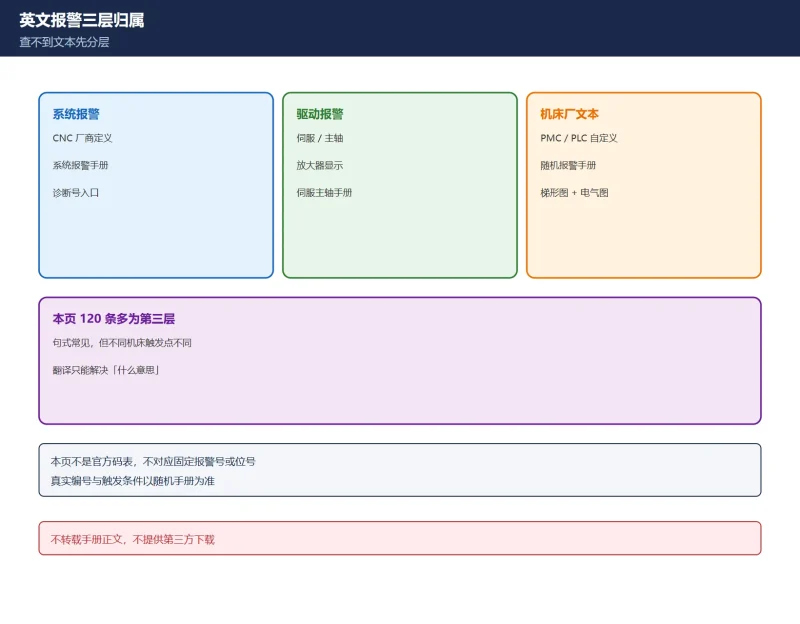
Most copied “English alarm lists” give translations but no action. Every alarm belongs to one of three layers:
| Layer | Defined by | Where to look |
|---|---|---|
| System alarms (CNC itself) | FANUC / Siemens / Mitsubishi | System alarm manual, diagnostics |
| Drive alarms (servo / spindle) | CNC or drive maker | Servo/spindle manual, amplifier display |
| Machine-builder text | Builder, in PMC/PLC | Machine alarm manual, ladder, drawings |
Table 1 Three alarm layers
Most of the 120 entries below belong to the third layer: the phrasing is common, but meaning and trigger point can change completely between machines.
2. 120 common English alarm phrases (12 groups x 10)
2.1 Tool / ATC
| English phrase (field example) | Chinese meaning | Semantics |
|---|---|---|
| TOOL NOT READY | 刀具未就绪 | NOT READY |
| TOOL CLAMP FAILURE | 刀具夹紧失败 | FAULT |
| TOOL UNCLAMP FAILURE | 刀具松开失败 | FAULT |
| ATC TIMEOUT | 换刀超时 | TIMEOUT |
| MAGAZINE NOT IN POSITION | 刀库未到位 | NOT IN POSITION |
| TOOL NO. MISMATCH | 刀号不符 | MISMATCH |
| TOOL MISSING | 刀具缺失 | FAULT |
| ARM ROTATION FAULT | 机械手旋转故障 | FAULT |
| TOOL STATION BUSY | 刀位占用 | INTERLOCK |
| ATC INTERLOCK | 换刀互锁未满足 | INTERLOCK |
2.2 Spindle
| English phrase (field example) | Chinese meaning | Semantics |
|---|---|---|
| SPINDLE NOT READY | 主轴未就绪 | NOT READY |
| SPINDLE OVERLOAD | 主轴过载 | OVERLOAD |
| SPINDLE SPEED NOT REACHED | 主轴转速未达到 | TIMEOUT |
| SPINDLE ORIENTATION FAULT | 主轴定向故障 | FAULT |
| SPINDLE TEMP HIGH | 主轴温度高 | HIGH |
| SPINDLE LOAD HIGH | 主轴负载高 | HIGH |
| SPINDLE DRIVE FAULT | 主轴驱动故障 | FAULT |
| GEAR SHIFT FAILURE | 档位切换失败 | FAULT |
| SPINDLE STOP ERROR | 主轴停止异常 | FAULT |
| SPINDLE COOLANT FAULT | 主轴冷却异常 | FAULT |
2.3 Coolant
| English phrase (field example) | Chinese meaning | Semantics |
|---|---|---|
| COOLANT NOT READY | 冷却未就绪 | NOT READY |
| COOLANT LEVEL LOW | 冷却液位低 | LOW |
| COOLANT FLOW FAULT | 冷却流量故障 | FAULT |
| COOLANT PRESSURE LOW | 冷却压力低 | LOW |
| COOLANT PUMP OVERLOAD | 冷却泵过载 | OVERLOAD |
| COOLANT TEMP HIGH | 冷却液温度高 | HIGH |
| COOLANT VALVE FAULT | 冷却阀故障 | FAULT |
| NO COOLANT | 无冷却液 | LOW |
| COOLANT FILTER CLOGGED | 冷却滤芯堵塞 | BLOCKED |
| COOLANT RETURN BLOCKED | 冷却回液堵塞 | BLOCKED |
2.4 Lubrication
| English phrase (field example) | Chinese meaning | Semantics |
|---|---|---|
| LUBRICATION PRESSURE LOW | 润滑压力低 | LOW |
| OIL LEVEL LOW | 油位低 | LOW |
| LUB PUMP OVERLOAD | 润滑泵过载 | OVERLOAD |
| LUBRICATION TIMEOUT | 打油超时 | TIMEOUT |
| NO OIL DELIVERY | 未供油 | FAULT |
| OIL FILTER CLOGGED | 油滤堵塞 | BLOCKED |
| LUB VALVE FAULT | 润滑阀故障 | FAULT |
| OIL TEMP HIGH | 油温高 | HIGH |
| MIST UNIT FAULT | 油雾装置故障 | FAULT |
| LUB CYCLE INCOMPLETE | 润滑循环未完成 | TIMEOUT |
2.5 Chip conveyor
| English phrase (field example) | Chinese meaning | Semantics |
|---|---|---|
| CHIP CONVEYOR OVERLOAD | 排屑器过载 | OVERLOAD |
| CONVEYOR JAM | 排屑卡死 | BLOCKED |
| CHIP REMOVAL FAULT | 排屑故障 | FAULT |
| CONVEYOR REVERSE FAULT | 排屑反转故障 | FAULT |
| CHIP LEVEL HIGH | 切屑堆积高 | HIGH |
| CONVEYOR MOTOR OVERLOAD | 排屑电机过载 | OVERLOAD |
| AUGER STALL | 螺旋排屑堵转 | BLOCKED |
| CHIP BIN FULL | 集屑箱满 | HIGH |
| CONVEYOR NOT RUNNING | 排屑器未运行 | NOT READY |
| CHIP WASH FAULT | 冲屑故障 | FAULT |
2.6 Air
| English phrase (field example) | Chinese meaning | Semantics |
|---|---|---|
| AIR PRESSURE LOW | 气压低 | LOW |
| AIR NOT READY | 气源未就绪 | NOT READY |
| CLAMP AIR NOT READY | 夹紧气未就绪 | NOT READY |
| AIR LEAK | 漏气 | LOW |
| AIR VALVE FAULT | 气阀故障 | FAULT |
| UNCLAMP AIR FAILURE | 松刀气失败 | FAULT |
| AIR FILTER CLOGGED | 气滤堵塞 | BLOCKED |
| LOW AIR FLOW | 气流量低 | LOW |
| AIR PRESSURE SWITCH FAULT | 气压开关故障 | FAULT |
| PNEUMATIC TIMEOUT | 气动动作超时 | TIMEOUT |
2.7 Hydraulic
| English phrase (field example) | Chinese meaning | Semantics |
|---|---|---|
| HYDRAULIC PRESSURE LOW | 液压压力低 | LOW |
| HYD OIL TEMP HIGH | 液压油温高 | HIGH |
| HYD PUMP FAULT | 液压泵故障 | FAULT |
| HYD VALVE FAULT | 液压阀故障 | FAULT |
| HYD LEAK | 液压泄漏 | LOW |
| CLAMP PRESSURE LOW | 夹紧压力低 | LOW |
| HYD FILTER CLOGGED | 液压滤芯堵塞 | BLOCKED |
| HYD CYLINDER TIMEOUT | 油缸动作超时 | TIMEOUT |
| HYD OIL LEVEL LOW | 液压油位低 | LOW |
| HYD MOTOR OVERLOAD | 液压电机过载 | OVERLOAD |
2.8 Safety / door / E-stop
| English phrase (field example) | Chinese meaning | Semantics |
|---|---|---|
| DOOR OPEN | 防护门打开 | OPEN |
| SAFETY DOOR INTERLOCK | 安全门互锁 | INTERLOCK |
| E-STOP ACTIVE | 急停有效 | INTERLOCK |
| GUARD NOT CLOSED | 防护罩未关闭 | CLOSE |
| LIGHT CURTAIN BLOCKED | 光幕被遮挡 | BLOCKED |
| SAFETY RELAY FAULT | 安全继电器故障 | FAULT |
| EMERGENCY STOP RESET REQUIRED | 需复位急停 | INTERLOCK |
| OPERATION MODE INVALID | 操作模式无效 | FAULT |
| KEY SWITCH FAULT | 钥匙开关故障 | FAULT |
| SAFETY CIRCUIT OPEN | 安全回路断开 | OPEN |
2.9 Axis / servo
| English phrase (field example) | Chinese meaning | Semantics |
|---|---|---|
| AXIS NOT IN POSITION | 轴未到位 | NOT IN POSITION |
| SERVO OVERLOAD | 伺服过载 | OVERLOAD |
| AXIS LIMIT OVERRUN | 轴超程 | HIGH |
| FOLLOWING ERROR EXCESSIVE | 跟随误差过大 | FAULT |
| AXIS DRIVE FAULT | 轴驱动故障 | FAULT |
| Z AXIS BRAKE FAULT | Z 轴抱闸故障 | FAULT |
| AXIS HOME NOT FOUND | 未找到参考点 | FAULT |
| POSITION LOST | 位置丢失 | FAULT |
| SOFT LIMIT EXCEEDED | 软限位超程 | HIGH |
| AXIS TEMPERATURE HIGH | 轴温度高 | HIGH |
2.10 Clamp / work
| English phrase (field example) | Chinese meaning | Semantics |
|---|---|---|
| WORK CLAMP NOT READY | 工件夹紧未就绪 | NOT READY |
| FIXTURE NOT CLAMPED | 夹具未夹紧 | CLOSE |
| WORKPIECE NOT DETECTED | 未检测到工件 | FAULT |
| CHUCK PRESSURE LOW | 卡盘压力低 | LOW |
| TAILSTOCK NOT FORWARD | 尾座未前进 | NOT IN POSITION |
| STEADY REST INTERLOCK | 中心架互锁 | INTERLOCK |
| WORK COORDINATE INVALID | 工件坐标无效 | FAULT |
| PART LOADING FAULT | 上料故障 | FAULT |
| UNLOADING TIMEOUT | 下料超时 | TIMEOUT |
| CLAMP RELEASE FAILURE | 夹紧释放失败 | FAULT |
2.11 Temperature / electrical
| English phrase (field example) | Chinese meaning | Semantics |
|---|---|---|
| ELECTRICAL CABINET TEMP HIGH | 电柜温度高 | HIGH |
| CONTROL VOLTAGE LOW | 控制电压低 | LOW |
| FUSE BLOWN | 熔断器熔断 | FAULT |
| FAN MOTOR FAULT | 风扇电机故障 | FAULT |
| BATTERY LOW | 电池电压低 | LOW |
| OVERHEAT WARNING | 过热警告 | HIGH |
| INSULATION FAULT | 绝缘故障 | FAULT |
| POWER SUPPLY FAULT | 电源故障 | FAULT |
| TRANSFORMER OVERLOAD | 变压器过载 | OVERLOAD |
| CABLE DISCONNECTED | 电缆断开 | OPEN |
2.12 Program / operation / general
| English phrase (field example) | Chinese meaning | Semantics |
|---|---|---|
| PROGRAM NOT FOUND | 程序未找到 | FAULT |
| CYCLE START INTERLOCK | 循环启动互锁 | INTERLOCK |
| FEED HOLD ACTIVE | 进给保持有效 | INTERLOCK |
| M CODE INVALID | M 代码无效 | FAULT |
| G CODE NOT SUPPORTED | G 代码不支持 | FAULT |
| PARAMETER WRITE PROTECT | 参数写保护 | INTERLOCK |
| DATA TRANSFER ERROR | 数据传输错误 | FAULT |
| OPERATION PANEL FAULT | 操作面板故障 | FAULT |
| ALARM RESET FAILED | 报警复位失败 | FAULT |
| SYSTEM BUSY | 系统忙 | INTERLOCK |
Table 2 120 field phrase examples by subsystem, not an official code list
3. Keyword to root cause
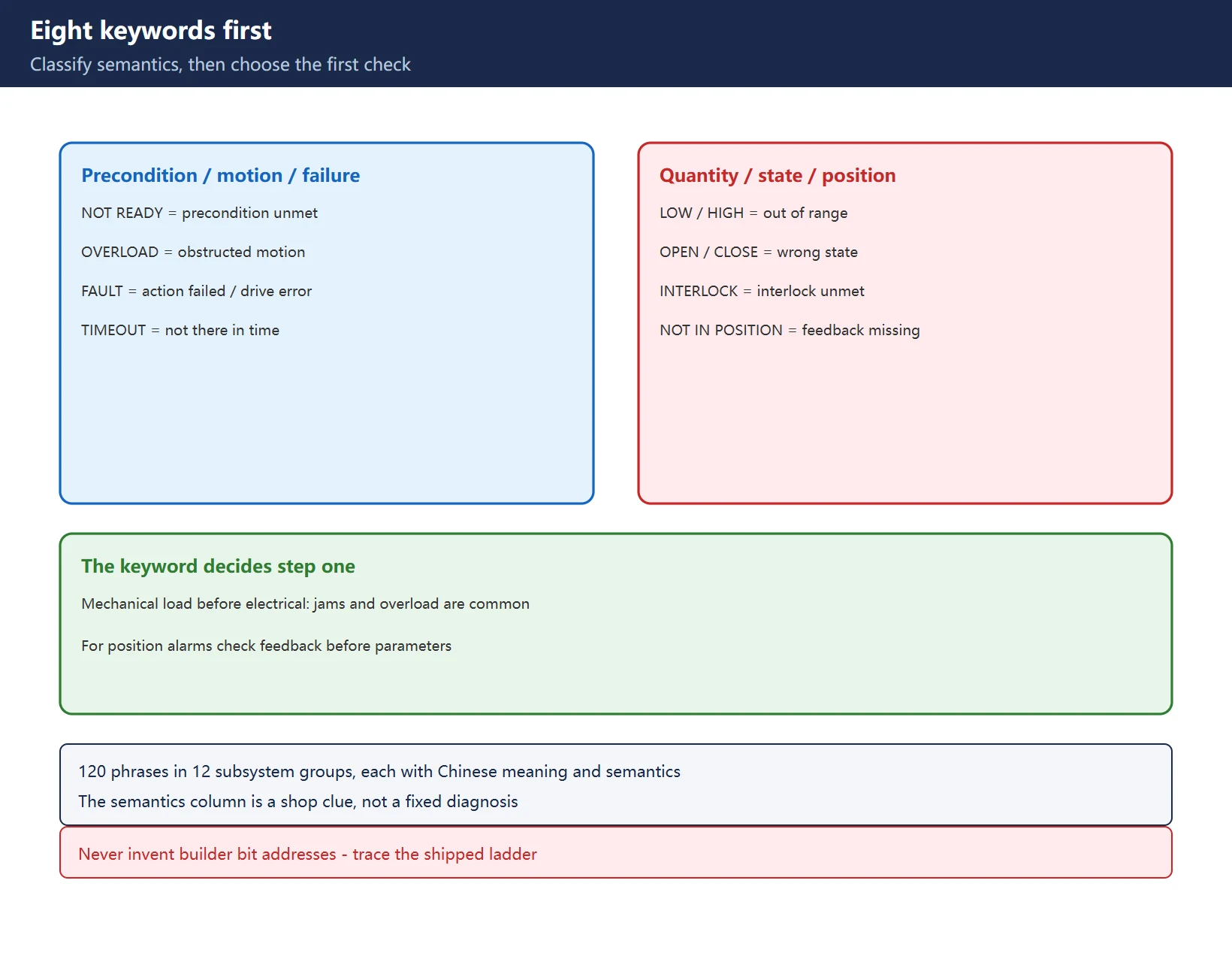
Six shop rules cover the semantics column:
NOT READY– a precondition is unmet: initial switch states, enable chain, reset.OVERLOAD– motion is obstructed: jam, binding, poor lubrication before thermal relay and insulation.FAULT– action failed or drive error: compare command and feedback.TIMEOUT– not there in time: jam and timer setting.LOW/HIGH/OPEN– quantity or state out of range: measure directly.INTERLOCK/NOT IN POSITION– sequence or position feedback: sensor first, parameters last.
Table 3 Six keyword interpretation rules
4. NOT IN POSITION: feedback first, parameters last
This wording is often misread as a parameter problem. Correct order:
- Does the field switch/sensor actually change state (DI status)?
- Is the mechanism physically there (chips, unclamped part, cylinder not extended)?
- Where does that condition sit in the ladder sequence?
- Only then consider parameters or position feedback calibration.
For gravity-axis cases, check brake sequencing too – see gravity-axis brake; for tool changers see ATC 1010-1024 tracing.
5. Alarms the CNC manual cannot explain
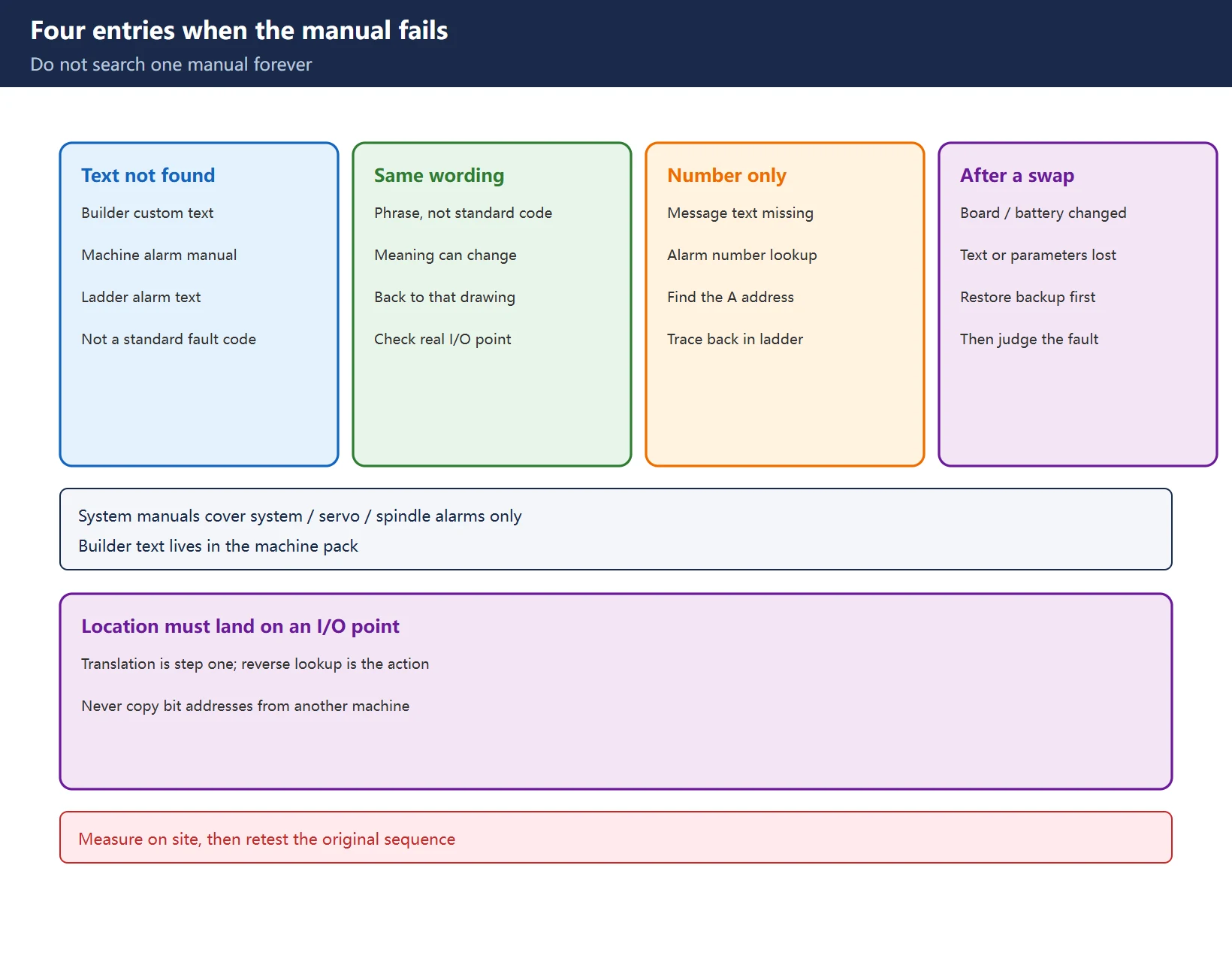
| Symptom | Meaning | Correct entry |
|---|---|---|
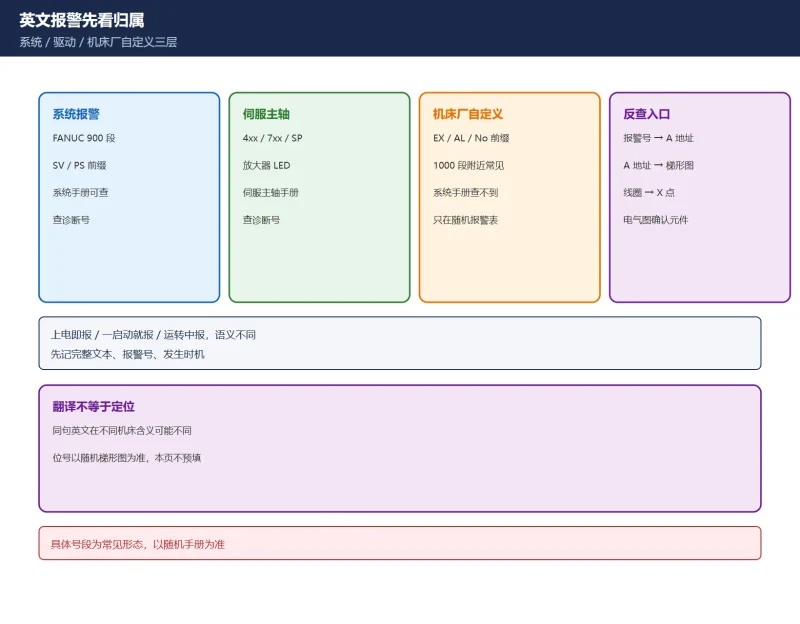
| Text not found in the system manual | Machine-builder custom text | Machine alarm manual / ladder alarm text |
| Same English wording, different meaning on another machine | Phrasing, not a standard code | That machine's drawings and ladder |
| Number only, no description | Message text missing or lost | Alarm number to A-address reverse lookup |
| Appeared after board or battery replacement | Text or parameters lost | Restore backup before judging |
Table 4 Four entries when the manual has no answer
These are builder-written hints, not standard fault codes. Translation is step one; location must land on that machine’s I/O point.
6. Three field questions and the four-step chain
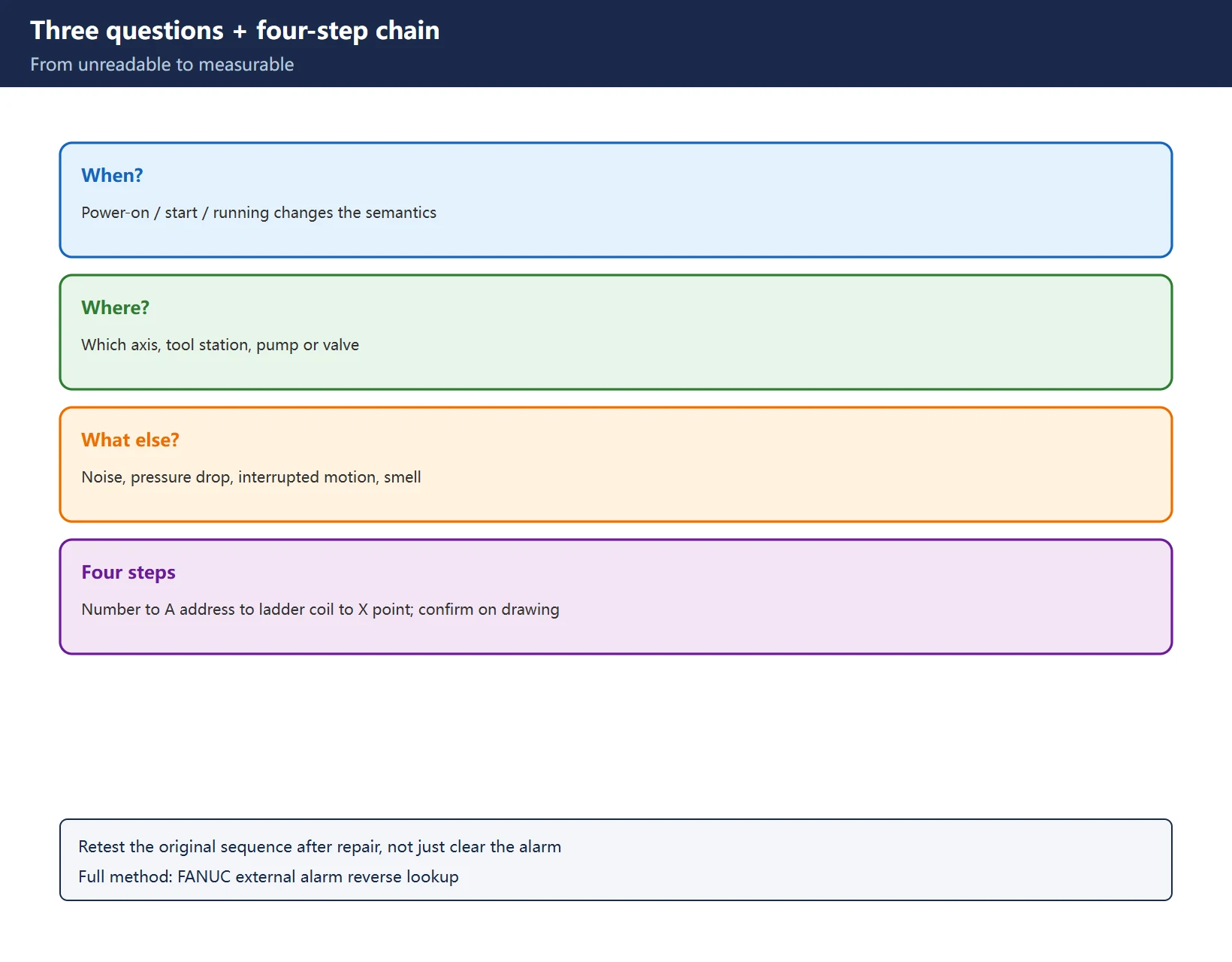
Ask three questions:
- When did it appear? Power-on / cycle start / during motion changes the semantics.
- Where? Which axis, tool station, pump or valve?
- What else? Noise, smell, pressure drop, interrupted motion.
Four-step reverse lookup:
- Alarm number to its A address in the PMC maintenance screen;
- A address to the ladder coil;
- Coil traced back through contacts to the X point or internal relay;
- Confirm on the electrical drawing, measure on site, then retest the original sequence.
See external alarm four-step tracing and five peripheral alarm clusters.
Frequently Asked Questions
I cannot read an English CNC alarm. Which keywords should I memorise first?
Start with NOT READY, OVERLOAD, FAULT, TIMEOUT, LOW, INTERLOCK and NOT IN POSITION. They decide the first check: precondition, mechanical load, failed action, timeout, out-of-range quantity, interlock or position feedback. A dictionary translation alone is not enough.
Why can’t I find an English alarm in the FANUC manual?
Most likely it is machine-builder text. The builder triggers an alarm through a PMC A address and writes the English message into the display. FANUC manuals only cover system, servo and spindle alarms; builder text lives in the machine’s alarm manual and ladder. Trace from alarm number to A address to ladder to I/O point.
For OVERLOAD alarms, check mechanical or electrical first?
Mechanical first. OVERLOAD usually means obstructed motion: chips, jams, overloading and poor lubrication are far more common than a burned motor. Clear the obstruction and check gearing and load, then measure current, thermal relay and insulation. The exact trigger is in that machine’s ladder.
Last updated: 2026-11-16
Where to go next
- FANUC Troubleshooting — the full guide library: alarms, diagnosis numbers, servo, spindle, PMC and electrical faults, organised by symptom.
- CNC Repair Tools — which instrument measures what: multimeters, clamp meters, insulation testers and oscilloscopes, with the specification that actually matters.
- Remote Technical Support — have the readings reviewed with you: alarm reverse lookup, PMC ladder analysis and servo tuning advice by call. Repair companies and integrators welcome.
- Buying & Ownership Decisions — refurbished vs new, used-machine checks, software licensing and manuals: spend with the field facts in hand.
Read the guide, get the right instrument, or walk the diagnosis through with someone — pick whichever you need.
The original Chinese version — same procedure, with the full field notes.













暂无评论内容