


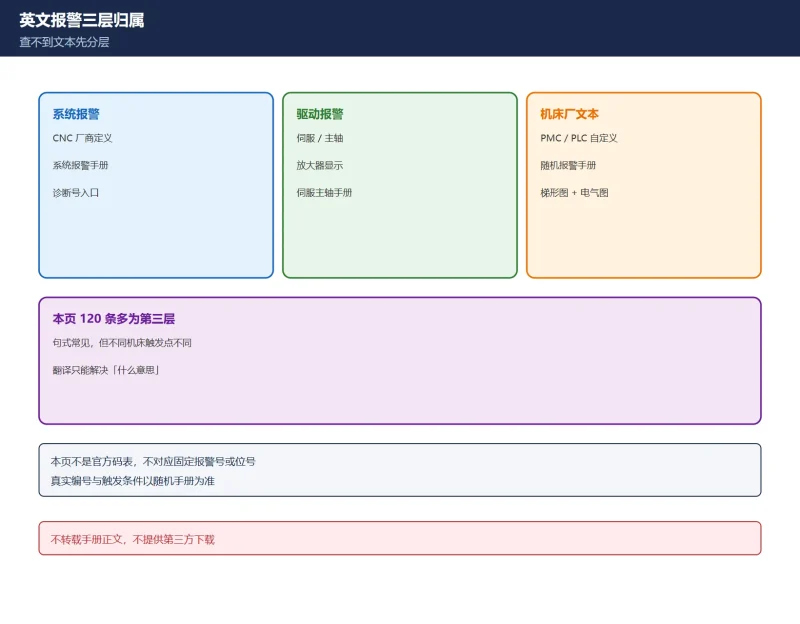
🚨 Scope and compliance: The number framework and PLC alarm addresses here are cross-checked against the public GSK988T User Manual (Volume II) Appendix A.8 and the GSK980TDb standard-ladder alarm table. The manual explicitly states that PLC alarm text is defined by the STANDARD ladder and the actual machine follows its own ladder – machine builders may have modified it, so the address table here must not be applied blindly. P/S and process ranges are framework only; refer to the machine manual for exact text. This page reproduces no manual content and provides no download links.
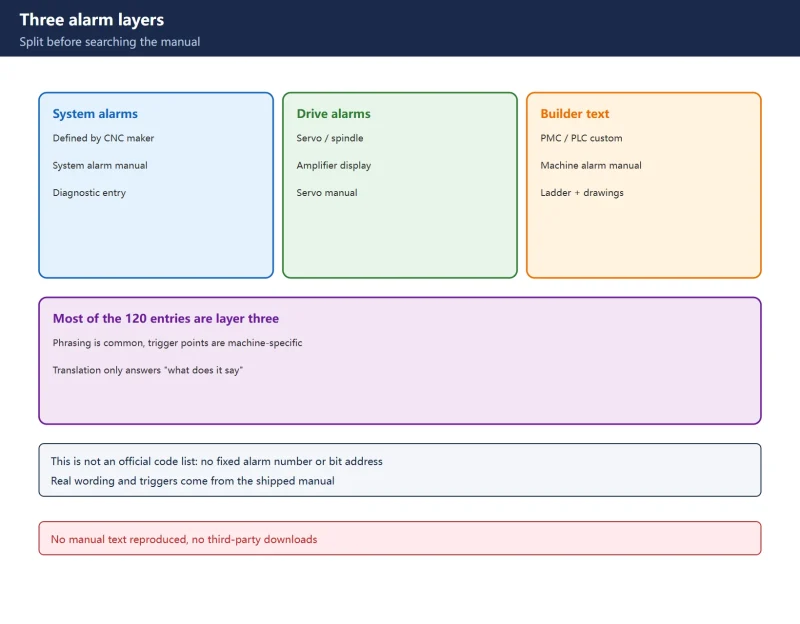
30-second triage: identify the system, then the number
| Step | Action | Why |
|---|---|---|
| 1 | Read the model: 980T / 980TD / 988T / 988TA | Three-digit vs four-digit, different ranges |
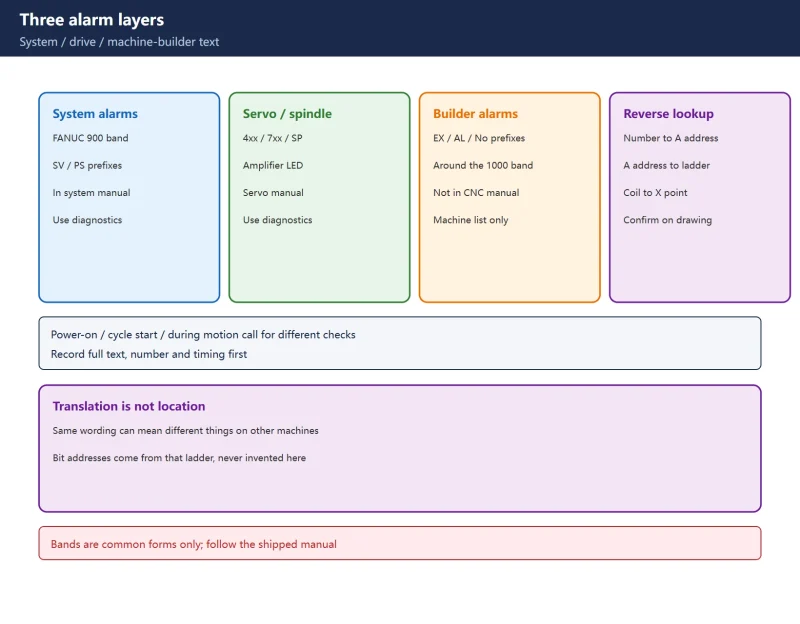
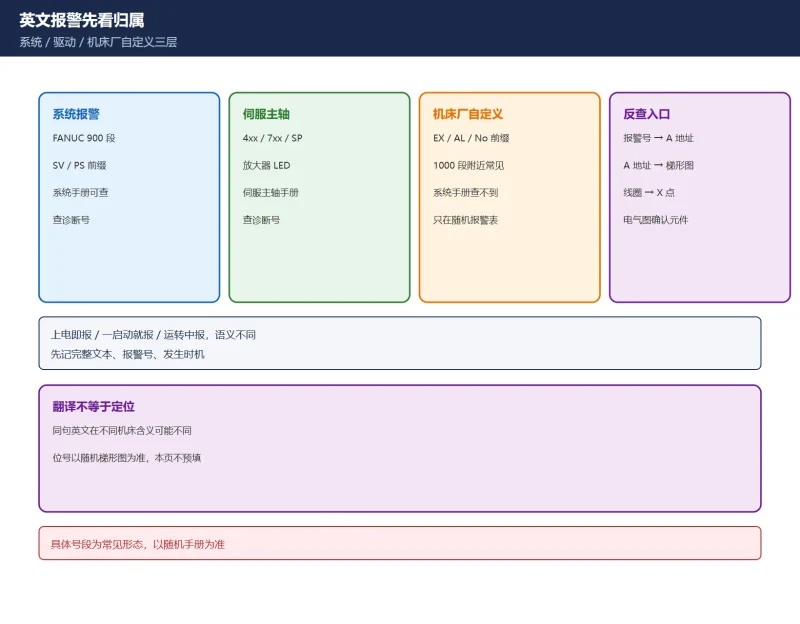
| 2 | Separate NC alarms from PLC alarms (1000 range) | Different screens and tables |
| 3 | For PLC alarms, check the ladder version | Same number, different meaning and address |
Table 0 Three-step GSK alarm triage
Related: CNC alarm number formats by brand and Fanuc alarm / parameter / diagnostic cross-reference. See also legacy 0i-B/0i-C alarms: same number, different board.
1. Four system generations and their alarm formats
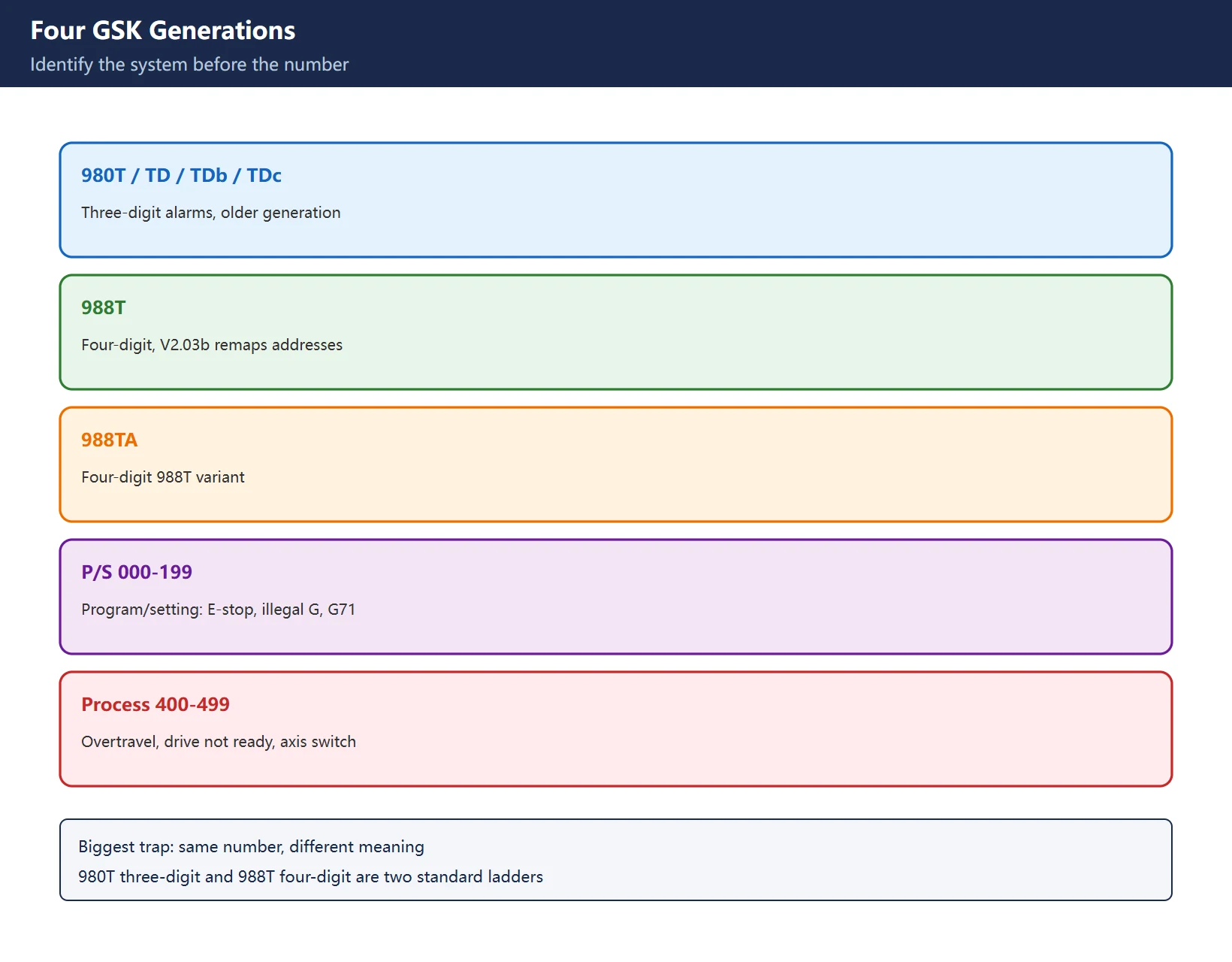
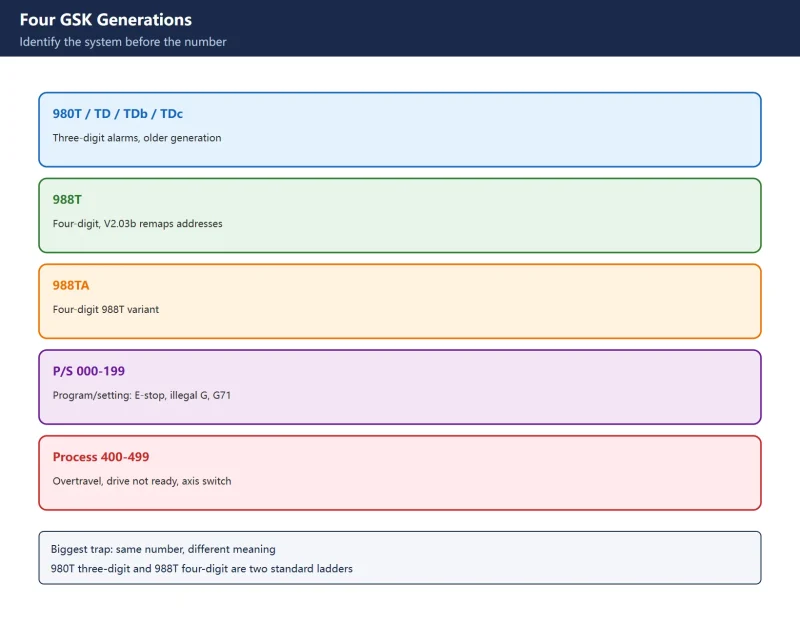
| System | Digits | Note |
|---|---|---|
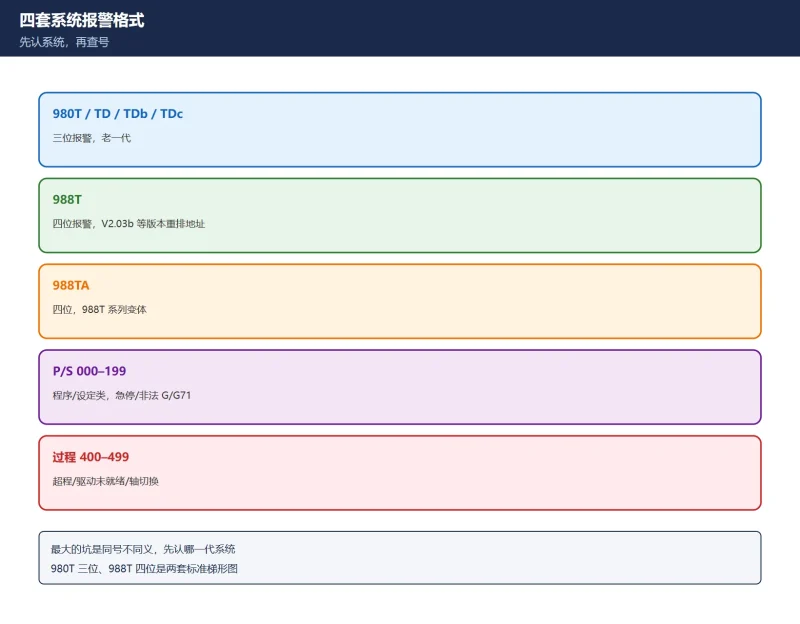
| GSK980T / 980TD / 980TDb / 980TDc | Three | Older generation; PLC alarms use A0000.x bits |
| GSK988T | Four | Newer; ladder V2.03b etc. remaps addresses |
| GSK988TA | Four | Variant of the 988T family |
Table 1 GSK alarm formats by generation
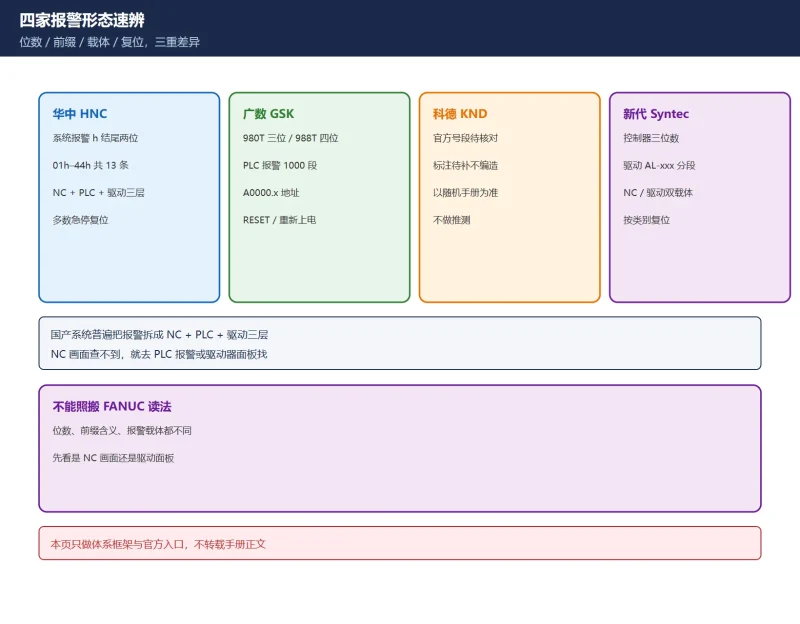
The biggest trap is same-number-different-meaning: alarm 1001, 1016, 1037 mean different things on 980TDb and 988T, and sit at different A-address bits. They are two generations with two standard ladders. Always confirm the system generation first.
2. P/S alarms: the 000-199 range
P/S (program/setting) alarms sit in 000-199: E-stop not released, program not started, illegal G code, G71 contour definition errors and similar. Check machine state first (E-stop / reset / mode), then the program block, and only then parameters. Exact numbering is not identical across systems, so this page gives the framework rather than a full transcription that could mislead.
3. Process alarms: the 400-499 range
Process alarms sit in 400-499: overtravel, drive not ready, PLC axis-switch failures and similar. Decide first whether it is a mechanical position issue (overtravel) or an electrical state issue (drive not ready), then trace the I/O signal chain.
4. PLC alarms 1000-1037 and A-address mapping
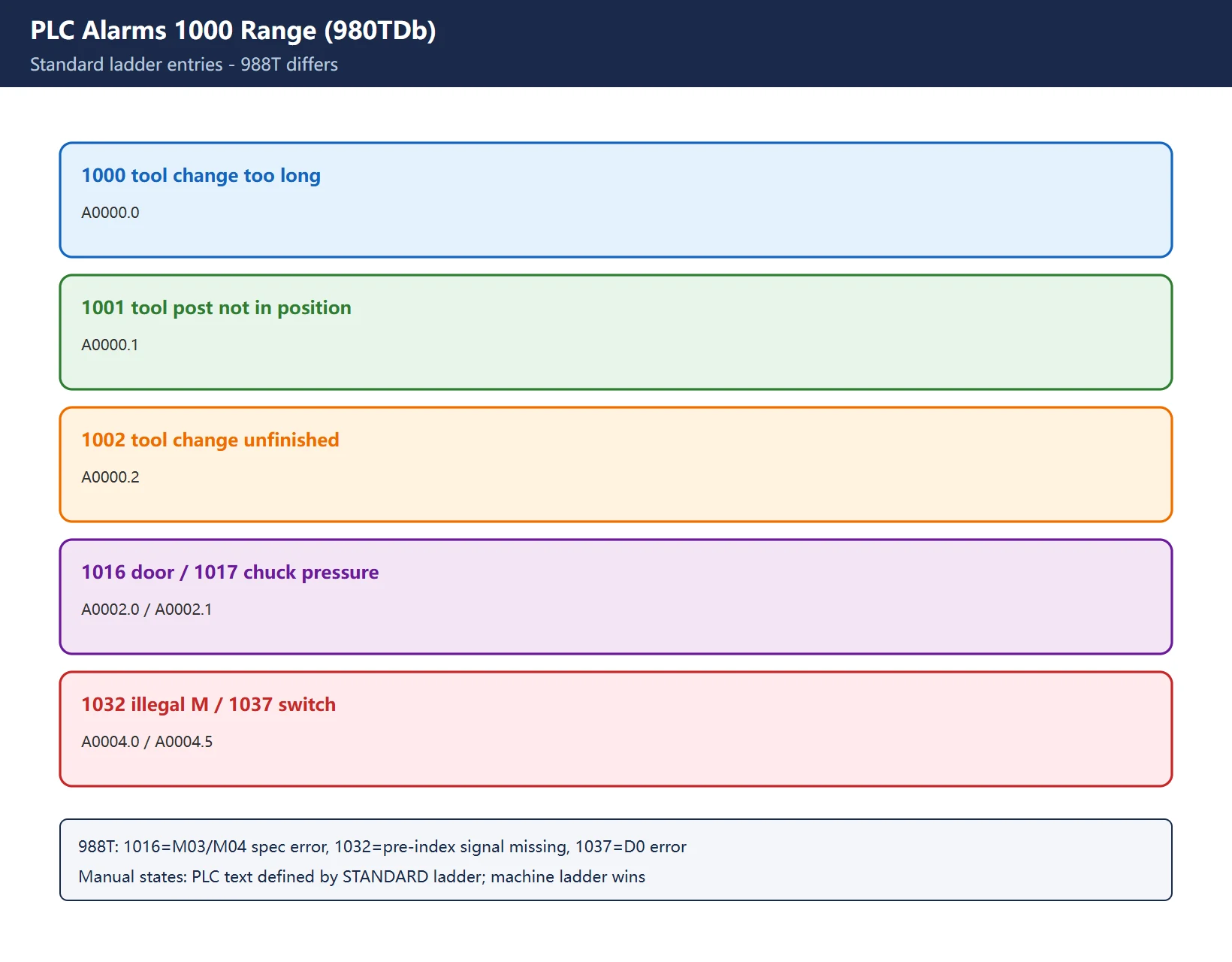
This is the most useful table for GSK field work. PLC alarm numbers map to A-address bits, and the bit sits on a ladder rung. For the GSK980TDb standard ladder (selected common entries):
| Alarm | Meaning (980TDb standard ladder) | Address |
|---|---|---|
| 1000 | Tool change time too long | A0000.0 |
| 1001 | Tool post not in position at end of tool change | A0000.1 |
| 1002 | Tool change unfinished | A0000.2 |
| 1016 | Protection door not closed | A0002.0 |
| 1017 | Chuck low pressure | A0002.1 |
| 1032 | Illegal M code | A0004.0 |
| 1037 | Spindle speed/position switch time too long | A0004.5 |
Table 2 GSK980TDb standard-ladder PLC alarms (common entries)
988T is NOT this table: in 988T (V2.03b), 1016 is M03/M04 specification error (A0002.0), 1032 is pre-indexing proximity switch signal not received (A0004.0), and 1037 is D0 setting error (A0004.5). Same numbers, entirely different meanings and addresses. For 988T, always use the 988T manual appendix – never the 980T table.
Tracing method: alarm number → A-address bit → find that bit in the ladder → identify which input signal it monitors → meter the field device (limit switch, pressure relay, door switch) at the terminal strip.
5. Same number, different fault: 980T 1001 vs 988T 1001
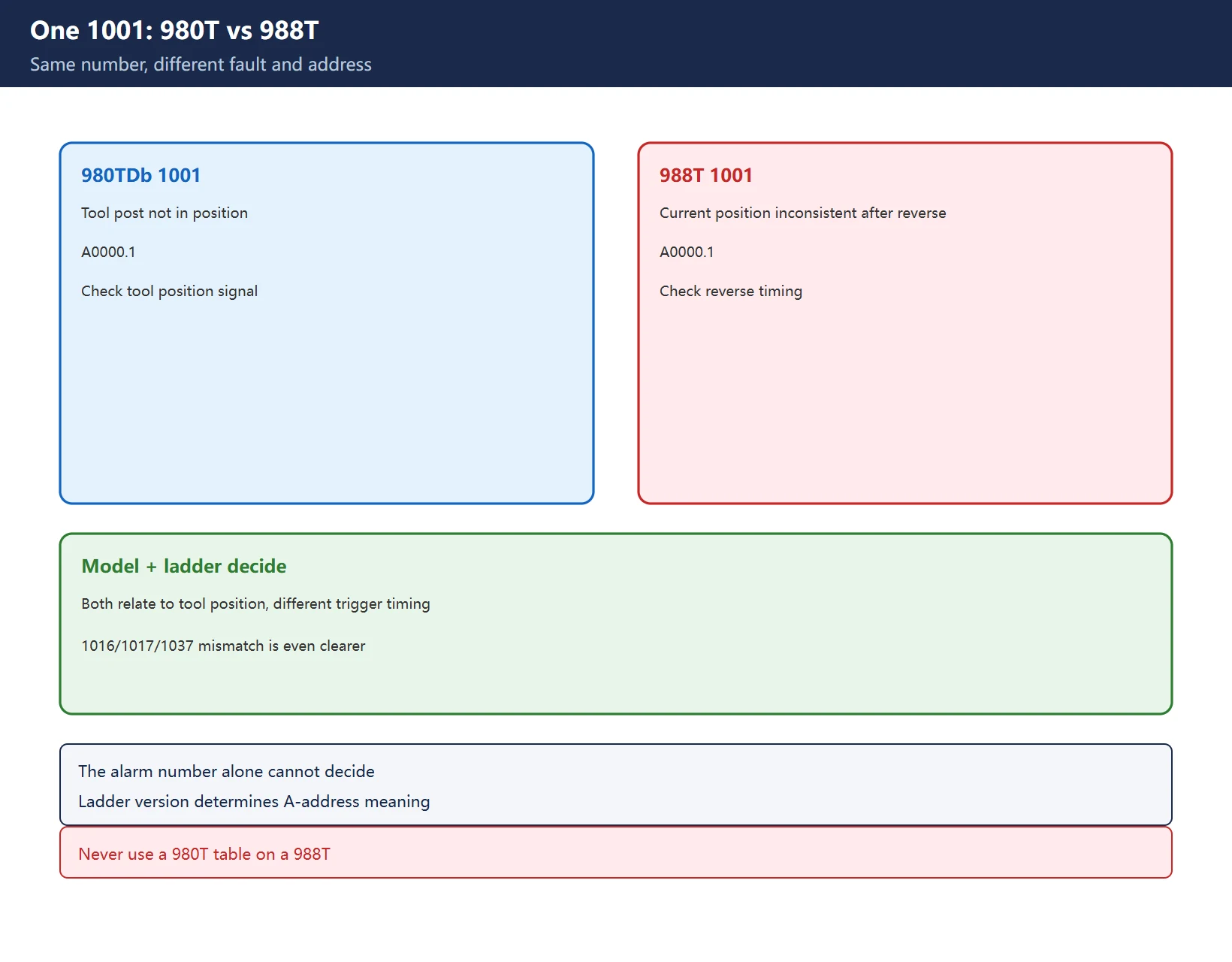
Put the two 1001 entries side by side: on 980TDb it is “tool post not in position at end of tool change”; on 988T it is “after reverse rotation, current tool position inconsistent with expected”. Both relate to tool position, but the trigger timing and diagnostic path differ. The mismatch is even clearer on 1016/1017/1037. The deciding factor is the system model plus ladder version, never the alarm number alone.
Table 3 Same-number-different-meaning examples
6. Official manuals and version matching
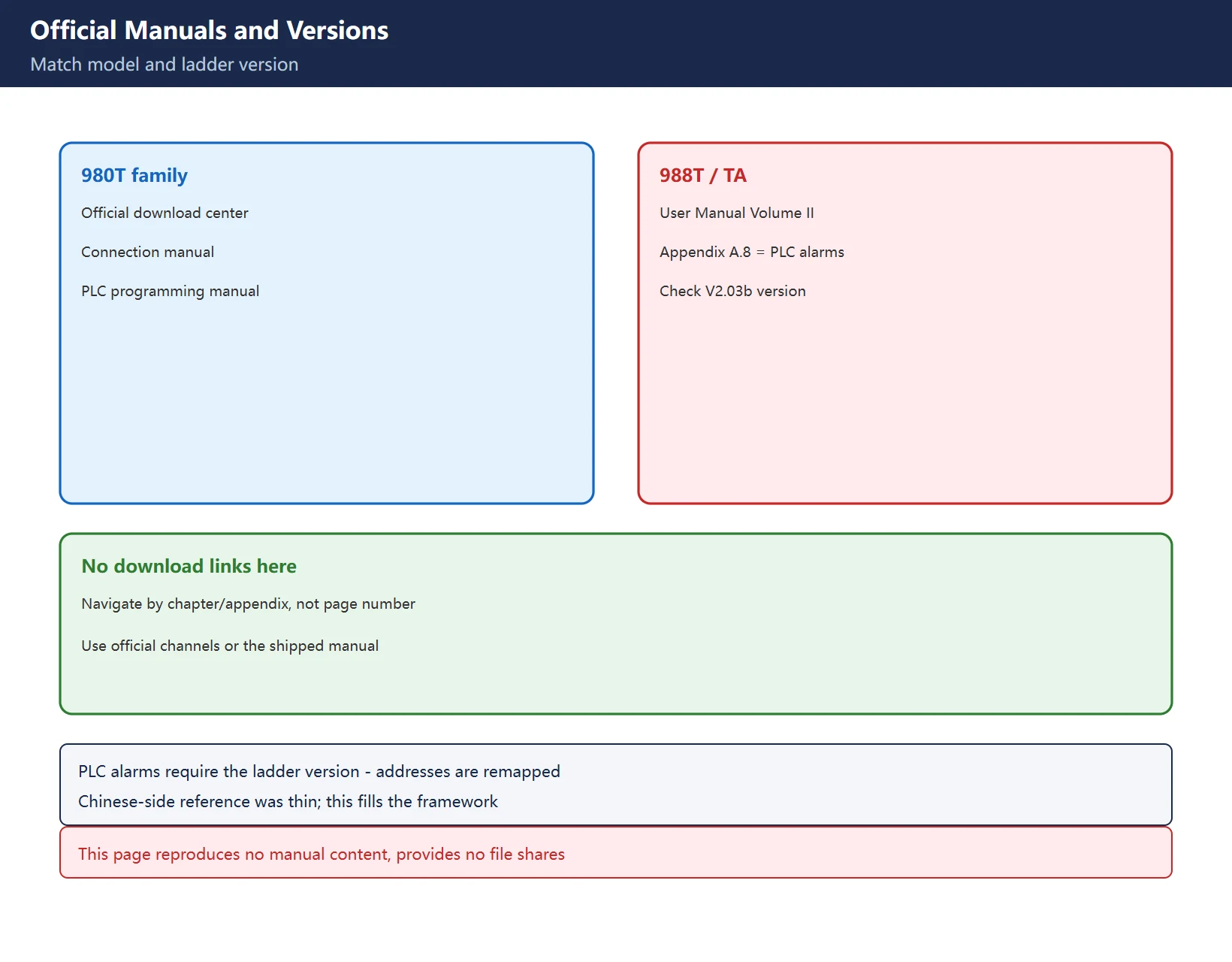
On the GSK official site’s download center, look up the manual by system model: 980T family uses the connection manual and PLC programming manual; 988T uses the “Turning CNC System User Manual” Volume II (Appendix A.8 is the PLC alarm table). For PLC alarms, always check the ladder version (e.g. 988T V2.03b), because addresses are remapped between versions. Navigate by chapter/appendix number, not page number.
This page provides no PDF links or file shares; use the official download center or the manual shipped with the machine.
Frequently Asked Questions
Are GSK 980T and 988T alarm codes interchangeable? Why does the same number mean different things?
No. 980T uses three-digit alarms and 988T four-digit; they are two generations with two standard ladders. The same PLC alarm number (e.g. 1016, 1037) has different meanings and A-address bits on the two systems. Confirm the system model and ladder version first.
Which address does GSK alarm 1000-series map to? Where do I find a tool-change-timeout PLC alarm?
The 1000 range is PLC alarms, mapped to A0000.x bits. For the 980TDb standard ladder, 1000 tool-change time too long = A0000.0 and 1001 tool-post mismatch = A0000.1. But the 988T address table differs, and machine builders may have modified the ladder – defer to the machine’s own ladder and alarm table.
Where do I download the GSK alarm code table? Which official PDF versions exist?
Use the GSK official download center and select by system: 980T, 980TDb/c, 988T, 988TA each have their own manuals; the 988T PLC alarm table is in the User Manual Volume II Appendix A.8. This page provides no download links – use official channels.
Last updated: 2026-11-16
Beyond GSK ranges: GE Fanuc badge and board-number spares
Where to go next
- FANUC Troubleshooting — the full guide library: alarms, diagnosis numbers, servo, spindle, PMC and electrical faults, organised by symptom.
- CNC Repair Tools — which instrument measures what: multimeters, clamp meters, insulation testers and oscilloscopes, with the specification that actually matters.
- Remote Technical Support — have the readings reviewed with you: alarm reverse lookup, PMC ladder analysis and servo tuning advice by call. Repair companies and integrators welcome.
- Buying & Ownership Decisions — refurbished vs new, used-machine checks, software licensing and manuals: spend with the field facts in hand.
Read the guide, get the right instrument, or walk the diagnosis through with someone — pick whichever you need.
The original Chinese version — same procedure, with the full field notes.

















暂无评论内容