


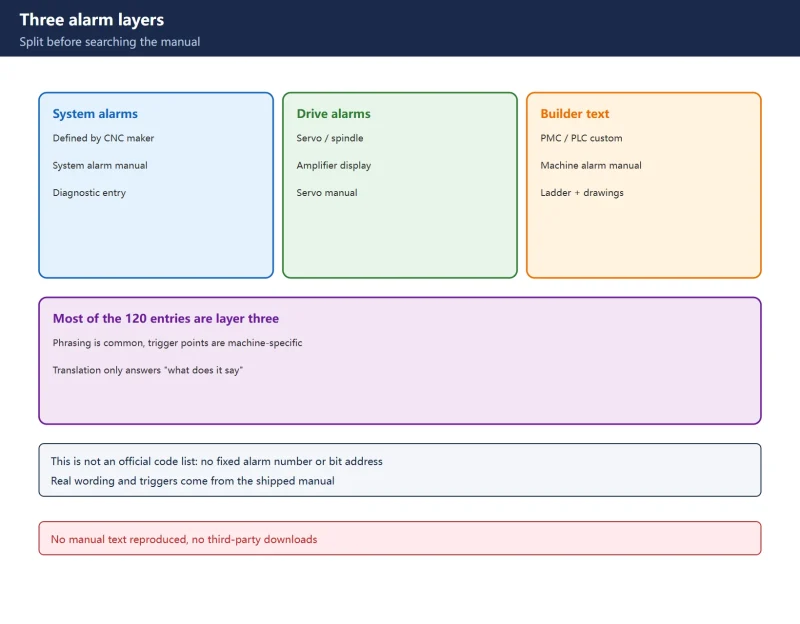
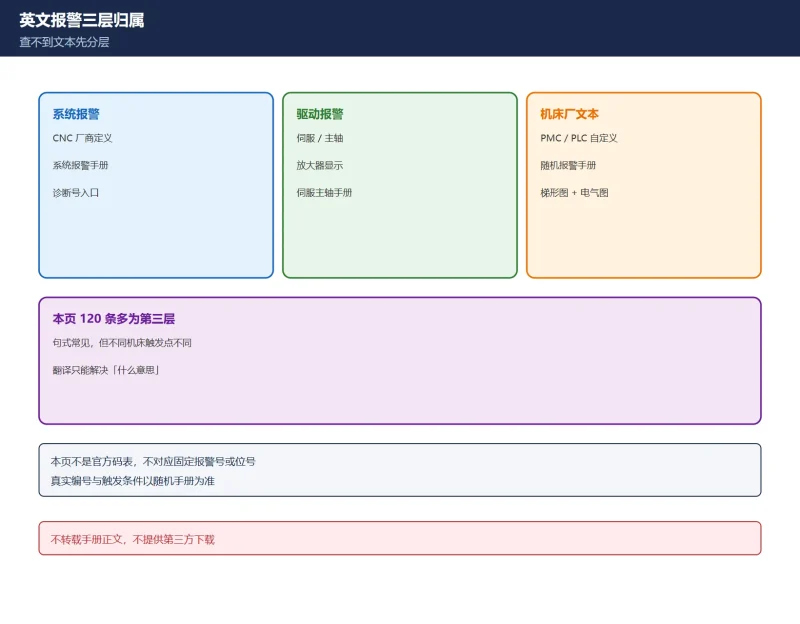
🚨 Scope and compliance: English alarm texts below are common field phrasings, not an official code list from any CNC maker or machine builder. Actual alarm numbers, PMC/PLC addresses, wording and trigger conditions must come from the electrical drawings, ladder and alarm manual shipped with that machine. This page does not provide or invent any machine-builder bit address. No manual text is reproduced and no third-party download links are given. The reverse-lookup method is covered in FANUC external alarm reverse lookup.
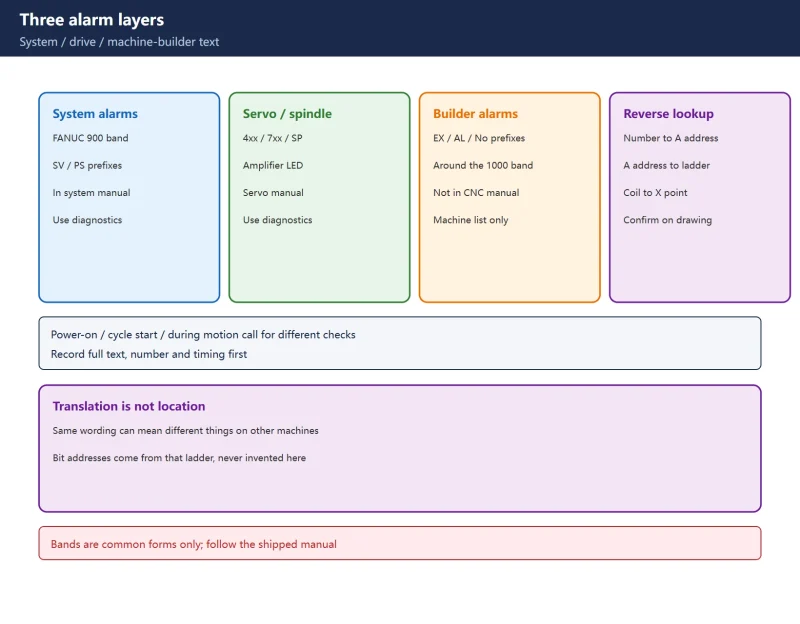
30-second triage by timing
| When it appears | Likely class | First check |
|---|---|---|
| At power-on | Initial sensor state unmet (low level/pressure, valve not homed, E-stop not cleared) | Actual switch state and wiring |
| On cycle start | Precondition missing (NOT READY / INTERLOCK) | Enable chain and precondition bits |
| During operation | Movement obstructed (OVERLOAD / TIMEOUT / LOW PRESSURE) | Mechanical load first, then electrical |
Table 0 Three-phase triage of peripheral alarms
Related: 120 English alarm phrases and 30-second triage, external alarm reverse lookup, spindle unclamp air supply, gravity-axis brake, spindle alarm timing.
1. Machine-builder alarms vs system alarms
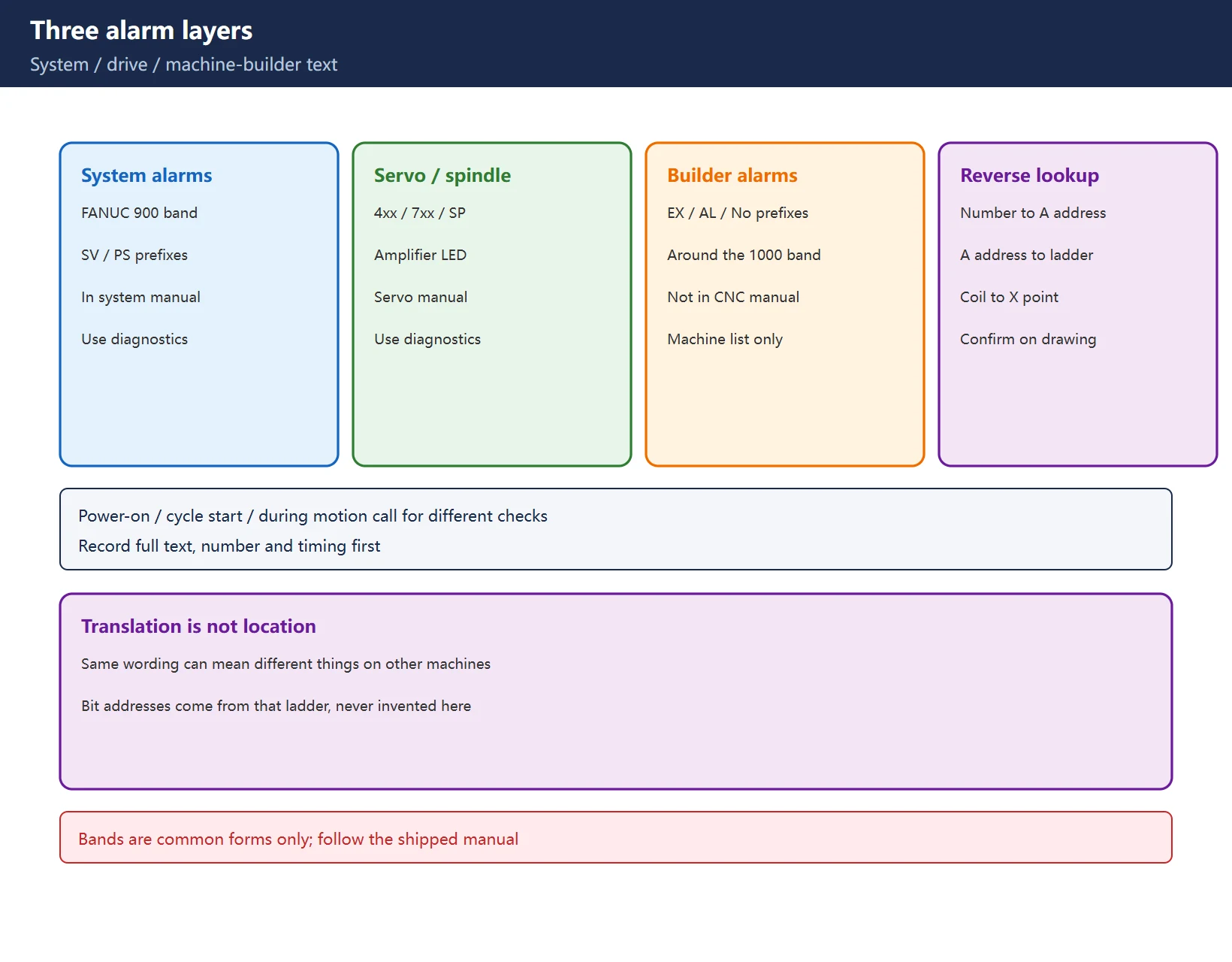
| Class | Written by | In the CNC manual? | Lookup entry |
|---|---|---|---|
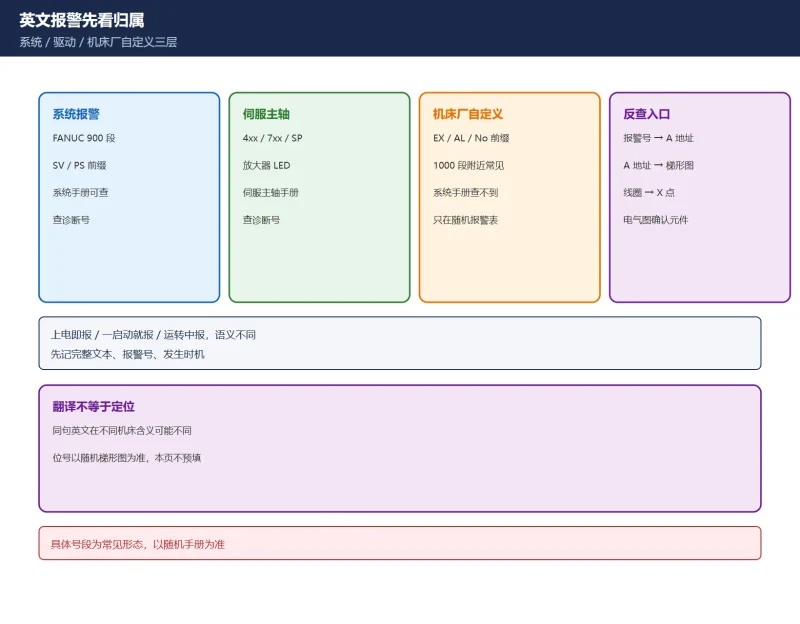
| System alarms (e.g. 900-band, SV/PS prefixed) | CNC maker | Yes, system alarm manual | Diagnostic / alarm number |
| Servo and spindle alarms (4xx / 7xx / SP series) | CNC maker | Yes, servo/spindle manual | Amplifier LED / diagnostic |
| Peripheral alarms (often EX/AL/No prefixed, around the 1000 band) | Machine builder | No – only in the machine's own list | Alarm number to A address to ladder to I/O point |
Table 1 Alarm ownership and lookup entries (bands are common forms only)
A simple test: if the CNC manual has no entry and the same English wording means something different on another machine, it is a machine-builder alarm. Translation is not diagnosis – the alarm must be traced to that machine’s input point and ladder condition.
2. Cross-system matrix of five subsystems
| Subsystem | Common wording (examples) | Trigger semantics | Feedback device | First action |
|---|---|---|---|---|
| Coolant | COOLANT NOT READY / COOLANT FLOW FAULT / COOLANT LEVEL LOW | not ready / flow failure / low level | level, flow, pressure relay, thermal relay | Check pump rotation and piping, not just whether the motor turns |
| Lubrication | LUBRICATION PRESSURE LOW / OIL LEVEL LOW / LUB PUMP OVERLOAD | low pressure / low oil / pump overload | pressure switch, level switch, pump thermal relay | Check lube sequence and distributor delivery |
| Chip conveyor | CHIP CONVEYOR OVERLOAD / CONVEYOR JAM / CHIP REMOVAL FAULT | stalled / jammed / action failed | thermal relay, overload relay, torque feedback | Clear chips first, then gearbox and chain |
| Air | AIR PRESSURE LOW / CLAMP AIR NOT READY / AIR LEAK | low pressure / clamp air not ready / leakage | pressure switch, airline filter-regulator-lubricator | Check FRL setting and leak points |
| Hydraulics | HYDRAULIC PRESSURE LOW / HYD OIL TEMP HIGH / HYD PUMP FAULT | low pressure / high oil temperature / pump fault | pressure relay, temperature switch, pump | Check relief valve, filter, oil temperature and pump |
Table 2 Five-subsystem matrix (example phrasings, not an official code list)
The same English sentence can be driven by completely different devices on different machines. The “feedback device” column is a probability clue, not an address.
3. Coolant: a running pump is not proof of flow
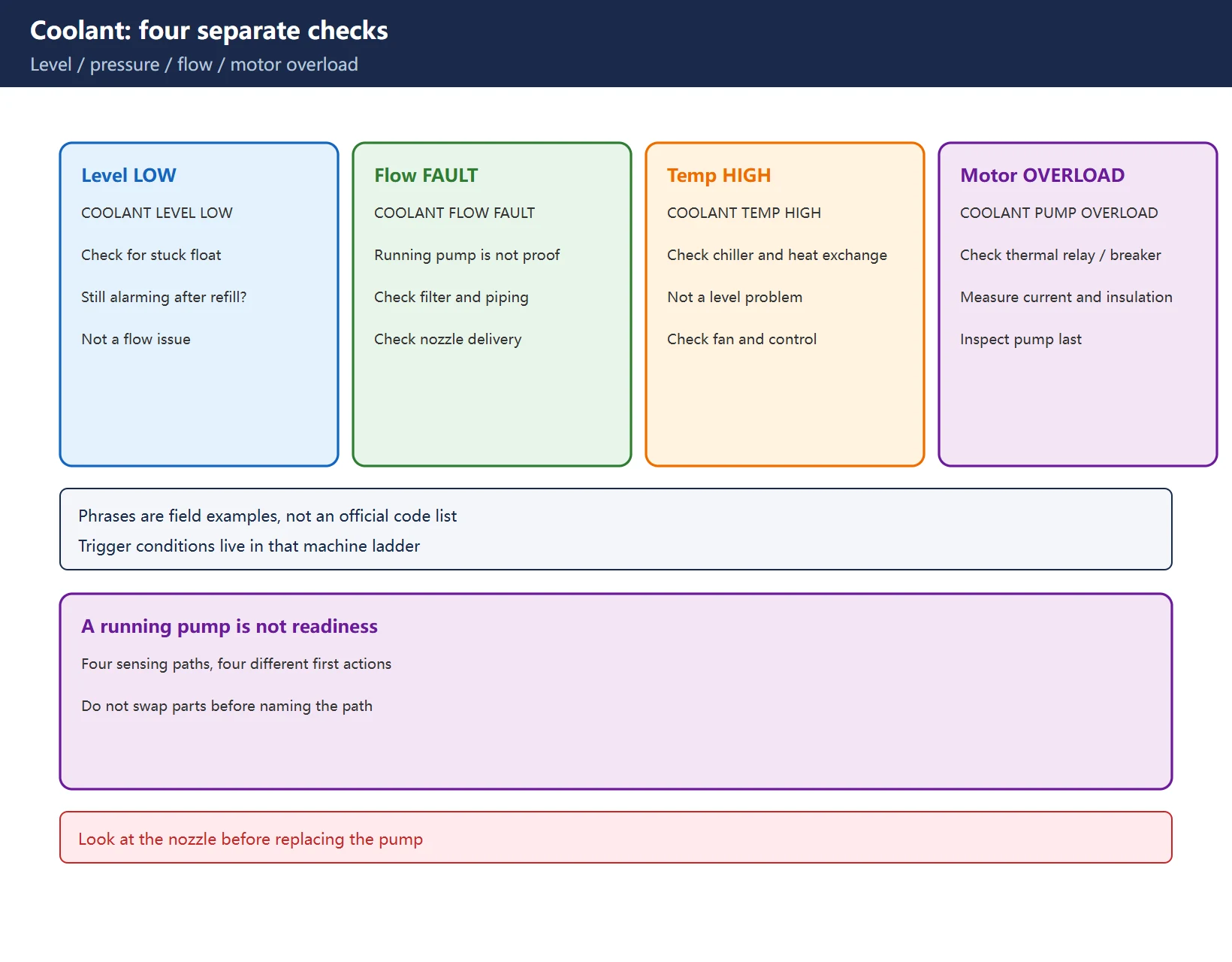
A coolant branch is easy to misdiagnose as a bad pump. Four separate sensing paths exist:
- Level switch:
COOLANT LEVEL LOWreports level, not flow. A stuck float can keep the alarm after refilling. - Flow / pressure sensing:
COOLANT FLOW FAULTasks whether coolant reaches the nozzle. A blocked line, clogged filter or worn impeller still alarms with the motor running. - Temperature sensing:
COOLANT TEMP HIGHpoints to the chiller or heat exchange, not the level. - Motor thermal relay / breaker:
COOLANT PUMP OVERLOADis the only one that points to the motor circuit – check insulation and current first.
Table 3 Four coolant sensing paths and their wording
Rule of thumb: separate “no liquid / no pressure / no flow / motor overload” before replacing anything.
4. Lubrication: pressure switch, oil level and pump overload
Separate the pumping action from the confirmation of delivery:
- Does the pump start on its ladder timer and interval?
- Does the pressure switch close within the expected time? If not:
LUBRICATION PRESSURE LOW. - Is the level switch healthy? If not:
OIL LEVEL LOW. - Does oil actually reach the lubrication points? A blocked distributor can prevent pressure build-up even when the pump runs.
LUB PUMP OVERLOAD points to the thermal relay and motor, not to an oil shortage. For the full metering sequence and X-point tracing, see the external alarm reverse-lookup guide.
5. Chip conveyor: overload usually means a jam
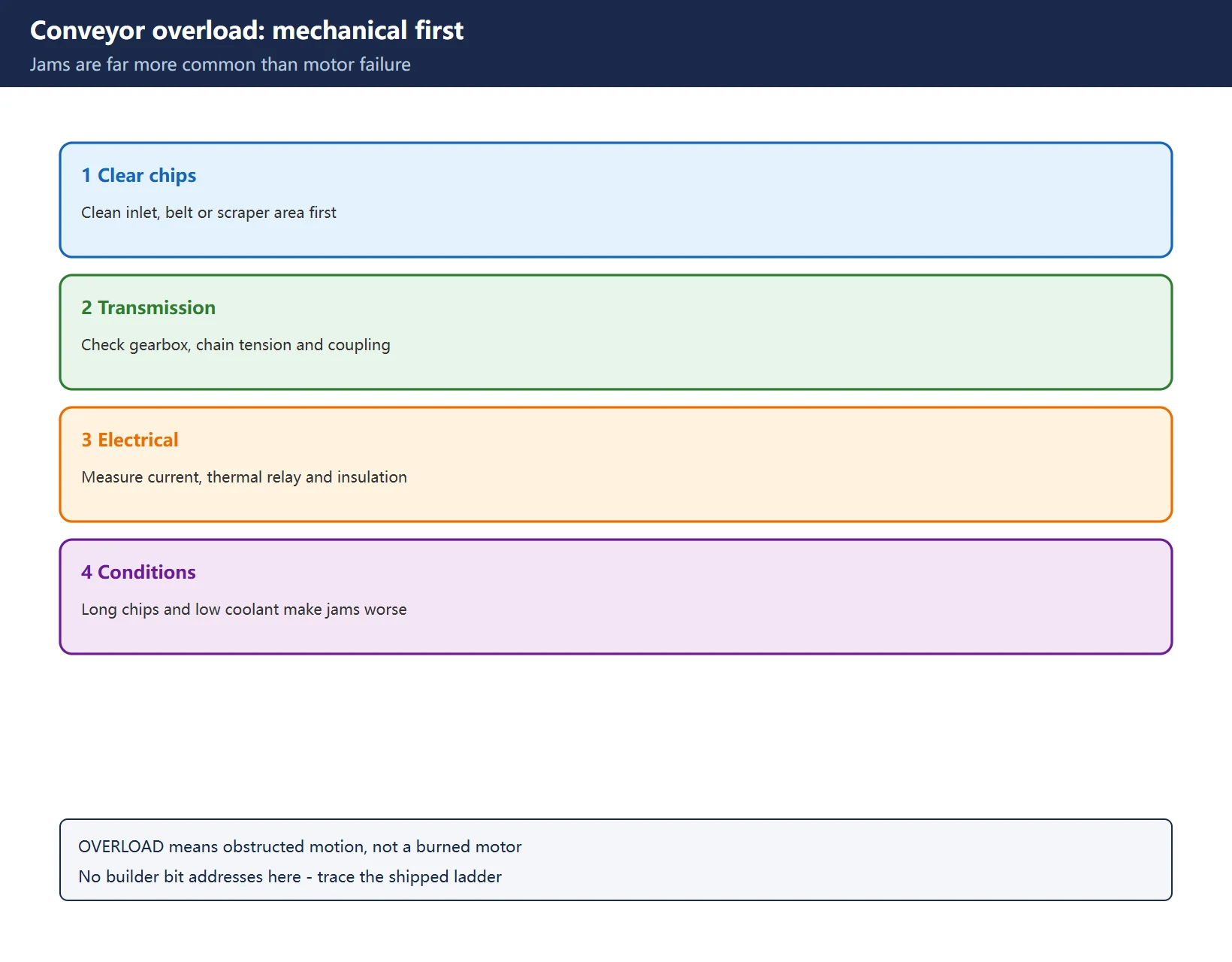
CHIP CONVEYOR OVERLOAD / CONVEYOR JAM normally means the moving mechanism is obstructed, not that the motor burned out:
- Stop and clear chips at the inlet and around the belt/scraper;
- Check gearbox, chain tension and coupling for binding;
- Only then measure motor current, thermal relay setting and insulation;
- Long stringy chips and insufficient coolant make jams worse, so check chip-breaking and coolant delivery too.
Table 4 Four-level positioning of a conveyor overload
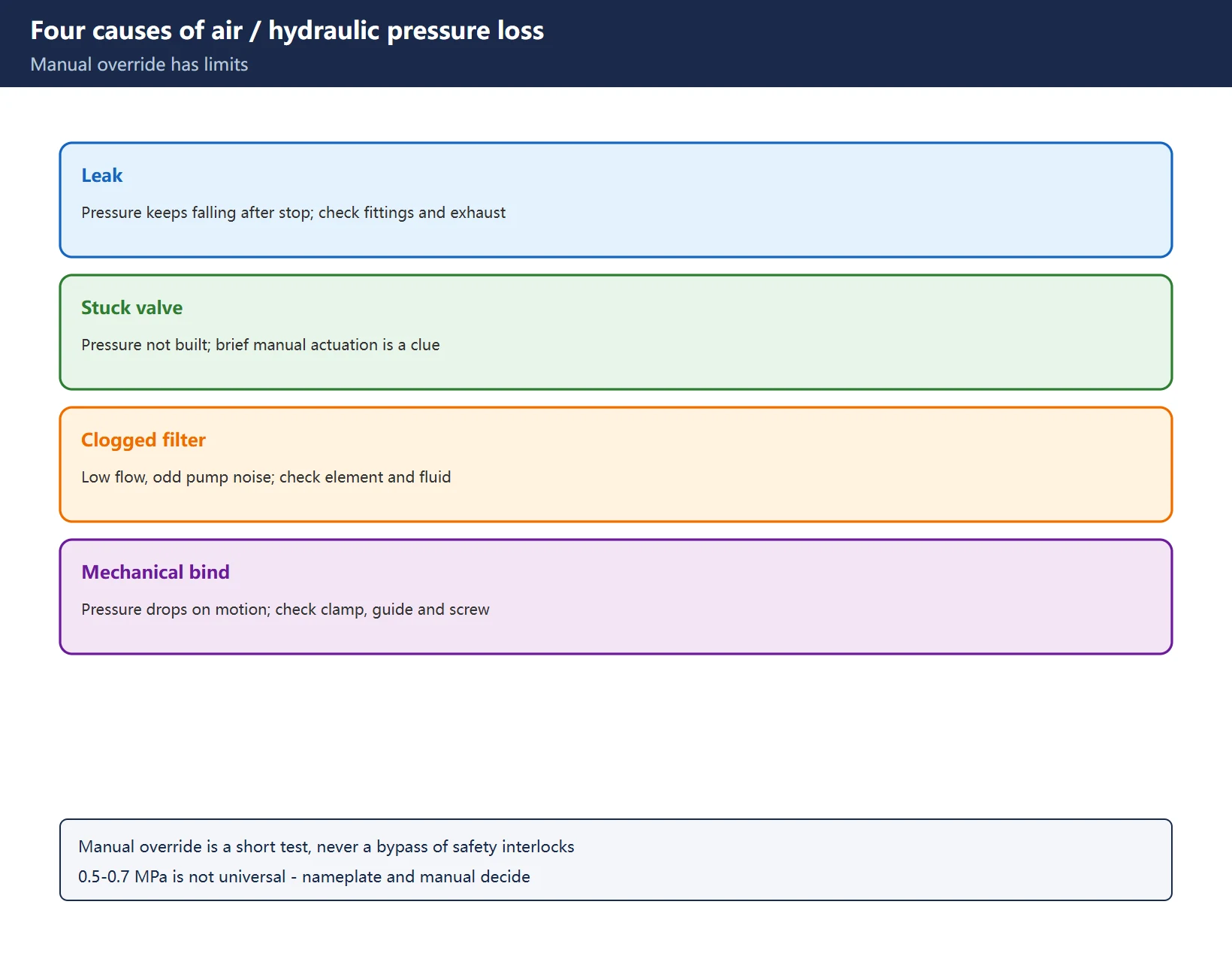
6. Air and hydraulics: four causes of pressure loss
| Cause | Typical sign | First check |
|---|---|---|
| Leak | Pressure keeps falling after stop | Fittings, seals, valve exhaust ports |
| Stuck valve / not reset | Pressure does not build after a move | Manually actuate the valve briefly and watch pressure |
| Clogged filter | Low flow, abnormal pump noise | Filter element, strainer, fluid contamination |
| Mechanical load | Pressure drops as soon as the axis/clamp moves | Cylinder, clamp mechanism, guide and screw |
Table 5 Four causes of pressure loss
Manual override boundary: briefly actuating a solenoid can prove whether the valve and hydraulic path work, but it does not replace a full cycle test and must never bypass safety interlocks. For clamping, spindle unclamp or gravity-axis brake circuits, confirm mechanical state and personnel safety first – see spindle unclamp air supply and gravity-axis brake sequencing. Commonly quoted figures such as 0.5-0.7 MPa are not universal; the machine nameplate and its manual decide.
7. General framework: turn text into an action
All five clusters share one reverse-lookup chain:
- Record the full text, alarm number, timing and concurrent motion;
- Classify semantics:
NOT READY(precondition),OVERLOAD(obstructed motion),FAULT(action failed),TIMEOUT,LOW(quantity),INTERLOCK; - Find the A address or internal relay tied to that alarm number in the PMC/PLC;
- Trace back from the coil to its contacts and finally to the X point;
- Confirm the device on the electrical drawing, measure on site, then retest the original sequence.
Full four-step method: FANUC external alarm reverse lookup; ATC-specific builder alarms: ATC 1010-1024 tracing. The power-on / start / running split is the same pattern used in spindle alarm triage.
Frequently Asked Questions
Does COOLANT NOT READY mean the coolant level is low?
Not necessarily. NOT READY says a precondition is unmet; level, flow, pressure, temperature or the thermal relay can each be responsible. The pump may run while the line is blocked, the filter clogged or the impeller worn. Identify the sensing path before topping up or replacing the pump.
Is CHIP CONVEYOR OVERLOAD a bad motor or a jam?
OVERLOAD in most shop contexts means obstructed motion, and jams are far more common than motor failures. Clear chips, then check gearbox, chain and coupling, and only then measure current and insulation. The exact trigger condition is in that machine’s ladder.
Why does manually actuating a solenoid help diagnose low hydraulic pressure?
Manual actuation bypasses the control conditions and drives the valve directly. If pressure builds immediately, the valve and hydraulic path are probably healthy and the fault is upstream (interlock, control voltage, coil, signal chain). If pressure still does not build, focus on leaks, filters, pump and relief valve. Keep the override brief and never bypass safety interlocks.
Last updated: 2026-11-16
Where to go next
- FANUC Troubleshooting — the full guide library: alarms, diagnosis numbers, servo, spindle, PMC and electrical faults, organised by symptom.
- CNC Repair Tools — which instrument measures what: multimeters, clamp meters, insulation testers and oscilloscopes, with the specification that actually matters.
- Remote Technical Support — have the readings reviewed with you: alarm reverse lookup, PMC ladder analysis and servo tuning advice by call. Repair companies and integrators welcome.
- Buying & Ownership Decisions — refurbished vs new, used-machine checks, software licensing and manuals: spend with the field facts in hand.
Read the guide, get the right instrument, or walk the diagnosis through with someone — pick whichever you need.
The original Chinese version — same procedure, with the full field notes.

















暂无评论内容