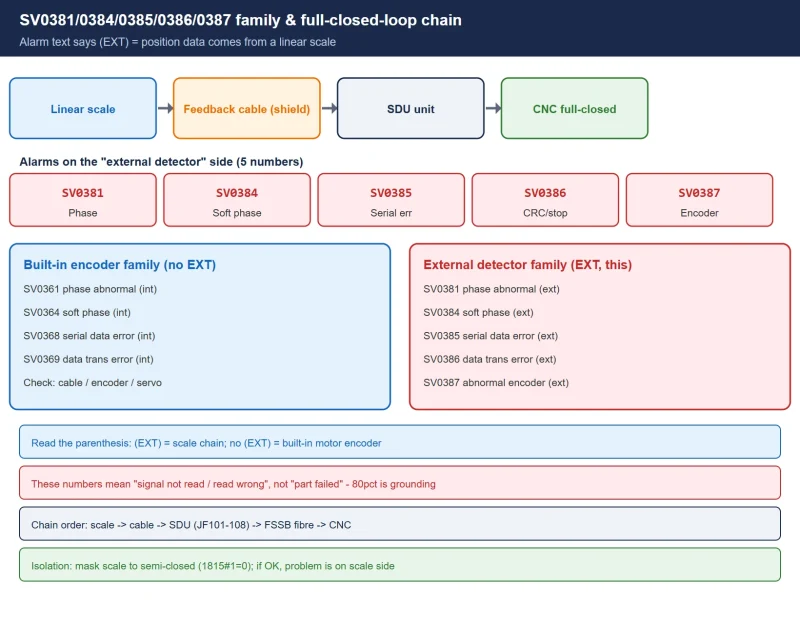



On a full-closed-loop machine, SV0381, SV0384, SV0385, SV0386 and SV0387 often show up alternately, or keep tripping on the same axis. The usual misdiagnosis is “the scale is broken” or “the amplifier is bad”. In fact they all point to one place — the feedback path of an external (separate) detector, i.e. the linear scale — and the most common root cause is not a failed part but poor grounding and shielding that let noise into the encoder signal. This article follows the FANUC alarm manual, technical report TMN01/178E (A-65434EN, “Preventive measures against errors of linear scale caused by noise”) and the Connection Manual (Hardware).
1. Know the family first: SV0381/0384/0385/0386/0387 are all “external detector” alarms
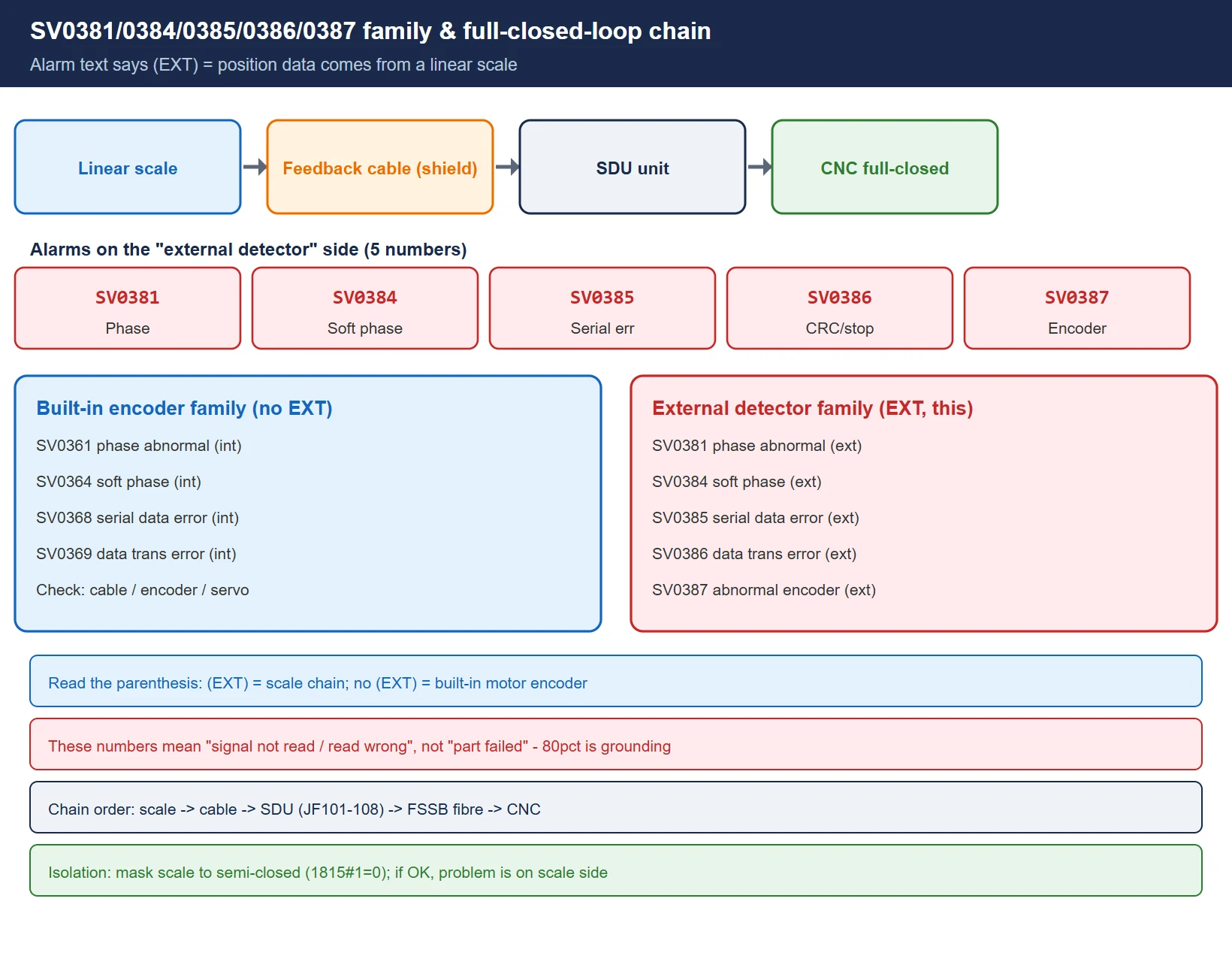
When you see these numbers, the first thing is to check whether the alarm text says “(EXT)” or “external”. If it does, the position data comes from a separate detector such as a linear scale, not the built-in motor encoder and not the servo amplifier. The official FANUC 0i/30i alarm manual descriptions are:
| Alarm | English (alarm manual) | Field meaning |
|---|---|---|
| SV0381 | ABNORMAL PHASE (EXT) | Abnormal position data on the separate detector |
| SV0384 | SOFT PHASE ALARM (EXT) | Digital servo software detected abnormal data on the separate detector |
| SV0385 | SERIAL DATA ERROR (EXT) | Communications data could not be received from the separate detector |
| SV0386 | DATA TRANS. ERROR (EXT) | CRC error or stop-bit error in the communications data |
| SV0387 | ABNORMAL ENCODER (EXT) | Abnormality on the separate detector; contact the scale manufacturer |
This group maps one-to-one to the external detector. SV0380 (LED), SV0382 (count miss) and SV0383 (pulse miss) are also in the external family but not covered here. Do not mix them with the built-in family: the same phase / soft-phase / serial-data errors on the motor encoder are SV0361 / SV0364 / SV0368 / SV0369, with no “(EXT)”. One diagram shows both families and the whole feedback chain:
2. Signal chain and checkpoints: scale → cable → SDU → FSSB → CNC
The external detector does not go straight into the CNC. On a full-closed-loop machine the chain is:
- Linear scale: mounted on the bed, reads the real slide position;
- Feedback cable: shielded cable carrying the scale signal to the interface unit;
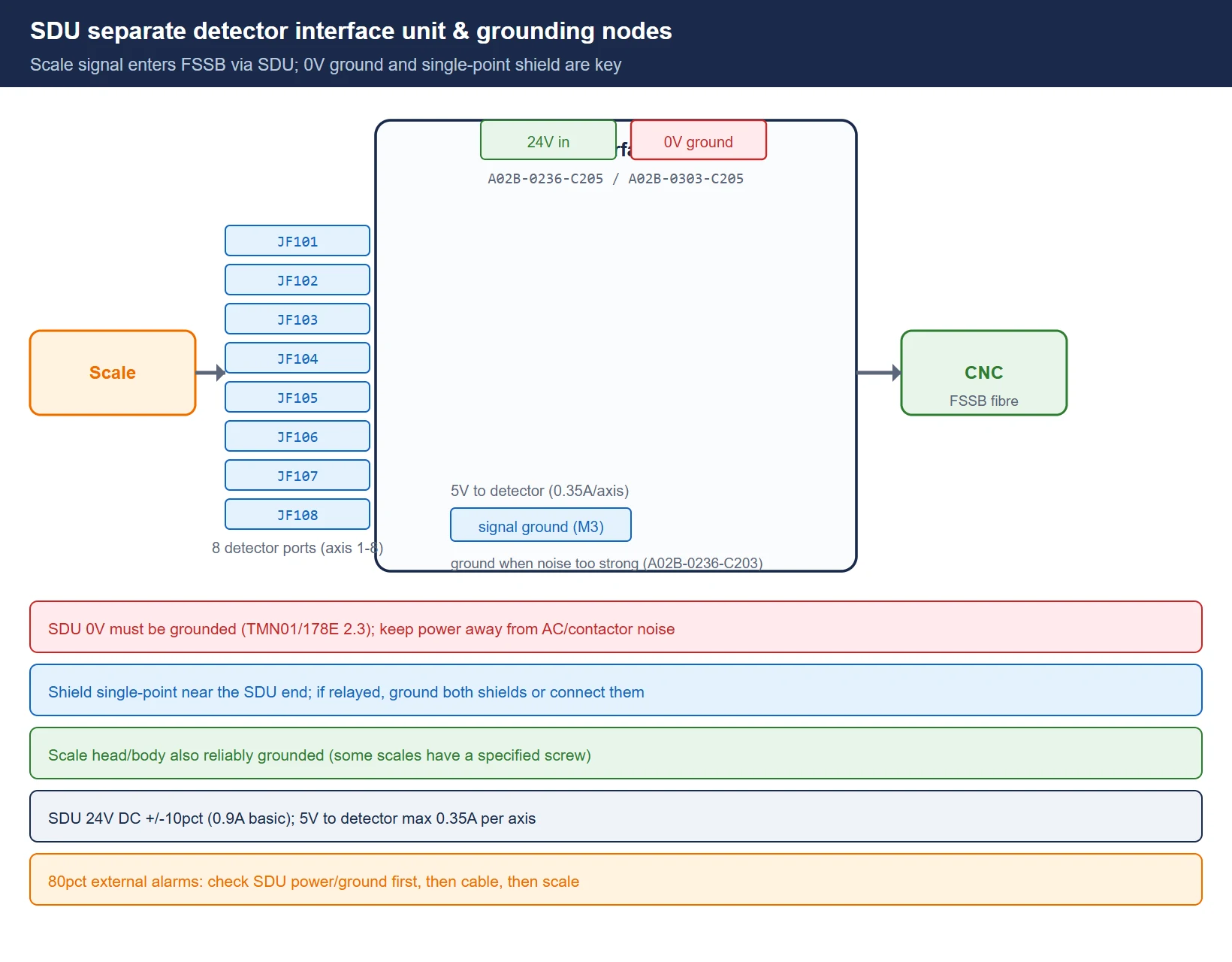
- Separate Detector Interface Unit (SDU) — FANUC manual A-73402E: on older machines a standalone module (basic unit A02B-0236-C205, expandable to 8 axes with SDU2; newer units such as A02B-0303-C205 / A06B-6061-C202); axis detectors connect to JF101–JF108, the SDU attaches to the servo bus via FSSB optical fibre and supplies 5V (max 0.35A per axis) to the detectors, drawing 24V DC (±10%, 0.9A basic) itself;
- CNC: receives the position feedback for full-closed-loop control.
So an “external detector alarm” is traced from the scale back toward the CNC: scale → cable → SDU (power / up) → FSSB → servo side. The structure diagram and the grounding point at each node:
3. How poor grounding “infects” these alarms: 4 noise paths
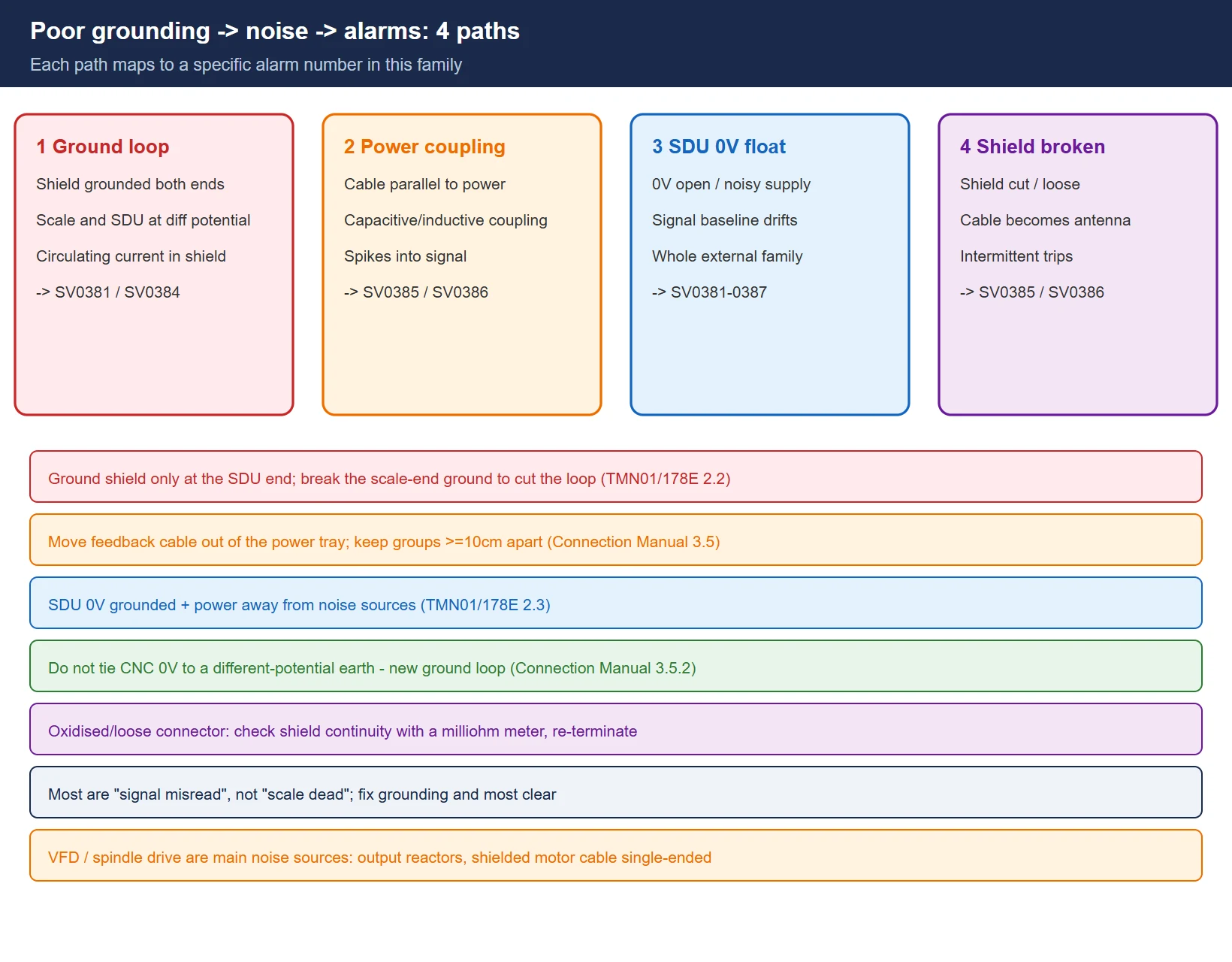
FANUC technical report TMN01/178E attributes linear-scale errors to “noise intrusion”. When grounding and shielding are wrong, noise mainly takes these 4 paths, which line up with this family of alarms:
- Ground loop (shield grounded at both ends): the scale end and the SDU end sit at different ground potentials, so a circulating current flows in the shield and superimposes common-mode noise on the encoder signal → shows as SV0381 phase abnormal / SV0384 soft phase.
- Running parallel to power lines (coupled interference): the feedback cable is bundled with or runs alongside servo/spindle power lines or contactor wiring; capacitive/inductive coupling injects spikes into the signal → shows as SV0385 serial data error / SV0386 CRC or stop-bit error.
- SDU 0V not grounded / noisy power line: the SDU reference floats and the signal baseline drifts → the whole external alarm family can appear.
- Broken shield / loose ground terminal / oxidised connector: the signal line loses its shield and becomes an antenna → intermittent SV0385 / SV0386 that clears after a reset and returns later.
Key point: these alarm numbers mean “signal not read / read wrong”, not “part failed”. Often it is a loose connector, a missing shield, a feedback cable tied to power lines, or oxidised terminals. Map the path first, then act:
4. Official grounding and shielding requirements: what TMN01/178E says
The report (A-65434EN) lists noise-prevention measures that map directly to field remediation:
- 2.1 Scale body grounding: the head and body of the linear scale must be grounded steadily; some scales need a specified screw — follow the scale installation manual.
- 2.2 Shield treatment: the scale cable must be shielded; ground the shield near the unit it connects to (single-point grounding at the SDU / amplifier side); when cables are relayed, ground both shields or connect them for steady conduction.
- 2.3 SDU case: the 0V of the SDU DC supply must be grounded, and keep the power line away from noise sources (AC cables, contactors, etc.).
- 2.4 Other measure: if noise is too strong, grounding the signal ground terminal on the SDU board (M3 screw, part A02B-0236-C203) may help.
Add the general rules from the FANUC Connection Manual (Hardware): signal cables are grouped — A (primary/secondary AC, servo/spindle power), B (DI/DO, 24VDC), C (position/velocity feedback, encoder, manual pulse generator, RS232/422); keep group C away from B and separated from or steel-shielded against A, at least 10cm between groups; inside the CNC the 0V and the protective-ground terminal are tied together, so do not connect the CNC 0V to a different-potential ground electrode (that creates a ground loop). Requirements vs purpose:
| Official requirement | Alarm / purpose |
|---|---|
| Scale body reliably grounded (specified screw) | Lower scale baseline drift, fewer SV0384/0381 |
| Shield single-point near the SDU end | Break ground loop, fewer SV0381/0384 |
| SDU 0V grounded, power away from noise | Stable SDU reference, whole external family |
| Feedback cable separate from power lines, ≥10cm | Less coupled spikes, fewer SV0385/0386 |
| 0V not tied to a different-potential earth | Avoid ground loop, stop intermittent trips |
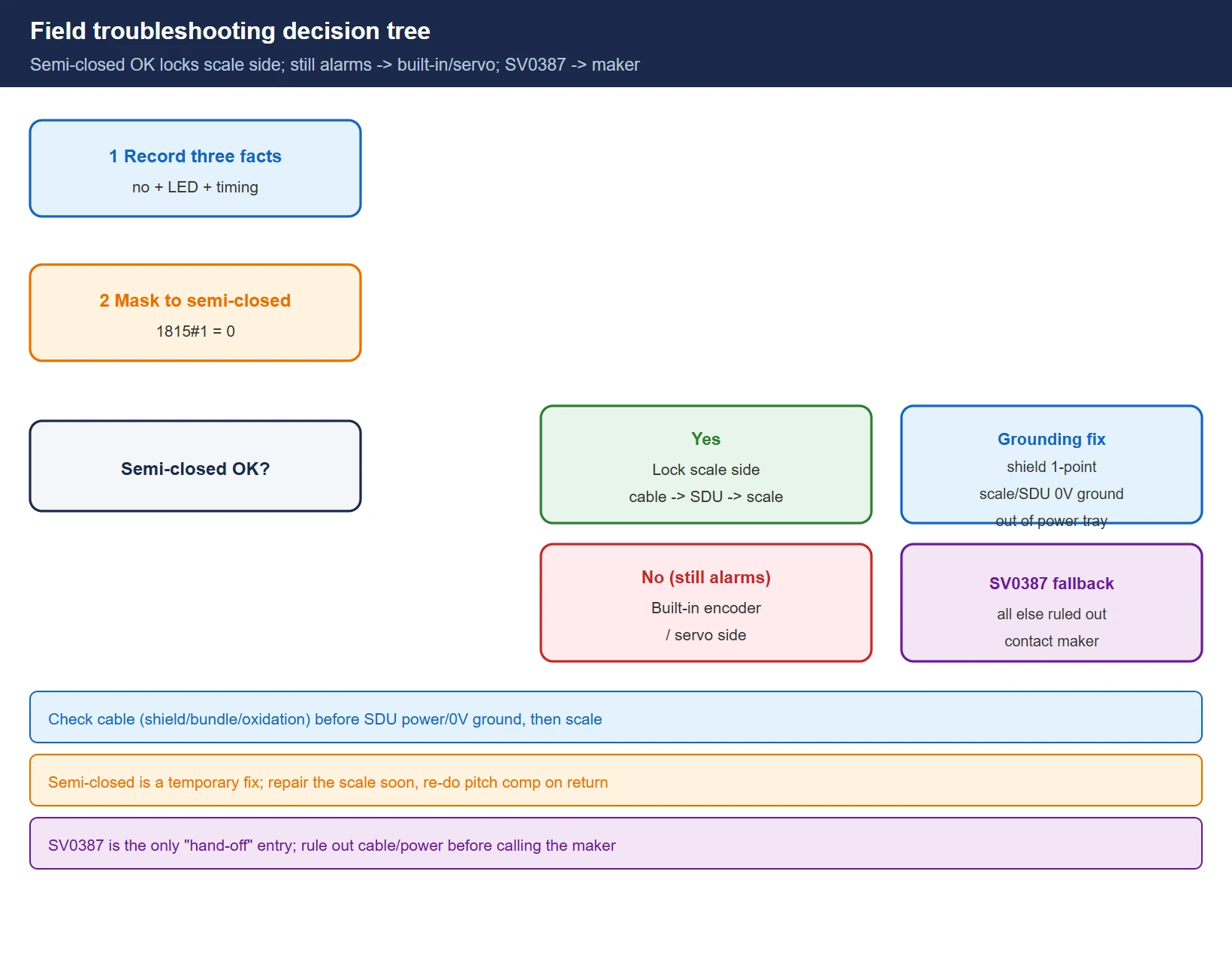
5. Field troubleshooting in seven steps: from the three facts to the fix
When an external detector alarm appears, do not swap parts yet — follow this order:
- Record three things: the SV alarm number + the servo amplifier panel LED letter code + when it occurs (which motion, cold or warm, moving or stationary). Together they fix the direction.
- Check the cable first: is the shield connected, is it bundled with power lines, are the connector terminals oxidised or black, has it been pinched by sheet metal.
- Check the SDU: is it powered up (LED), is the 24V supply stable, is the 0V grounded.
- Check the scale: is the reader head contaminated, is the body damaged, is mounting loose.
- Run the isolation test: mask the scale feedback and switch to semi-closed loop (next section); if semi-closed is fine the problem is on the scale side, if semi-closed also alarms, check the built-in encoder / servo side.
- Fix the grounding: per section 4, make the shield single-point near the SDU, ground the scale body and SDU 0V, and move the feedback cable out of the power-line tray.
- SV0387 fallback: if everything else is ruled out and SV0387 remains, contact the scale manufacturer as the manual suggests (criteria are not in the FANUC manual).
The decision tree at a glance:
6. Semi-closed-loop isolation test: parameters to mask the scale
The isolation test temporarily switches full-closed to semi-closed: set parameter 1815#1 (OPT, separate position detector) from 1 to 0 for the axis, and the system uses the built-in motor encoder for position feedback. Power cycle to take effect; a DS300 (reference return request) appears, and you must re-set these for semi-closed loop (values per the machine builder):
| Parameter | Meaning | Semi-closed setting |
|---|---|---|
| 1815#1 | Separate detector OPT | 1 = full-closed, 0 = semi-closed (scale off) |
| 2084 / 2085 | Flexible gear ratio N / M | From ball-screw pitch, e.g. 10mm direct: N/M = 1/100 |
| 2024 | Position feedback pulses | Typical 12500 (per motor spec) |
| 1821 | Reference counter capacity | Position pulses per motor revolution |
Three cautions: semi-closed is only a temporary fix — accuracy drops to the screw/bearing level, so repair the scale soon; switching back to full-closed requires re-doing pitch error compensation and the reference point; some models also need 1815#4 (APZ) / #5 (APC) checked. Semi-closed stable → problem is on the scale side (cable, mounting, contamination, the scale itself); semi-closed also alarms → problem is the built-in encoder or servo side.
7. Summary and further reading
SV0381/0384/0385/0386/0387 are a family of signal-quality alarms on the external detector feedback path; eight out of ten root causes are grounding and shielding, not parts. Remember three things: read the “(EXT)” in the alarm text, ground the shield at a single point near the SDU, and mask to semi-closed loop before swapping parts. Further reading: FANUC servo amplifier replacement · Servo inertia ratio setting · FANUC program transfer methods
Frequently Asked Questions
Does SV0387 always mean the scale is broken and I must call the manufacturer?
Not necessarily. SV0387 is the one entry the manual explicitly “hands off” — the criteria for the external detector are not in the FANUC manual, so the manufacturer is suggested. But before that, rule out SDU power, feedback-cable shield/ground, and scale contamination/mounting; cable and power problems make up most of these alarms and do not mean the scale itself is dead.
How much accuracy is lost when I mask the scale and run semi-closed loop, and can I run it long-term?
Semi-closed drops the real position loop of the scale, so accuracy is set by the screw and bearings and is usually well below full-closed. Use it only as a temporary fix to resume production and repair the scale promptly; switching back to full-closed needs pitch-error compensation and the reference point redone. Running it long-term hides mechanical wear — not recommended.
What is the difference between SV alarms that say “EXT” (external) and those that do not?
“EXT / external” means the position data comes from a separate detector such as a linear scale. The same phase / soft-phase / serial-data errors on the built-in motor encoder are SV0361 (phase), SV0364 (soft phase), SV0368 (serial data) and SV0369 (data trans). Read the parenthesis in the alarm text to tell them apart — the two families have different troubleshooting directions (cable/encoder/servo side) and should not be confused.
Last updated: 2026-10-25
The original Chinese version — same procedure, with the full field notes.








暂无评论内容